

TL;DR:
- Multiple options like cash discounts, government programs, and sliding-fee clinics lower healthcare costs for the uninsured.
- Price transparency tools enable patients to compare costs and ask providers for cash prices to save money.
- Self-advocacy and understanding coverage pathways are essential to achieving truly affordable healthcare.
Getting medical care without insurance can feel overwhelming, but the assumption that it’s simply unaffordable is no longer the full story. Between cash-pay discounts, federally funded clinics, and price transparency laws, more pathways to lower-cost care exist today than most people realize. 63.2% of uninsured adults say cost is their main reason for skipping care. This guide walks you through key definitions, real strategies, and practical steps so you can get the treatment you need, at a price that actually works for you.
Table of Contents
- What does affordable healthcare really mean?
- How price transparency helps you find lower-cost care
- Sliding-fee clinics and Federally Qualified Health Centers (FQHCs)
- Affordable coverage options and hardship pathways
- Why price transparency alone isn’t enough: a real-world perspective
- Take the next step toward affordable care with Chameleon
- Frequently asked questions
Key Takeaways
| Point | Details |
|---|---|
| Affordable care options exist | Many clinics, hospitals, and programs offer income-based or discounted rates, even for people without insurance. |
| Use price transparency | You can compare and select care by checking hospitals’ and clinics’ published self-pay prices before visiting. |
| Sliding-fee clinics serve all | Federally Qualified Health Centers and similar clinics provide care on a sliding fee scale and won’t turn you away if you can’t pay. |
| Marketplace hardship options | If you don’t qualify for full subsidies, hardship exemptions still provide lower-cost catastrophic coverage for major health needs. |
What does affordable healthcare really mean?
Now that we’ve challenged the affordability myth, let’s clarify exactly what affordable healthcare means in practice. For most people without insurance, the goal is straightforward: spend as little as possible at the point of care while still getting real medical attention.
Affordable healthcare basics really comes down to three main approaches, and knowing the difference helps you pick the right path for your situation:
- Cash or self-pay discounts: Many providers offer reduced rates when you pay out of pocket without filing through an insurer. These discounts can be significant, sometimes 30% to 60% off the standard rate.
- Government assistance programs: Medicaid covers qualifying low-income individuals at little or no cost. ACA Marketplace plans with premium subsidies can also bring monthly costs down for those who earn too much for Medicaid but still struggle with full-price coverage.
- Sliding-fee clinics: Federally Qualified Health Centers and community clinics charge based on your income, meaning your bill shrinks as your income does.
It’s worth noting that “affordable” means something different to everyone. What matters most is what you can actually pay today for the care you need right now. A $150 urgent care visit might feel steep for one person and manageable for another.
“Affordable healthcare for uninsured people means low out-of-pocket costs and/or use of financial assistance programs.”
Even people who technically have insurance available sometimes find that premiums, deductibles, and copays are still beyond reach. That means the strategies in this guide aren’t just for the fully uninsured. They can help anyone who’s trying to manage real medical costs without financial stress.
The most important mindset shift: affordable care is not a lucky accident. It’s something you can actively seek out with the right knowledge and a few phone calls.
How price transparency helps you find lower-cost care
With a clear understanding of affordability, let’s explore how you can use price transparency rules to your advantage. This is one of the most underused tools available to people paying out of pocket.
The Centers for Medicare and Medicaid Services requires that hospitals post online pricing for their services, both as a downloadable file and in a consumer-friendly format. That means you can look up what a facility charges for common procedures before you ever walk through the door.
Here’s a simplified comparison of how prices can vary for a basic urgent care visit at different types of facilities:
| Facility type | Typical self-pay range | Notes |
|---|---|---|
| Emergency room | $500 to $3,000+ | Highest cost; best for true emergencies |
| Urgent care clinic | $100 to $300 | Good for non-life-threatening conditions |
| Telehealth visit | $30 to $90 | Best for common conditions; no travel needed |
| FQHC (sliding-fee) | $0 to $75 | Income-based; may require documentation |
Using telemedicine and affordable care options together with price transparency tools puts real control in your hands. You can compare costs before committing, which helps you avoid surprise bills that can spiral into debt.
How do you actually use this in practice? Start by visiting a hospital’s website and searching for their “standard charges” or “price transparency” page. Then call the billing department and ask specifically for the cash price or self-pay rate for the service you need. These are often two different numbers, and the cash price is almost always lower.
For fast, affordable access to care, telehealth platforms often list their pricing upfront on their websites, so there’s no guesswork involved.
Pro Tip: Always ask for the “cash price” before scheduling any appointment or procedure. Providers are not required to volunteer this information, but they must give it when asked. This one question can save you hundreds of dollars.
Sliding-fee clinics and Federally Qualified Health Centers (FQHCs)
Even with transparent hospital prices, some people need care below those rates. Sliding-fee clinics and FQHCs help fill this gap by tying your payment to your income rather than a fixed rate.

Federally Qualified Health Centers are community health clinics that receive federal funding specifically to serve people regardless of ability to pay. By law, FQHCs provide sliding-fee discounts and will not refuse care due to inability to pay. That’s a powerful guarantee.
Here’s what a typical sliding-fee structure might look like based on household income:
| Income level (% of Federal Poverty Guidelines) | Estimated visit cost |
|---|---|
| Below 100% | $0 to $20 |
| 100% to 150% | $20 to $40 |
| 151% to 200% | $40 to $75 |
| Above 200% | Standard discounted rate |
Finding and using a sliding-fee clinic is simpler than you might expect. Here’s how to get started:
- Visit the HRSA Health Center Finder at findahealthcenter.hrsa.gov to locate an FQHC near you.
- Call ahead and explain that you are uninsured and looking for sliding-fee services.
- Ask what documents to bring, typically proof of income such as a pay stub or tax return.
- Schedule your appointment and bring your documentation to the visit.
- Review your bill after the visit and ask about payment plans if needed.
These clinics offer a wide range of services, including primary care, dental, mental health, and urgent care low-cost options for everyday conditions. You don’t need to be in crisis to use them.
For those who prefer virtual care, doctor visits without insurance through telehealth platforms offer another accessible path to treatment without the paperwork.
Pro Tip: Bring proof of income to your first FQHC visit, even if you’re not sure it’s required. Having it ready speeds up the eligibility process and can get you seen faster.
Affordable coverage options and hardship pathways
Beyond clinics and cash options, some people are eligible for affordable coverage or catastrophic protection through government programs. These are worth exploring before a major health event catches you off guard.
The ACA Marketplace offers subsidized plans based on your income and household size. Premium tax credits can reduce your monthly payment significantly, and cost-sharing reductions can lower your deductibles and copays if you choose a Silver-level plan. You can check eligibility at healthcare.gov during open enrollment or after a qualifying life event.
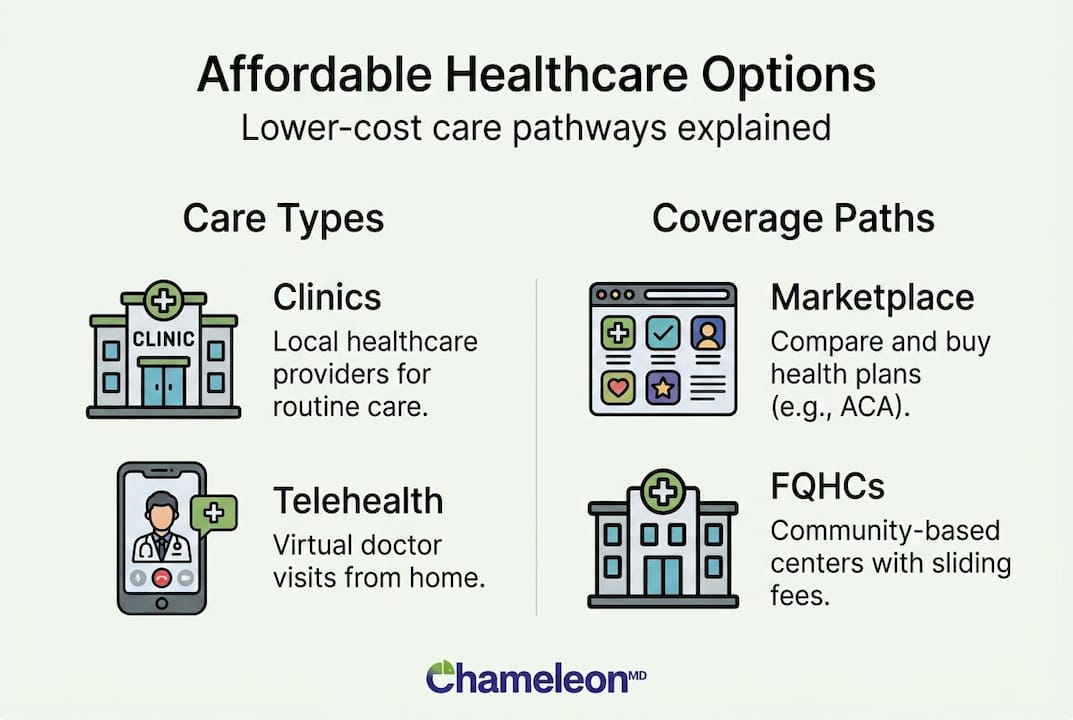
For people who genuinely can’t afford even subsidized Marketplace plans, catastrophic plans offer limited coverage with low monthly premiums for those who qualify through hardship exemptions. These plans cover essential health benefits after a high deductible is met, which protects you from financial disaster during a serious health event.
Who should consider these options? Here’s a quick look:
- Adults under 30 who are generally healthy and want protection from major expenses
- People who lost their previous coverage due to job loss or a life change
- Individuals who don’t qualify for Medicaid but find full-price Marketplace plans unaffordable
- Those who have experienced a qualifying hardship such as domestic violence, bankruptcy, or a natural disaster
Understanding healthcare access strategies in this space can help you determine whether a catastrophic plan or a subsidized standard plan makes more sense for your situation.
If you’re dealing with an unexpected health issue right now, exploring urgent care without insurance pathways can bridge the gap while you sort out your longer-term coverage options.
Why price transparency alone isn’t enough: a real-world perspective
You’ve seen the range of options. Now here’s the inside view of what actually works and what doesn’t in the real world.
Posting prices online is a meaningful step, but it’s only a first step. Many patients look at a hospital’s price list and feel more confused than empowered. They don’t know what’s included in a bundled rate, whether anesthesia is separate, or how facility fees add up. Price transparency helps but doesn’t guarantee lower spending if patients can’t interpret the numbers or access the right care setting.
Real affordability requires action. You have to make phone calls, ask the right questions, and sometimes push back on a first quote. Sliding-fee programs, cash discounts, and telemedicine for transparency all work well when you know to ask for them. Most people don’t, and that’s the real gap.
Affordable healthcare is a journey, not just a number posted on a website. The patients who succeed are the ones who stay curious, advocate for themselves, and treat each care decision like an informed choice rather than an automatic transaction.
Take the next step toward affordable care with Chameleon
Now that you know your affordable healthcare options, here’s how to put those strategies into action quickly.
At Chameleon Healthcare, we built our entire platform around the idea that you should know your cost before your visit, not after. Whether you’re dealing with a common condition or something that caught you off guard, we make it simple to connect with a licensed provider from your phone or computer.
You can browse conditions like care for heartburn or get guidance on vomiting symptoms help right from your screen. Our pricing is listed upfront, so there are no surprises. If you’re ready to explore affordable telehealth options, Chameleon is here to help you take that first step with confidence and clarity.
Frequently asked questions
What counts as ‘affordable healthcare’ if I don’t have insurance?
For uninsured people, affordable healthcare means clinics, hospitals, or programs that offer substantial cash or self-pay discounts, use income-based sliding-fee scales, or provide financial assistance to lower your cost at the point of care. The definition centers on low out-of-pocket costs or access to financial assistance programs.
How do I find hospitals or clinics with price transparency?
Search for hospitals’ online price lists or call clinics directly to ask for the self-pay or cash price. Hospitals are required by federal law to post this pricing information online so patients can estimate costs before receiving care.
Who qualifies for sliding-fee clinics and FQHCs?
Anyone can use FQHCs, but the biggest discounts go to those at or below 200% of the Federal Poverty Guidelines. Proof of income is usually required, and FQHCs provide income-based sliding-fee discounts with the greatest savings for lower-income patients.
Can I get coverage through the ACA Marketplace if full-price plans are too expensive?
If you can’t afford standard Marketplace plans, you may qualify for premium subsidies or catastrophic plans through hardship exemptions. Marketplace hardship exemptions allow some consumers to enroll in lower-premium catastrophic coverage when standard plans are genuinely unaffordable.