
You don’t need an insurance card to see a licensed doctor. Millions of Americans pay directly for medical care every year, skipping the paperwork, the referrals, and the surprise bills that come with traditional insurance. Federally Qualified Health Centers alone serve 30 million patients annually using sliding-scale fees, and that’s just one option. This guide breaks down exactly what a no-insurance doctor is, how the most common models work, what they cost, and how to find one that fits your life.
Table of Contents
- What is a no-insurance doctor?
- How do no-insurance doctors work?
- Comparing no-insurance doctor models
- Benefits and risks: is seeing a no-insurance doctor worth it?
- How to find affordable no-insurance doctors near you (and online)
- Affordable virtual care: get help online today
- Frequently asked questions
Key Takeaways
| Point | Details |
|---|---|
| No-insurance doctors defined | These providers offer healthcare directly for a fee, with no insurance required. |
| Lower routine care costs | Cash-pay, DPC, and telehealth can save 15% or more on routine medical visits. |
| Limits to coverage | No-insurance models are mainly for non-emergencies and primary care, not for hospital visits. |
| Choose the right model | Compare cash-pay, FQHC, DPC, and telehealth options for your budget and health needs. |
What is a no-insurance doctor?
A no-insurance doctor is simply a provider who accepts direct payment from patients without requiring insurance to process the visit. You agree on a price upfront, pay at the time of service, and get care. No prior authorization. No claim forms. No waiting to find out what your plan will cover.
The most common models include:
- Cash-pay clinics: Walk-in or scheduled visits where you pay a flat fee per appointment
- Direct primary care (DPC): A monthly membership model where you pay a flat fee for unlimited or bundled primary care visits
- Telehealth platforms: Online visits with licensed providers for telehealth care without insurance, typically for common conditions like sore throats, rashes, and sinus infections
- Federally Qualified Health Centers (FQHCs): Government-supported clinics with income-based sliding-scale fees
These models share a core strength: transparent pricing. You know what you’re paying before you’re seen. That’s a big deal when the average ER visit can cost thousands.
“Cash-pay avoids insurance administrative markups, reducing primary care costs by 15%, but lacks coverage for emergencies, hospitalizations, or specialists.”
The key limitation is scope. No-insurance doctors are built for routine and primary care, not major emergencies, surgeries, or specialist-heavy conditions. Think of them as your go-to for common online care conditions like UTIs, ear infections, and minor skin issues, not a replacement for a hospital system.
How do no-insurance doctors work?
The process is refreshingly simple compared to traditional insurance-based care. Here’s what a typical visit looks like from start to finish:
- Find a provider. Search for cash-pay clinics, FQHCs, or telehealth platforms in your area or online.
- Confirm the fee upfront. Ask directly what the visit costs before you book. Reputable providers will tell you immediately.
- Schedule your visit. Many telehealth services offer same-day online doctor visits, sometimes within hours.
- Attend your appointment. In-person or via video, you describe your symptoms and the provider evaluates and treats you.
- Pay directly. Cash, credit card, debit card, or digital payment. No claims, no billing department, no follow-up invoices.
Costs vary significantly by model. FQHC sliding-scale clinics may charge as little as $20 for a basic exam at low income levels. Telehealth visits typically range from $30 to $75 per session. DPC memberships often run $50 to $100 per month for adults, covering most routine visits within that flat fee.
Pro Tip: Always ask for an itemized price quote before your visit. Transparent providers will give you a clear number with no hidden fees. If a clinic hesitates or can’t give you a straight answer, that’s a red flag.
One underrated benefit here is time. Traditional insurance visits often involve scheduling weeks out, sitting in a waiting room, and then waiting again for billing to sort itself out. With cash-pay or telehealth, you’re often seen the same day and out in under 30 minutes.
Comparing no-insurance doctor models
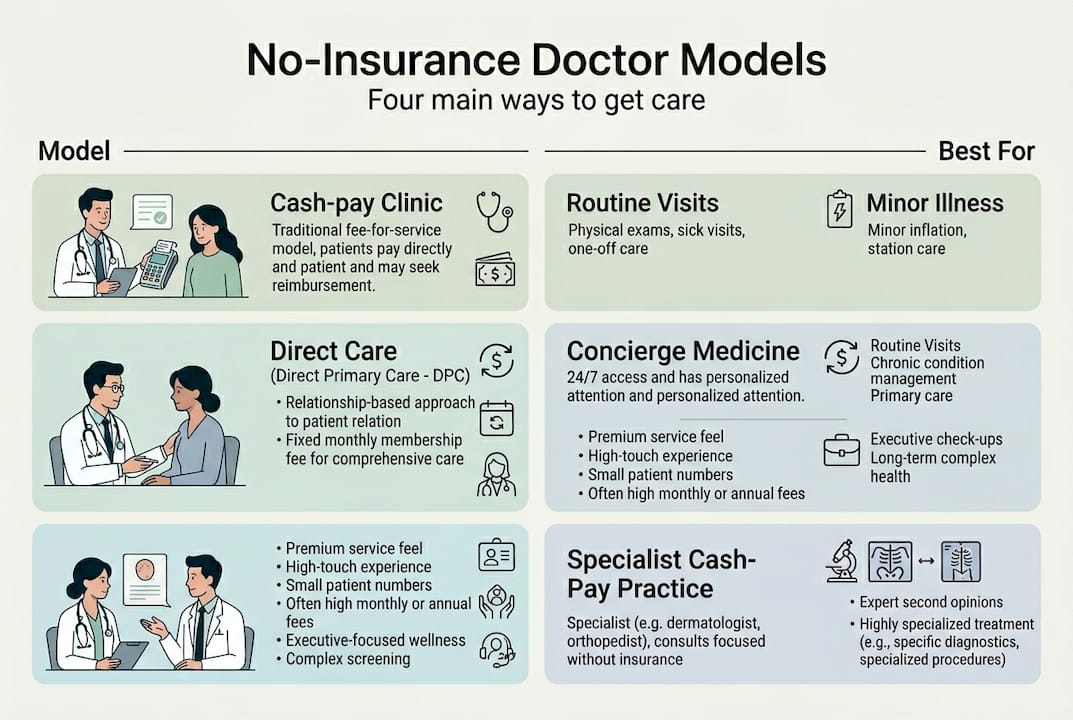
Not every model fits every situation. Here’s a side-by-side look at the four main options so you can pick the right one for your needs.
| Model | Typical cost | Best for | Key limitation |
|---|---|---|---|
| Cash-pay clinic | $60 to $150 per visit | Uninsured adults needing occasional care | No ongoing relationship with provider |
| Direct primary care (DPC) | $50 to $100/month | People who need frequent primary care visits | Not available to Medicare/Medicaid patients |
| FQHC | $20 to $100 (income-based) | Low-income individuals and families | Requires in-person visit, may have waitlists |
| Telehealth | $30 to $75 per visit | Busy adults with minor or common conditions | Not suitable for physical exams or emergencies |
According to a pros and cons comparison of cash-pay and DPC models, the core strengths are transparent pricing, faster access, and more personalized care. The core weakness is the same across all four: no catastrophic protection.
If you get into a car accident or need surgery, none of these models will cover you. They’re designed for the 80% of healthcare needs that are routine, not the 20% that are emergencies.
For most uninsured adults, telehealth is the fastest entry point. You can explore telehealth membership details to understand what a flat-fee plan covers, or browse virtual care for common problems to see which conditions are routinely treated online. For more pressing needs, urgent telehealth options can connect you with a provider fast.
Benefits and risks: is seeing a no-insurance doctor worth it?
For most common health issues, the answer is yes. But it depends on your health situation.
The benefits are real:
- Upfront pricing means no surprise bills weeks after your visit
- Fast access especially through telehealth, often same-day or next-day
- Simpler process with no insurance forms, referrals, or pre-authorizations
- Personalized attention since providers aren’t rushing through insurance-mandated visit quotas
- Lower cost for routine care compared to insured visits with high deductibles
The risks are equally real:
- No coverage for hospitalizations, surgeries, or specialist care
- DPC is not available for Medicare/Medicaid patients due to federal restrictions
- Cash-pay can become expensive fast if you have a chronic condition requiring frequent labs, imaging, or specialist referrals
- No safety net if a routine visit reveals something serious
“Cash-pay risks high costs for chronic or severe conditions without a safety net, and DPC is excluded for Medicare and Medicaid patients under current federal law.”
If you’re managing something like asthma, you need to think carefully about whether cash-pay alone covers your ongoing medication and monitoring needs. For something like a cold sore or a minor skin infection, a telehealth visit is fast, affordable, and completely appropriate.
Pro Tip: Use cash-pay or telehealth for most minor illnesses and routine needs. If you have a chronic condition or any history of serious health events, pair it with a low-cost catastrophic insurance plan to cover the worst-case scenarios.
How to find affordable no-insurance doctors near you (and online)
Knowing your options is one thing. Finding the right provider is another. Here’s a practical step-by-step approach.
- Start with the HRSA FQHC locator. The federal government maintains a searchable database of affordable clinics near you. These serve all income levels with sliding-scale fees.
- Search telehealth platforms. Many services specialize in common conditions and offer visits starting under $50. Look for platforms with licensed providers and clear pricing pages.
- Ask local urgent care clinics about cash pricing. Many clinics have a separate cash-pay rate that’s significantly lower than their insurance billing rate.
- Check DPC directories. Sites like the DPC Frontier mapper list direct primary care practices by state and city.
- Evaluate before you book. Confirm the visit fee, what’s included, whether prescriptions are handled, and what happens if you need a follow-up.
Here’s a quick reference for top resources:
| Resource | What it offers |
|---|---|
| HRSA Find a Health Center | Locates FQHCs with sliding-scale fees near you |
| Chameleon Healthcare | Same-day telehealth for common conditions, no insurance needed |
| DPC Frontier | Directory of direct primary care practices by location |
| GoodRx Care | Telehealth visits with integrated prescription discounts |
| NeedyMeds | Helps find low-cost clinics and patient assistance programs |
For telehealth for urgent care needs, online platforms are especially useful. Conditions like virtual UTI treatment, headaches, sore throats, and minor sprains and strains are routinely handled online without ever leaving your home.
Affordable virtual care: get help online today
If you’ve been putting off a doctor visit because you don’t have insurance, you don’t have to wait any longer. Chameleon Healthcare connects you with board-certified providers online for the conditions that come up in real life, sore throats, sinus infections, rashes, UTIs, and more.
There’s no insurance required, no waiting room, and no surprise bill at the end. You can see virtual care plans that fit your budget, or explore affordable care options built for individuals without coverage. Need help with a specific condition? Chameleon handles asthma care online and even care for sprains and strains through the same simple platform. Getting care shouldn’t feel like a second job. With Chameleon, it doesn’t.
Frequently asked questions
Do no-insurance doctors accept everyone?
Most cash-pay and telehealth providers see all adults regardless of insurance status, but direct primary care practices may exclude Medicare and Medicaid patients due to federal restrictions on those arrangements.
What happens if I need a specialist or hospital care?
You would pay entirely out of pocket or need separate insurance coverage. No-insurance clinics are designed for routine primary care and do not cover hospitalizations, surgeries, or specialist referrals.
How much does a no-insurance doctor visit usually cost?
It depends on the model. FQHC visits can start around $20 for low-income patients, while telehealth visits typically range from $30 to $75 per session.
Are prescriptions included in no-insurance visits?
Providers can write prescriptions during your visit, but you fill and pay for them separately at a pharmacy. Using discount programs like GoodRx can significantly reduce that cost.
Is telehealth a good option for the uninsured?
Yes. Telehealth offers fast, affordable access for most common and minor conditions without requiring insurance, and many platforms offer same-day appointments at transparent flat rates.