
Many people assume that living in the United States means healthcare is always within reach. But millions still struggle with basic access, even in 2026. The problem is not just about having insurance. It is about whether care is affordable, nearby, timely, and actually suited to your needs. This guide breaks down what healthcare access truly means, why so many people still face real barriers, and how newer models like telehealth and direct-pay care are opening doors that traditional insurance never could. If you are looking for faster, more affordable options, you are in the right place.
Table of Contents
- What does healthcare access actually mean?
- What factors limit or improve access to healthcare?
- How new models are changing healthcare access
- Nuances and real-world challenges in healthcare access
- A fresh perspective on making healthcare access work for you
- Affordable, flexible care is closer than you think
- Frequently asked questions
Key Takeaways
| Point | Details |
|---|---|
| Access is multi-dimensional | Healthcare access depends on more than just having insurance—cost, speed, location, and suitability matter too. |
| Barriers remain widespread | Many Americans still struggle with costs, location, or digital access—even as telehealth options grow. |
| New care models help | Direct primary care, telehealth, and memberships make fast, affordable care possible for more people. |
| No single perfect solution | Combining digital, direct-pay, and catastrophic coverage is often the most practical way to manage your healthcare. |
What does healthcare access actually mean?
After setting up the confusion around who actually has access to healthcare, let’s clarify what this term really means.
The phrase “healthcare access” gets used a lot, but it rarely gets explained well. It is easy to assume it simply means having a doctor you can call. In reality, it covers a much wider set of conditions that determine whether care is genuinely available to you.
The National Academy of Medicine and researchers like Levesque define access through five core dimensions. Each one shapes whether you can actually get the help you need, not just in theory, but in practice.
“Healthcare access includes availability, accessibility, affordability, acceptability, and appropriateness as its five essential dimensions.”
| Dimension | What it means | Real-world example |
|---|---|---|
| Availability | Are services there when you need them? | A clinic open evenings and weekends |
| Accessibility | Can you physically reach care? | A telehealth visit from your phone |
| Affordability | Can you pay for it without hardship? | A flat-fee urgent care visit |
| Acceptability | Does care match your values and culture? | A provider who speaks your language |
| Appropriateness | Is the care right for your condition? | Getting a specialist, not just a referral |
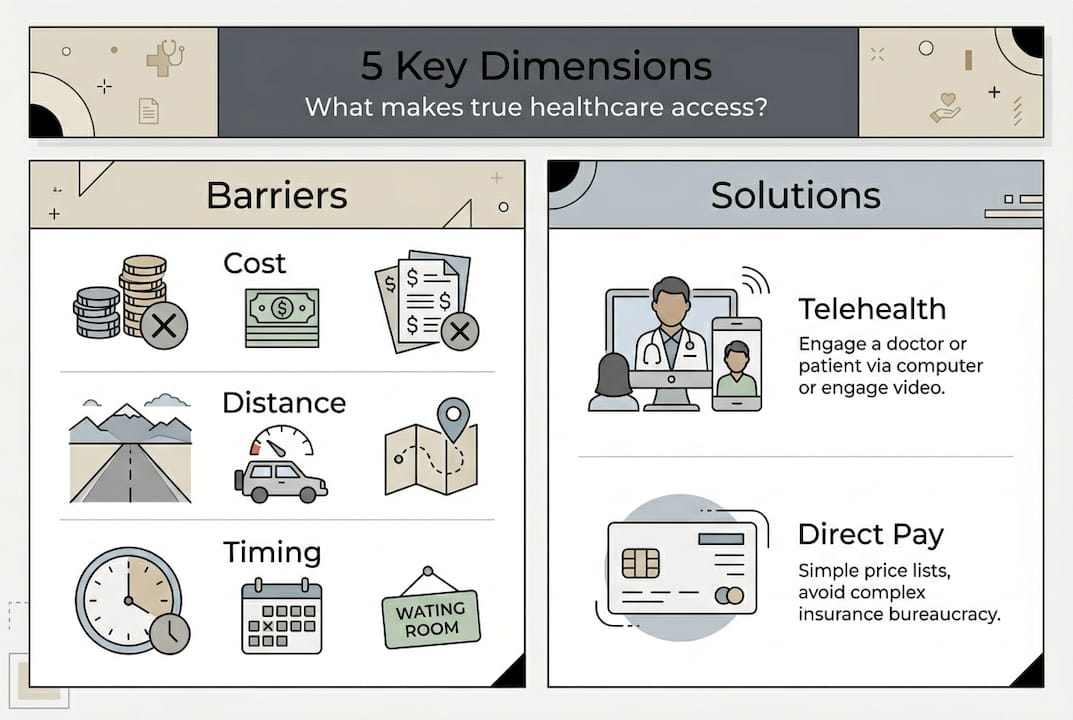
When even one of these dimensions is missing, access breaks down. You might have a doctor nearby, but if the cost is out of reach, that care might as well not exist.
For people without insurance or with nontraditional needs, these gaps show up constantly. Studies suggest that 57% of adults lack a regular primary care doctor, which means millions are navigating the system without a reliable starting point.
Here are the most common pain points for uninsured or underinsured individuals:
- High out-of-pocket costs with no clear pricing upfront
- Long wait times for appointments, sometimes weeks or months
- Limited clinic hours that conflict with work schedules
- No established relationship with a provider who knows their history
- Confusion about which type of care to seek for a given problem
Understanding these five dimensions gives you a smarter lens for evaluating your own situation and finding solutions that actually close the gaps.
What factors limit or improve access to healthcare?
Once you understand what healthcare access means, it helps to see why so many still struggle to get the care they need.
Access does not fail for one single reason. It fails because multiple barriers stack on top of each other. Cost is the most obvious one. Without insurance, a single urgent care visit can cost hundreds of dollars. But geography matters just as much. Rural communities often have fewer providers, longer travel distances, and limited specialist options.
Digital literacy is a growing factor too. As more care moves online, people without reliable internet or comfort with technology can get left behind. Barriers persist across financial, geographic, and digital lines, and closing them requires more than just one solution.
Here are the most common obstacles and what they actually mean for you:
- Cost: Even with insurance, deductibles and copays can make routine visits feel unaffordable
- Geography: Rural and underserved urban areas have fewer clinics and longer wait times
- Digital divide: Older adults and low-income households may lack devices or broadband access
- Wait times: Primary care shortages mean appointments can be weeks away
- Distrust: Past negative experiences with the healthcare system discourage people from seeking care
The good news is that digital health tools like telehealth and remote monitoring are actively changing this picture. Much like food access parallels in underserved communities, the solution is rarely one-size-fits-all. It requires layering options.
| Feature | Traditional insurance model | Telehealth or direct-pay model |
|---|---|---|
| Scheduling | Days to weeks out | Same day or next day |
| Cost transparency | Often unclear until billed | Flat fees shown upfront |
| Location required | In-person visit needed | From home or anywhere |
| Insurance required | Usually yes | No |
| Scope of care | Broad but gated | Common conditions, fast |
Learning about the benefits of telemedicine can help you see how much has changed. And if you are navigating care without a plan, a guide to affordable healthcare without insurance is a practical place to start.
Pro Tip: Before your next visit, call ahead and ask for the self-pay or cash price. Many clinics offer significant discounts for patients who pay directly, sometimes 40 to 60 percent less than the standard rate.
How new models are changing healthcare access
Knowing the roadblocks, let’s see how technology and direct-pay models are closing the gap for people who need quick, affordable answers.
The healthcare landscape is shifting in a meaningful way. Telehealth, virtual urgent care, and direct primary care (DPC) are no longer fringe options. They are becoming mainstream tools that give you faster, more transparent access to care.
Here is how these models typically work:
- Sign up or register on a telehealth platform or DPC practice, often with no insurance required
- Choose your visit type, such as urgent care, primary care, or a specific condition
- Connect with a licensed provider by video, phone, or chat, often within hours
- Receive a diagnosis, treatment plan, or prescription sent directly to your pharmacy
- Pay a flat fee or membership rate, with no surprise bills afterward
The numbers back this up. Telehealth now covers 6 to 7 percent of all primary care visits as of 2025, and that share is growing. For people without a regular doctor, this matters a lot. Research shows that 57 percent of virtual care users had no regular primary care physician before using these services.
Virtual urgent care also shows real clinical value. ER return rates for virtual urgent care visits are 2.53 percent compared to 3.26 percent for in-person visits, suggesting that remote care can be just as safe for many common conditions.
For the uninsured or cost-conscious, the benefits are clear. Instant scheduling, flat fees, and home-based treatment remove the friction that keeps people from getting help. Exploring telehealth without insurance is easier than most people expect. Families especially benefit, and learning about virtual visits for family health can help you plan ahead. If you want ongoing care at a predictable cost, telehealth memberships offer a structured, affordable path.
Pro Tip: Use virtual urgent care for non-emergencies like sinus infections, rashes, or ear pain. You will skip the waiting room, avoid the ER bill, and often get a same-day prescription without leaving home.
Nuances and real-world challenges in healthcare access
Before jumping in, it is important to know the limits, downsides, and real-life trade-offs of remote and direct-access care.
Telehealth and direct primary care are powerful tools, but they are not perfect for every situation. Knowing where they shine and where they fall short helps you make smarter choices.
Some conditions genuinely require in-person evaluation. Broken bones, chest pain, severe infections, and mental health crises often need hands-on care that a video call cannot provide. Technology requirements are also a real barrier for some. Not everyone has a reliable smartphone or a stable internet connection.
Research shows that telehealth cuts inpatient admissions by 4.3 percent and overall spending by 10.8 percent, but it can also increase outpatient and emergency department visits in the short term as more people seek care they previously avoided. Quality outcomes are mixed depending on the condition and the platform.
“Equity in healthcare access requires more than digital tools. It requires intentional design that meets people where they are, with care that fits their real circumstances.”
Here are some easily missed pitfalls and how to address them:
- Assuming telehealth covers everything: Always confirm the platform treats your specific condition before booking
- Skipping follow-up care: Virtual visits work best when paired with a plan for ongoing monitoring
- Ignoring tech barriers: If video is not an option, look for phone-based or asynchronous care options
- Treating DPC as insurance: Direct primary care is not a substitute for coverage on major medical events
- Delaying emergency care: If symptoms are severe or worsening fast, go to the ER or call 911
The smartest approach pairs telehealth or DPC with a low-cost catastrophic insurance plan for big risks. Use virtual care for same-day online doctor visits and routine needs. Reserve in-person care for what truly requires it. For a fuller picture of no-insurance doctor care, there are practical options worth knowing.
A fresh perspective on making healthcare access work for you
After exploring the details, here is a real-world perspective you will not find in most guides.
Most people still think of healthcare access as a binary: either you have insurance, or you are out of luck. That framing is outdated and, honestly, it keeps a lot of people stuck.
Real access today looks more like a personal toolkit. You use telehealth without insurance for everyday issues. You find a direct-pay doctor for routine checkups. You keep a catastrophic plan in your back pocket for the truly unexpected. You use apps and online resources to triage before spending money on a visit.
This mix-and-match model requires a bit more active navigation than just handing over an insurance card. But for many people, it is more affordable, faster, and far less frustrating than the traditional route. The key is knowing your options before you need them, not scrambling when something goes wrong.
Pro Tip: Build your healthcare safety net now. Identify one telehealth platform, one local urgent care with clear cash pricing, and a low-cost catastrophic plan. That combination covers most situations without breaking the bank.
Do not wait for the system to fix itself. Be proactive, stay informed, and build a plan that actually fits your life.
Affordable, flexible care is closer than you think
You do not need to face long waits or big bills to get quality care. Modern healthcare has moved well beyond the waiting room, and solutions built for your real life are available right now.
Chameleon Healthcare makes it simple to connect with a licensed provider from your phone or computer, often the same day. Whether you are dealing with a sore throat, a sinus infection, or a rash, you can get a diagnosis and treatment plan without insurance and without the stress. Explore flexible telehealth plans designed for people who want clear pricing and fast answers. Learn about Chameleon and see how easy it can be to get the care you need, exactly when you need it.
Frequently asked questions
What does healthcare access mean in simple terms?
Healthcare access means how easily you can get medical help when you need it, covering cost, location, timing, and whether the care fits your situation. All five dimensions need to work together for access to be real.
How can I access healthcare without insurance?
You can use telehealth, walk-in clinics, direct-pay doctors, or membership plans for same-day, affordable care. Digital health solutions and direct care models are specifically designed to fill gaps for people without traditional coverage.
Does telehealth count as good healthcare access?
Yes, for many common conditions, telehealth delivers fast and effective care. Telehealth covers 6 to 7 percent of primary care visits and continues to grow, though it works best alongside in-person options for more complex needs.
What are the biggest challenges to healthcare access today?
Cost, geography, and digital gaps are the top barriers. Barriers persist across financial, geographic, and technical lines, and they often stack together, making it harder for uninsured and rural populations to get timely care.
Is direct primary care the same as insurance?
No, direct primary care gives you easy access to routine services at a flat monthly fee, but it does not cover major medical events. Pair it with catastrophic coverage to protect yourself from large, unexpected bills.