
TL;DR:
- Healthcare data breaches are increasingly common, with hacking causing most incidents.
- Protect yourself by choosing HIPAA-compliant telehealth platforms with strong encryption and vendor BAAs.
- Being informed about privacy risks and following best practices helps ensure your personal health information remains secure.
Healthcare data breaches are no longer rare events. In January 2026 alone, 46 large breaches exposed over 1.4 million individuals, with hacking and IT incidents driving nearly 78% of those cases. As more people turn to telehealth for convenient, affordable care, the question of what happens to your personal health information has never been more important. This guide walks you through the key privacy frameworks, real security risks, and practical steps you can take to protect yourself while still enjoying the benefits of online care.
Table of Contents
- Understanding online healthcare privacy frameworks
- Telehealth security essentials: Beyond basics
- Common vulnerabilities and real-world breach data
- Privacy-by-design and patient actions
- A fresh perspective: What most privacy guides miss
- Explore secure, convenient online care with Chameleon
- Frequently asked questions
Key Takeaways
| Point | Details |
|---|---|
| HIPAA forms the core | HIPAA rules provide the foundation for online healthcare privacy in telehealth and digital settings. |
| Strong security is essential | Encryption, multi-factor authentication, and access controls are critical for protecting patient data. |
| Real risks exist | Millions of individuals are affected by healthcare data breaches every year, especially through insecure apps. |
| Patient action matters | You can minimize risk by choosing secure platforms, managing your device privacy, and staying informed. |
| Hybrid care is best | Combining online and in-person care provides both privacy and convenience when managed thoughtfully. |
Understanding online healthcare privacy frameworks
Before you can protect your health data, it helps to understand who is responsible for keeping it safe. The rules governing healthcare privacy are not vague suggestions. They are enforceable federal standards with real consequences for violations.
HIPAA and what it actually covers
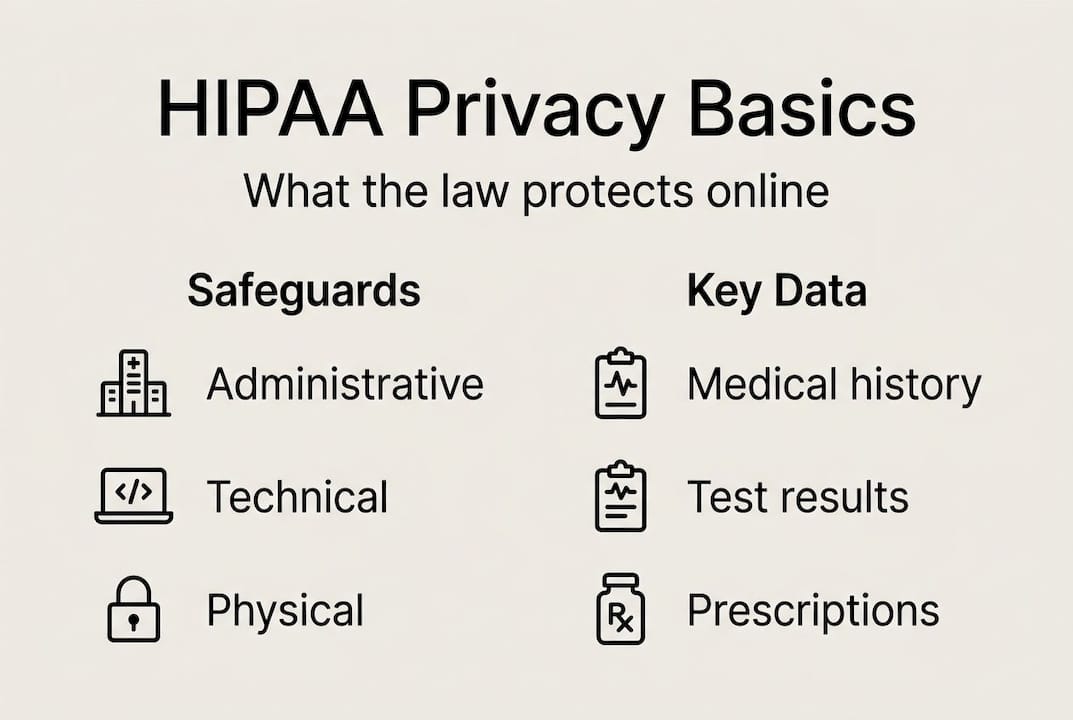
The Health Insurance Portability and Accountability Act, known as HIPAA, is the foundation of healthcare privacy in the United States. It applies to covered entities (doctors, hospitals, insurers) and their business associates. The HIPAA Privacy and Security Rules require three categories of safeguards for protected health information (PHI), which is any data that can identify you and relates to your health.
Here is how those three safeguard types break down:
| Safeguard type | What it covers |
|---|---|
| Administrative | Policies, staff training, risk assessments |
| Physical | Facility access, device controls, workstation security |
| Technical | Encryption, login controls, audit logs |
Telehealth adds layers of complexity to all three. When your visit happens over a video call or app, technical safeguards become especially critical. Platforms must use secure, HIPAA-compliant video tools, and providers need to ensure patient data is not accidentally exposed through unsecured networks or third-party software.
State laws can go further
Federal law sets the floor, but states can raise it. California’s Confidentiality of Medical Information Act (CMIA), for example, extends protections to a broader range of health-related data and applies to more types of businesses than HIPAA does. If you live in a state with stricter rules, your provider must meet both standards.
Understanding HIPAA for telehealth is a smart first step before choosing any online care platform. You want to know that the service you use is not just convenient but also legally required to protect your information.
Your health data is among the most sensitive information about you. The frameworks that govern it exist precisely because the stakes are so high.
Knowing these rules helps you ask better questions and make more informed choices about where you seek care.
Telehealth security essentials: Beyond basics
Understanding the rules is one thing. Knowing how they are put into practice is another. Secure telehealth platforms do not just check a compliance box. They build multiple layers of protection that work together to keep your data safe.
What a truly secure platform looks like
According to telehealth security standards, a properly secured telehealth platform must include encryption in transit using TLS 1.2 or higher, encryption at rest using AES-256, multi-factor authentication (MFA), role-based access controls, audit logs, and Business Associate Agreements (BAAs) with every vendor that handles PHI.
That last point matters more than most people realize. A BAA is a legal contract that holds third-party vendors accountable for protecting your data. If a telehealth platform uses a billing service, a scheduling tool, or a cloud storage provider, each of those vendors should have a signed BAA in place.
Steps to evaluate a telehealth platform’s security
- Check their privacy policy for explicit mention of HIPAA compliance.
- Look for MFA options during account setup.
- Ask whether they conduct regular HIPAA risk assessments.
- Confirm they use end-to-end encryption for video visits.
- Verify that third-party vendors are covered by BAAs.
Comparing security features
| Feature | Basic platform | Secure platform |
|---|---|---|
| Encryption | Partial or unclear | TLS 1.2+ and AES-256 |
| Authentication | Password only | MFA enabled |
| Vendor contracts | Not specified | BAAs in place |
| Audit logs | None | Full access tracking |
Pro Tip: Before your first telehealth visit, search the platform’s name alongside “HIPAA compliance” and “BAA.” A trustworthy provider will have clear documentation readily available.
The telehealth encryption practices a platform uses are one of the clearest indicators of how seriously they take your privacy. Do not skip this step.
Common vulnerabilities and real-world breach data
Even with strong regulations in place, breaches happen. Understanding how and why they occur helps you make smarter decisions about the tools and platforms you use.
The numbers tell a clear story
The healthcare breach stats paint a concerning picture. Hacking and IT incidents are by far the leading cause of breaches, and network servers are the most common point of attack. In January 2026, 78.3% of breaches were caused by hacking or IT incidents, affecting over 1.4 million individuals in a single month.
Stat to know: Healthcare records are among the most valuable data on the black market, often worth far more than financial records because they contain identity, insurance, and medical details all in one place.
The mHealth app problem
Mobile health apps are convenient, but many carry significant privacy risks. An audit of 272 Android mHealth apps found that 26.1% had excessive permissions, 49.3% used deprecated SHA-1 encryption (which is considered insecure), and 42% transmitted data without proper encryption. Nearly 28.5% of user reviews flagged privacy concerns.
These are not fringe apps. Many are widely used tools that people trust with sensitive health information.
Common vulnerabilities to watch for
- Tracking pixels embedded in patient portals that share data with advertisers
- Apps requesting access to contacts, camera, or location without clear justification
- Unencrypted data transmission over public Wi-Fi
- Outdated software with known security gaps
- Unsecured home devices used for telehealth visits
The risks in mHealth apps are real and often invisible to the average user. You may not know your data is being shared until it is too late. Understanding data privacy threats in digital healthcare is part of being a proactive patient.
| Vulnerability | Risk level | Common source |
|---|---|---|
| Unencrypted transmission | High | mHealth apps |
| Excessive app permissions | Medium-High | Consumer wellness apps |
| Tracking pixels | Medium | Patient portals |
| Unsecured home Wi-Fi | High | Patient environment |
Knowing these risks is not meant to scare you away from telehealth. It is meant to help you use it more safely.
Privacy-by-design and patient actions
The good news is that you are not powerless. Both the platforms you choose and the habits you build can significantly reduce your privacy risk.
What privacy-by-design means for you
Privacy-by-design means that a telehealth platform builds privacy protections into its foundation rather than adding them as an afterthought. This includes conducting risk analysis before launching new features, layering multiple safeguards, and educating patients about risks like unsecured home environments.
When a platform takes this approach, you benefit from protections you may never even see. But you still have a role to play.
Practical steps to protect your own data
- Use a private, password-protected Wi-Fi network for all telehealth visits.
- Enable MFA on every health-related account.
- Review app permissions before installing any health app.
- Read the privacy policy, especially the section on data sharing.
- Delete apps you no longer use to reduce your exposure.
- Use a dedicated device for health-related activities when possible.
Spotting apps that do not belong
Not every app that tracks your health is covered by HIPAA. Consumer wellness apps like fitness trackers and general wellness tools are typically regulated by the FTC under rules about deceptive practices, not HIPAA. That means they have fewer obligations around how they store or share your data.
Pro Tip: If an app does not mention HIPAA compliance anywhere in its documentation, assume it is not covered. Treat any health data you enter there as potentially shareable with third parties.
Looking for privacy by design in telehealth when evaluating platforms gives you a strong signal about their overall commitment to your safety. And understanding the virtual care privacy safeguards that reputable platforms offer helps you compare your options with confidence.
The most effective privacy protection is a combination of strong platform design and informed patient behavior. Neither one alone is enough.
A fresh perspective: What most privacy guides miss
Most online privacy guides focus on the same checklist: use encryption, enable MFA, read the privacy policy. That advice is solid, but it misses some of the more important shifts happening right now.
First, hybrid care models are often the smartest choice from a privacy standpoint. Telehealth expands the attack surface compared to in-person visits because it introduces more vendors, more networks, and more devices into the equation. For stable, ongoing conditions, telehealth outcomes are equivalent to in-person care. But knowing when to use each option matters.
Second, AI is entering healthcare faster than privacy frameworks can keep up. Platforms are using AI for diagnostics, documentation, and triage, and the 2026 enforcement trends show that regulators are increasingly focused on AI privacy, vendor oversight, and the layering of state laws on top of HIPAA. Most patients have no idea their data might be feeding an AI model.
Third, patient education is chronically underfunded. Providers are required to hand you a privacy notice, but that is not the same as actually helping you understand your rights. We believe that informed patients make better decisions, and that starts with conversations like this one. Explore the telemedicine benefits alongside the risks so you can make choices that work for your life.
Explore secure, convenient online care with Chameleon
At Chameleon Healthcare, we believe you should never have to choose between getting the care you need and protecting your personal health information. Our telehealth-first platform is built with your privacy in mind, combining HIPAA-compliant technology with clear, transparent practices so you always know how your data is handled.
Whether you are dealing with a sore throat, a sinus infection, a rash, or another common condition, you can connect with a licensed provider from your phone or computer, without a waiting room and without insurance. Browse our full range of secure symptom care options and see how easy getting the right care can be. Ready to get started? Learn about Chameleon and take the first step toward care that is both convenient and trustworthy.
Frequently asked questions
How can I tell if a telehealth app truly protects my privacy?
Look for explicit HIPAA compliance, strong encryption, MFA options, and a clear privacy policy. An audit of mHealth apps found that 26.1% had excessive permissions and 42% transmitted data without proper encryption, so those are specific red flags to check.
What should I do if I suspect my health data was breached?
Contact your provider immediately, change your account passwords, and monitor your accounts for unusual activity. Healthcare data is highly valuable on the black market, so acting quickly limits your exposure.
Are wellness tracking apps covered by HIPAA?
Most consumer wellness apps are not HIPAA-covered entities. The FTC regulates deceptive practices in this space, so read the terms and privacy notices carefully before entering any sensitive health information.
Is telehealth as private as in-person visits?
It can be, provided the platform uses strong security measures. However, telehealth expands the attack surface compared to in-person care because it involves more vendors and relies on your home network, so your own setup matters too.