
TL;DR:
- Some patients without insurance spend less on care than insured individuals after costs.
- No insurance healthcare options include community clinics, DPC memberships, and cash-pay clinics.
- Proactive use of safety-net providers and cost-saving strategies can improve access and affordability.
Many people assume that skipping insurance means skipping care altogether. But here’s something that might surprise you: some cash-pay patients actually spend less on medical visits than those with insurance, once you factor in premiums, deductibles, and copays. With roughly 25 million Americans uninsured, the demand for practical, affordable alternatives has never been higher. No insurance healthcare is not a last resort. It’s a real system of options, from community health centers to telehealth memberships, designed to help you get the care you need without financial panic.
Table of Contents
- What does ‘no insurance healthcare’ really mean?
- Exploring safety-net providers: FQHCs, free clinics, and charity care
- Direct Primary Care and cash pay: Predictable costs and rapid access
- Barriers and challenges: What to watch out for without insurance
- A fresh perspective: What most people miss about healthcare without insurance
- Ready for affordable care? Explore your options with Chameleon
- Frequently asked questions
Key Takeaways
| Point | Details |
|---|---|
| Multiple options exist | You can access affordable healthcare through FQHCs, free clinics, cash-pay models, and DPC even if you lack insurance. |
| Costs vary widely | Cash pay and DPC can be cheaper than insurance for some services, but high-cost events pose risks. |
| Be proactive | Get informed and plan ahead—documentation and knowing alternative providers can ease access and lower costs. |
| Potential access challenges | Location, eligibility, and ability to pay may affect your options, especially in rural areas. |
What does ‘no insurance healthcare’ really mean?
No insurance healthcare simply means accessing medical care without relying on private or public insurance to cover the cost. You pay directly, use community resources, or join a membership model. It’s more structured than most people realize, and the options are broader than you might expect.
The main types of no insurance care include:
- Federally Qualified Health Centers (FQHCs): Government-funded clinics that charge based on your income using a sliding fee scale
- Free and charitable clinics: Volunteer-run facilities offering care at little or no cost
- Hospital charity care programs: Financial assistance offered by hospitals to patients who qualify based on income
- Direct Primary Care (DPC): A monthly membership model giving you unlimited access to a primary care provider
- Cash-pay clinics: Providers who offer transparent, upfront pricing for visits and procedures
- Prescription assistance programs: Manufacturer or nonprofit programs that reduce or eliminate drug costs
A common misconception is that you simply cannot get quality care without insurance. That’s not true. Safety-net providers exist specifically because public health depends on everyone being able to access basic medical services, regardless of their financial situation.
Here’s a quick look at the scale of these resources:
| Provider type | Number of sites | Patients served annually |
|---|---|---|
| FQHCs | 13,000+ sites | 30+ million |
| Free clinics | 1,400+ | Millions of low-income patients |
| Hospital charity programs | Thousands | Varies by region |
| DPC practices | Growing nationally | Primarily working adults |
“No insurance doesn’t mean no care. It means knowing where to look and what to ask for.”
If you’re navigating an urgent issue and wondering where to start, our urgent care without insurance guide walks you through practical first steps.
Exploring safety-net providers: FQHCs, free clinics, and charity care
With the main types outlined, let’s focus on your options if you need ongoing primary or routine care.
FQHCs are one of the most reliable resources available. These federally funded health centers are required by law to serve patients regardless of their ability to pay. They use a sliding fee scale based on Federal Poverty Level: if your income is at or below 100% of the Federal Poverty Level (FPL), you pay a nominal fee. If you earn between 101% and 200% FPL, you receive a discounted rate. No one is turned away.
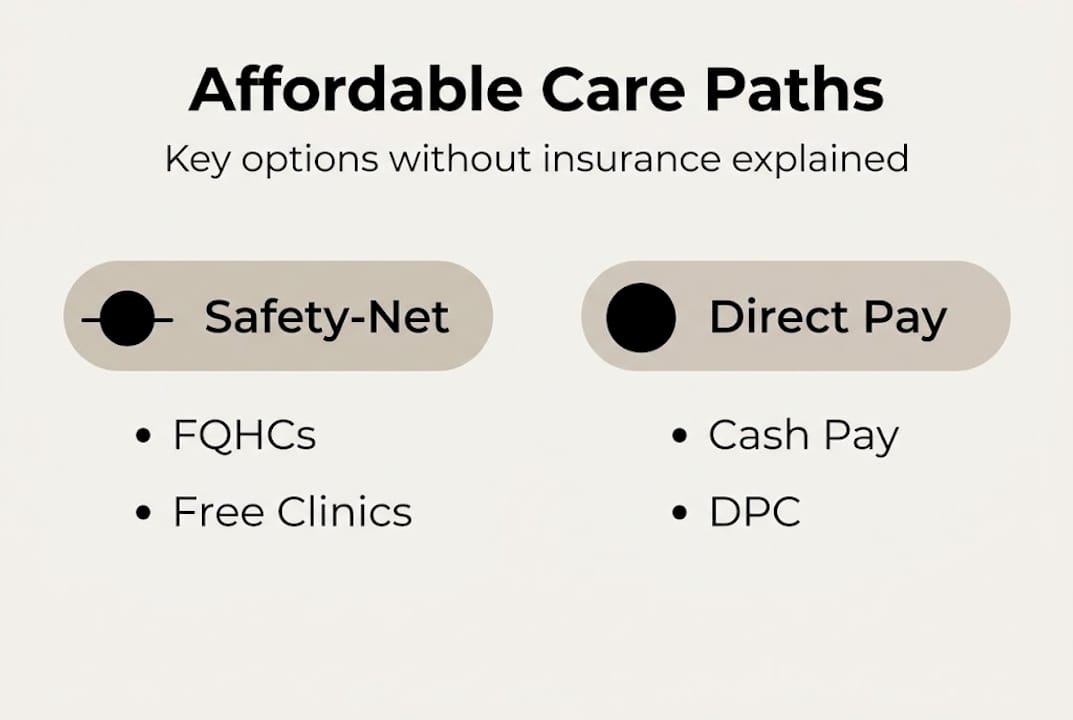
Free clinics work differently. They are typically run by volunteers and funded through donations. Services may be limited to certain hours or specialties, but they can be a lifeline for basic care, screenings, and referrals.
Hospital charity care programs are less well known but widely available. Most nonprofit hospitals are legally required to offer financial assistance. You typically apply after receiving care, and qualifying can reduce or eliminate your bill entirely.
Comparing your safety-net options:
| Option | Cost | Eligibility | Services |
|---|---|---|---|
| FQHC | Sliding scale, as low as $0 | Income-based, all welcome | Primary, dental, mental health |
| Free clinic | Free | Low income, uninsured | Basic primary care |
| Hospital charity care | Reduced or forgiven | Income and asset-based | Hospital services |
| DPC membership | Flat monthly fee | Anyone | Primary care, labs |
Access gaps are real, especially in rural areas where FQHCs may be far away. If distance is a challenge, telehealth can fill that gap and our guide to healthcare access covers those options in more detail.
- Bring a government-issued ID
- Gather recent pay stubs or tax documents as proof of income
- Have a utility bill or lease ready as proof of address
Pro Tip: Call ahead before your first visit. Ask specifically about their sliding fee program and what documents to bring. Being prepared speeds up the process and helps you get the most affordable rate possible.
Direct Primary Care and cash pay: Predictable costs and rapid access
For those seeking speed and predictable costs, alternative models like DPC and cash-pay options offer another path.
Direct Primary Care works like a gym membership for your health. You pay a flat monthly fee, typically between $50 and $100, and in return you get unlimited visits, same-day or next-day appointments, and direct access to your provider by phone or text. There’s no per-visit billing, no insurance paperwork, and no surprise charges.
Cash-pay clinics take a different approach. You pay upfront for each visit or procedure, but the prices are often dramatically lower than what insured patients see. Here’s a real-world example that surprises most people:
- MRI scan (insured): $1,000 to $3,000 depending on deductible and plan
- MRI scan (cash pay): $300 to $500 at many imaging centers
- Generic prescription (with insurance): Can vary widely based on formulary
- Generic prescription (cash pay with GoodRx): Often just a few dollars
The savings for cost-conscious patients can be significant, especially for routine services and prescriptions. DPC works best for busy professionals who need frequent primary care access without the hassle of insurance billing.

That said, cash pay and DPC are not for everyone. If you have a chronic condition requiring expensive specialist care, or if you’re at risk for a major medical event, the lack of an out-of-pocket maximum means costs can escalate quickly. These models shine brightest for people with generally good health who need episodic or preventive care.
Pro Tip: Use tools like GoodRx or SingleCare before filling any prescription. Prices vary dramatically between pharmacies, and the cash price is sometimes lower than your insurance copay.
For a broader look at how telehealth fits into affordable care, explore the benefits of telemedicine and how it compares to traditional visits. You can also read more about no insurance doctor options to find what fits your situation.
Barriers and challenges: What to watch out for without insurance
Knowing the main options, it’s just as important to be aware of common risks so you can make safer choices.
The most significant barrier is delayed care. When cost is a concern, it’s tempting to wait and see if a symptom resolves on its own. But that waiting often leads to bigger problems and bigger bills. Uninsured individuals use fewer services and experience higher rates of delayed care due to cost, which can turn manageable conditions into serious ones.
Here are some of the most common challenges people face:
- Skipping follow-up care: Starting treatment but not finishing it because of cost
- Avoiding specialists: Limited access to specialty care outside of hospital charity programs
- Rural access gaps: Fewer safety-net providers in rural or underserved areas
- Chronic disease management: Conditions like diabetes or hypertension require consistent care that can be hard to maintain without insurance
- Undocumented patients: Facing additional barriers due to fear or limited program awareness
“The biggest cost of uninsurance isn’t the bill you receive. It’s the care you never sought.”
The good news is that many of these risks are manageable with the right approach. Using an FQHC for ongoing primary care, combining DPC with a catastrophic coverage plan, and price-shopping for procedures can significantly reduce your exposure.
Being proactive matters more than most people realize. Preventive screenings, annual checkups, and early treatment almost always cost less than emergency care. Explore more about barriers to healthcare access and practical ways to work around them.
A fresh perspective: What most people miss about healthcare without insurance
Here’s something worth sitting with: insurance is not automatically the most efficient path to care. For straightforward, predictable needs, cash pay and DPC can actually be faster, cheaper, and far less stressful than navigating insurance networks, prior authorizations, and surprise bills.
The conventional wisdom says “get insurance at all costs.” But the reality of healthcare inefficiency tells a more nuanced story. Roughly 25% of U.S. healthcare spending is lost to administrative waste, much of which comes from the insurance billing process itself. Cash models sidestep a lot of that friction.
The real danger for uninsured patients isn’t the model they choose. It’s avoidance. Skipping care, waiting too long, or assuming nothing is affordable leads to worse outcomes and higher costs down the line. DPC practices have shown measurable reductions in emergency room visits precisely because they make preventive care easy and accessible.
For episodic needs or basic primary care, it’s genuinely worth questioning whether insurance adds value or just adds complexity. Explore what an alternative approach to no insurance healthcare could look like for your specific situation.
Ready for affordable care? Explore your options with Chameleon
Understanding your options is the first step. Taking action is the next one. Whether you need help with a common condition, want to explore a care plan that fits your budget, or just want to talk to a licensed provider without the insurance headache, Chameleon Healthcare is built for exactly that.
With Chameleon’s care plans, you get transparent pricing, same-day access, and no waiting rooms. From everyday issues like heartburn and reflux to ongoing primary care needs, we make it simple to get the support you need. Visit Chameleon Healthcare to find the right fit for you and take your next step toward affordable peace of mind.
Frequently asked questions
What if I can’t afford any visits at all?
Many FQHCs and free clinics will not turn you away based on your ability to pay. FQHCs are required to offer care at little to no cost for those who qualify.
Can undocumented people get no insurance healthcare?
Yes. FQHCs and free clinics provide care regardless of immigration status and do not require insurance. Undocumented individuals rely on these safety-net providers for essential care.
Which is cheaper: paying cash or using insurance?
For many services and prescriptions, cash pay can be significantly cheaper. Cash-pay rates are often 50%+ lower than insured rates, though it depends on the provider and service.
Are prescription drugs affordable without insurance?
Generic drugs are often very affordable, and tools like GoodRx can help you find the lowest price near you. GoodRx and SingleCare frequently lower medication costs below what insured patients pay.
What documentation do I need for a sliding fee scale?
You’ll typically need a government-issued ID, proof of income such as pay stubs or a tax return, and proof of address. FQHC sliding fee programs use these documents to determine your discounted rate.