

TL;DR:
- Most employers assume that offering health benefits guarantees employee healthcare access, but actual use depends on cost, convenience, and trust. Addressing structural barriers like enrollment complexity, affordability, and tailored support improves utilization among low-wage and part-time workers. Innovative on-site and virtual clinics effectively enhance access, reduce costs, and foster workforce health and loyalty.
Most employers assume that offering health benefits means their workforce has healthcare access. The reality is more complicated. The role of healthcare access for employees goes far beyond simply having a plan available during open enrollment. Cost, convenience, scheduling, and trust all determine whether workers actually use the care available to them. If you are an HR manager or employer looking to build a healthier, more productive workforce, understanding where the gaps are, and how to close them, is where effective strategy begins.
Table of Contents
- Current landscape of employee healthcare access and coverage
- Financial challenges and affordability in employer health benefits
- Innovative healthcare access solutions beyond traditional insurance
- Tailoring healthcare access to diverse employee needs and wage levels
- Practical impact of improving healthcare access for employees
- Rethinking employer healthcare: balancing cost, access, and employee trust
- Explore Chameleon’s cost-effective healthcare solutions for employers
- Frequently asked questions
Key Takeaways
| Point | Details |
|---|---|
| Not all employees have equal access | Lower-wage and service workers face significant barriers to employer-sponsored health benefits access and enrollment. |
| High costs limit coverage uptake | Rising premiums and out-of-pocket costs prevent many employees from enrolling or using health benefits effectively. |
| On-site clinics enhance access | Workplace health centers provide convenient care that can lower costs and improve employee satisfaction. |
| Tailoring boosts participation | Employers can increase enrollment and satisfaction by using income-based subsidies and care navigation services. |
| Employee trust is critical | Building trust and engagement is essential to maximizing the value of healthcare access investments. |
Current landscape of employee healthcare access and coverage
Access to employer health benefits sounds like a solved problem. It is not. Understanding healthcare access means recognizing that availability and actual use are two very different things. While 74% of civilian workers have access to employer health benefits, that number falls to just 44% for workers in the lowest wage quartile and 52% in service occupations.
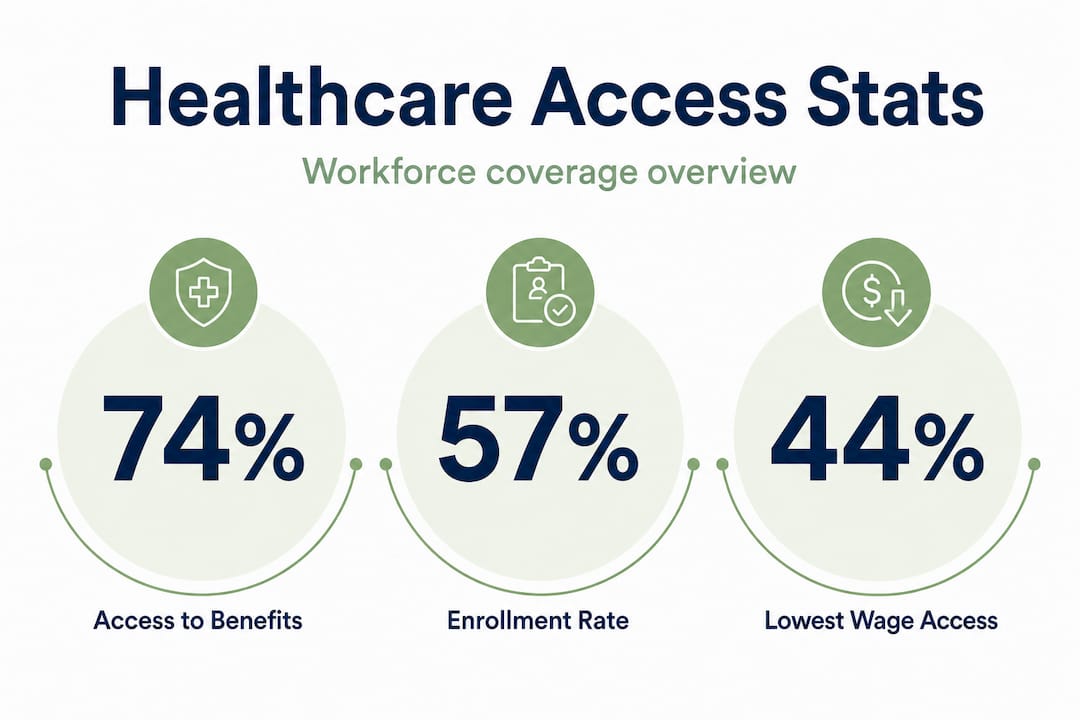
That gap matters enormously. The workers who need affordable care the most are often the least likely to have it offered or to enroll when it is. Healthcare accessibility for workers cannot be treated as uniform across your workforce.
Access and enrollment by worker category:
| Worker category | Access to benefits | Enrollment rate |
|---|---|---|
| All civilian workers | 74% | ~57% |
| Lowest wage quartile | 44% | 49% |
| Service occupations | 52% | Below average |
| Management/professional | Above 80% | Higher than average |
The takeaway here is not just statistical. It reflects a structural problem. Lower-wage workers are more likely to work part-time, work for smaller employers, or hold positions where coverage is simply not offered. Even when it is offered, enrollment lags because premiums feel unmanageable on a smaller paycheck.
Key patterns employers and HR teams should understand:
- Offer rates vary by industry. Retail, food service, and hospitality have lower offer rates than finance, healthcare, or professional services.
- Take-up is influenced by more than cost. Complexity of enrollment, language barriers, and lack of trusted guidance all reduce participation.
- Part-time status is a major barrier. Many benefit plans exclude workers under a certain hours threshold, leaving a portion of your workforce without options.
Financial challenges and affordability in employer health benefits
Cost is the most honest conversation in employer healthcare, and it is one many organizations avoid. Average annual premiums reach $8,940 for single coverage and $25,400 for family coverage, with employers typically covering 80 to 83% of single premiums and 70 to 73% of family premiums. That still leaves a meaningful employee contribution, particularly for family plans.

For a worker earning $35,000 per year, a family premium contribution of several thousand dollars is not a minor line item. It is a genuine financial decision that competes with rent, groceries, and childcare. Employee premium contributions and deductibles can consume 10% or more of income in many states, creating a real risk of underinsurance even for those who do enroll.
Comparing employer vs. employee healthcare cost responsibilities:
| Cost component | Employer share | Employee share |
|---|---|---|
| Single premium | 80-83% | 17-20% |
| Family premium | 70-73% | 27-30% |
| Deductibles | Varies | 100% until met |
| Copays/coinsurance | None | 100% at point of care |
These numbers tell a story about why employee health benefits, as designed, do not always translate into actual care. Employees may enroll, carry a card in their wallet, and still avoid the doctor because the out-of-pocket cost at the visit feels too high.
Pro Tip: If you have lower-wage workers in your workforce, consider auditing your current plan’s employee contribution requirements. A plan that costs workers more than 5% of their household income to join is likely to see high dropout or non-enrollment rates, especially at annual renewal.
Exploring affordable healthcare alternatives alongside traditional insurance can reduce the financial pressure on both sides. The benefits of telemedicine as a supplemental or standalone option include dramatically lower per-visit costs and no facility fees, making care genuinely reachable for workers who would otherwise delay or skip it.
Innovative healthcare access solutions beyond traditional insurance
The most forward-thinking employers are not waiting for traditional insurance to become more affordable. They are building access into the work environment itself.
Charter Communications facilitated over 10,000 appointments at three corporate campus health centers, giving employees same-day access to care without leaving work. The result was measurable cost control alongside higher utilization. Workers used the clinic because it was easy, not because they were told to.
On-site clinics staffed by nurse practitioners offer same-day appointments, on-site labs, and a measurable reduction in emergency room visits. There are IRS compliance considerations around fair market rates when these clinics are integrated with existing health plans, but the operational and financial case is strong for mid-size and large employers.
What these models have in common:
- Convenience removes the friction that causes workers to delay care until a condition is worse and more expensive to treat.
- Same-day access matches how people actually experience illness. A sore throat or a suspected sinus infection does not wait for an appointment two weeks out.
- On-demand options reach shift workers. Employees working early mornings, nights, or weekends often cannot call a doctor’s office during regular hours. Virtual and on-site models serve them where traditional office-based care does not.
Pro Tip: When evaluating on-demand healthcare options for your workforce, look beyond cost per visit. Factor in reduced absenteeism, lower ER diversion costs, and the time employees lose when they have to travel to off-site care during working hours.
Workplace clinic models vary widely in scale and structure. You do not need to build a full medical facility on campus. Partnering with a workplace healthcare services provider or integrating virtual care as a primary access point can deliver similar results at a fraction of the cost.
Tailoring healthcare access to diverse employee needs and wage levels
One plan, one price, one communication style for your entire workforce is how healthcare benefits fail. The impact of healthcare on productivity is strongest when care is actually used, and use depends heavily on whether the access model fits the worker’s reality.
High-performing employers use income-based premium subsidies, navigation services, and community health worker partnerships to meaningfully boost enrollment among lower-wage workers. These are not complicated programs. They are intentional acknowledgments that a flat-rate benefit does not land equally across a workforce with different financial situations.
Here is a practical framework employers can apply:
- Segment your workforce by wage band. Identify which groups are least likely to enroll and why. Survey results often reveal cost as the primary driver, but trust and complexity are close behind.
- Introduce tiered premium contributions. Workers earning less contribute less. This requires plan redesign but significantly increases enrollment and actual utilization.
- Assign care navigators or benefits counselors. A real person who helps employees understand their options, complete enrollment, and find in-network providers removes the confusion that causes people to give up.
- Partner with community health organizations. For workforces in underserved areas, local partnerships extend your reach and build cultural trust in ways a corporate benefits portal cannot.
- Align access points with shift schedules. Telemedicine for diverse workforces allows workers on non-traditional hours to connect with a provider at 10pm as easily as 10am. This alone removes one of the most common barriers to healthcare for employees.
Strategies by workforce segment:
| Workforce segment | Key barrier | Recommended solution |
|---|---|---|
| Low-wage hourly workers | Cost and complexity | Tiered premiums and navigation support |
| Shift or night workers | Scheduling conflicts | Virtual care with extended hours |
| Part-time workers | Ineligibility for coverage | Direct-pay or membership-based care |
| Non-English speakers | Communication barriers | Multilingual navigation services |
Low-cost urgent care strategies are particularly effective for the part-time segment, where traditional insurance eligibility thresholds leave workers without any employer support at all.
Practical impact of improving healthcare access for employees
The business case for improving healthcare access for employees is clear and measurable. This is not a feel-good initiative. It produces returns.
More than half of employers report over 200% return on investment from workplace clinics, with early detection of urgent conditions and measurably higher employee satisfaction driving much of that value.
The benefits stack up across multiple dimensions:
- Early detection prevents costly episodes. When employees can see a provider quickly and affordably, conditions like infections, elevated blood pressure, or early-stage diabetes get caught before they become hospitalizations.
- Fewer emergency room visits. ER care costs five to ten times more than a primary or urgent care visit. Every avoided ER trip for a non-emergency condition is a direct cost saving.
- How healthcare access affects retention is direct. Workers who feel their employer genuinely supports their health stay longer. Healthcare is consistently ranked among the top factors in job satisfaction and employer loyalty.
- Reduced absenteeism. Untreated illness keeps people home. Accessible care means faster recovery and faster return to work.
“When employees can access care without hassle, they actually use it. That shift, from having a benefit to using it, is where the real value lives.”
Connecting your workforce to affordable virtual care plans is one of the most direct ways to convert a paper benefit into a real one workers trust and use.
Rethinking employer healthcare: balancing cost, access, and employee trust
Here is the uncomfortable truth that most HR conversations skip: cost reduction alone will not maximize the value of your healthcare investment. You can build the most financially efficient benefits package available and still have a workforce that does not trust it, does not understand it, and does not use it.
Larry Boress, a workplace health advocate, captures this clearly, noting that on-site centers are “all about access” and are particularly valued by lower-income workers who face the highest barriers to care. Access is not just a logistical feature. It is a message you send to your workforce about whether their health matters to you.
What we have seen consistently is that employers who treat healthcare as a trust-building tool, not just a cost center, get better outcomes on both sides of the ledger. When workers believe their employer genuinely cares about their wellbeing, they use their benefits more appropriately. They go to primary care instead of the ER. They address health concerns early. They stay.
The opposite is also true. A benefits package that looks good on paper but requires a worker to navigate a complex portal, wait three weeks for an appointment, or pay $2,000 out of pocket before anything is covered communicates something different. It says the benefit was designed for liability protection, not for actual use.
The employers getting this right are those who combine alternative affordable healthcare options with clear communication, honest acknowledgment of cost barriers, and a willingness to customize their approach for different worker segments. A single enrollment email sent in October is not a healthcare access strategy. A year-round, approachable, worker-centered program is.
Explore Chameleon’s cost-effective healthcare solutions for employers
If you are rethinking how your workforce accesses care, Chameleon Healthcare was built for exactly this challenge. Our telehealth-first model delivers fast, licensed medical care without the friction of traditional insurance, with transparent pricing that makes sense for workers at every wage level.
Explore virtual care plans for employers that give your team same-day access to providers from their phone or computer, with no waiting rooms and no surprise bills. Whether your employees need help with respiratory conditions like asthma or everyday injuries like sprains and strains, Chameleon connects them with licensed providers quickly and affordably. It is a practical, modern solution for employers who want to offer real healthcare access, not just coverage on paper.
Frequently asked questions
What percentage of employees typically have access to employer-provided health benefits?
About 74% of civilian workers have access to employer health benefits, but that drops to 44% for workers in the lowest wage quartile and 52% in service occupations, making access far from universal.
Why do some employees with access to coverage choose not to enroll?
Employees often decline coverage because of affordability concerns, complexity during enrollment, or existing coverage through a spouse. Workers in lower-wage occupations show only 49% enrollment in the lowest wage quartile, even when coverage is available to them.
What are the benefits of workplace health clinics for employers?
Workplace clinics improve care access, reduce costly emergency room visits, and increase employee satisfaction. More than half of employers report over 200% return on investment from their on-site clinic programs.
How can employers improve healthcare affordability for low-wage workers?
Offering income-based premium subsidies, tiered cost-sharing structures, and dedicated navigation services are the most effective approaches. High-performing employers combine these tools to meaningfully boost enrollment and actual care utilization among lower-wage workers.