

TL;DR:
- Online healthcare is accessible and affordable for uninsured, rural, and under-served patients.
- Virtual visits are suitable for minor conditions but not emergencies or complex health issues.
- Preparation and understanding telemedicine limits enhance the quality and safety of virtual healthcare.
If you’ve ever assumed that online healthcare is only for people who are tech-savvy, well-insured, or living near a major city, you’re not alone. That assumption keeps a lot of people from getting the care they actually need. The truth is, online healthcare providers are one of the most practical and affordable options available to uninsured patients, caregivers, and anyone dealing with a non-emergency health concern. This guide walks you through how these services work, what conditions they handle well, who benefits most, and how to get the most from your visit.
Table of Contents
- How online healthcare providers work
- Conditions well-suited for online providers
- Benefits for uninsured, under-served, and rural patients
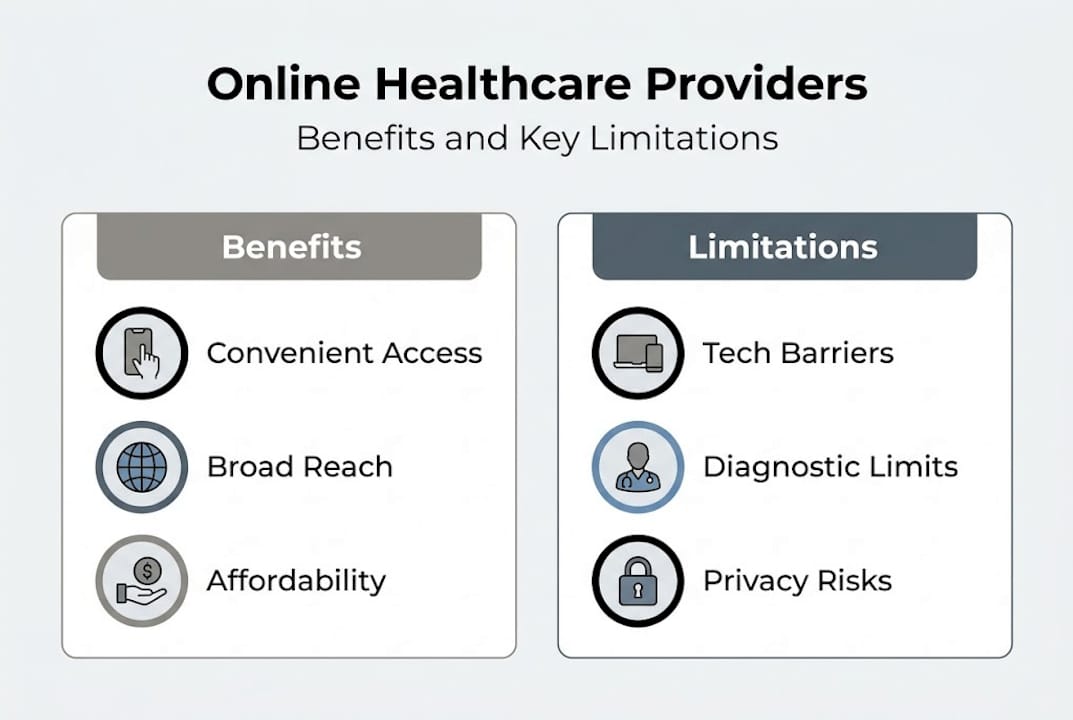
- Limitations and risks of online healthcare providers
- Maximizing your online healthcare visit
- What most guides miss about online healthcare providers
- Find the right online care for your needs
- Frequently asked questions
Key Takeaways
| Point | Details |
|---|---|
| Simple virtual process | Online healthcare visits follow clear steps from sign-up to treatment and are designed to be user-friendly. |
| Best for common issues | Colds, UTIs, rashes, and refills are efficiently managed online, but hands-on exams still require in-person care. |
| Greater access for uninsured | These services make quality care possible for those without insurance or living far from clinics. |
| Limits to virtual care | Some cases—emergencies and complex conditions—aren’t suitable for online treatment, and digital access matters. |
| Preparation is key | Readying your space and questions helps you get the most out of every online healthcare visit. |
How online healthcare providers work
After outlining why online care matters, let’s break down exactly how these services function and what you can expect as a patient.
The telemedicine care process is more straightforward than most people expect. You sign up through an app or website, enter your symptoms, and connect with a licensed provider through video or chat. From there, the provider reviews your information, asks follow-up questions, and makes a diagnosis. If appropriate, they send a prescription directly to your pharmacy.
Here is a typical virtual visit broken down step by step:
- Create your account on the provider’s platform and enter basic health details
- Describe your symptoms through a digital intake form or symptom checker
- Connect with a provider via video call, phone, or secure chat
- Receive a diagnosis and care plan based on your consultation
- Get a prescription sent electronically to a pharmacy of your choice, if needed
Understanding how telemedicine works also means knowing the technology behind it. Most platforms use a three-tier structure. The first tier includes your personal device and any connected health sensors like a thermometer or blood pressure cuff. The second tier is the communication gateway that securely transmits your data. The third tier is the provider’s system, where your information is reviewed and a response is generated. This layered approach supports remote diagnosis for conditions like colds, UTIs, rashes, and prescription refills.
| Visit type | Typical turnaround |
|---|---|
| Urgent minor illness | Same day, often within hours |
| Prescription refill | Same day to 24 hours |
| Follow-up consultation | Scheduled, flexible timing |
| Skin concern or rash | Same day with photo upload |
Pro Tip: Before your visit, write down your symptoms, how long you’ve had them, and a full list of your current medications. This helps your provider give you a faster and more accurate assessment.
Conditions well-suited for online providers
Now that you know how online visits work, let’s clarify which health issues can and cannot be managed virtually.
Online providers handle a wide range of everyday health concerns effectively. If you’re dealing with something that doesn’t require a physical exam or emergency intervention, there’s a good chance a virtual visit can help. The common conditions treated online include:
- Colds, flu, and sore throat
- Urinary tract infections (UTIs)
- Pink eye (conjunctivitis)
- Skin rashes and mild allergic reactions
- Acid reflux and heartburn
- Mild asthma or allergy symptoms
- Prescription refills for stable, ongoing conditions
- Sinus infections and ear infections
These virtual treatment examples represent the kinds of issues where you can get real answers without leaving home. However, it’s equally important to know when to seek in-person care. Telemedicine systems are suitable for minor illnesses and refills, but not for emergencies or conditions requiring hands-on exams.
| Appropriate for online care | Not appropriate for online care |
|---|---|
| Minor rash or skin irritation | Suspected broken bone |
| Urinary tract infection | Chest pain or stroke symptoms |
| Prescription refill | Deep wounds needing stitches |
| Pink eye | Severe abdominal pain |
| Mild asthma flare | Mental health crisis or emergency |
If you’re ever unsure, most platforms list treatable conditions right on their website. Check that list before booking, and if your symptoms feel serious or are getting worse quickly, go to an emergency room.
Benefits for uninsured, under-served, and rural patients
Once you understand the conditions and scenarios, it’s vital to see the unique advantages that online care offers to those typically left out of traditional systems.
For people without insurance, the advantages of virtual care go beyond convenience. Cost transparency is one of the biggest. Instead of surprise bills, you see a flat fee upfront. That alone removes a major source of stress. The telemedicine benefits for uninsured patients are real and measurable.
Here is what stands out most:
- No insurance required to access licensed providers
- Flat, upfront pricing so there are no unexpected charges
- No travel needed, which is critical for rural patients or those with limited mobility
- Flexible scheduling, including evenings and weekends
- Same-day access for urgent but non-emergency concerns
The numbers reflect growing need. Approximately 30 million Americans are currently uninsured, and around 23% of gig workers lack coverage. Telehealth helps reduce the risk of large out-of-pocket medical bills for these groups. For rural communities especially, telehealth improves equity by reducing travel burdens and improving satisfaction when services are accessible.
“Online care doesn’t just save time. For someone without insurance living an hour from the nearest clinic, it can be the difference between getting treated and going without.”
Federally Qualified Health Centers and sliding fee programs can complement telehealth access for patients who need additional support. The main barrier remains access to a reliable device and stable internet connection. That is a real gap, and it’s worth knowing before relying solely on virtual care.
Limitations and risks of online healthcare providers
Even with all its promise, there are important caveats and risks to understand before choosing online healthcare.
Virtual care is not a replacement for all medical needs. There are situations where it simply cannot deliver safe or accurate results, and knowing those situations upfront protects you.
Here are the key limitations to keep in mind:
- Physical exams are not possible online, which rules out things like orthopedic testing for injuries such as ACL tears
- Complex mental health conditions, including eating disorders, severe substance use disorder, or borderline personality disorder, often require in-person treatment
- Misdiagnosis risk is real. Online care carries a 13 to 16 percent misdiagnosis rate in some cases, which has led to missed diagnoses of conditions like pneumonia and fractures
- Emergencies are never appropriate for a virtual visit. Call 911 or go to an emergency room immediately
- The digital divide means that patients without reliable internet or a smartphone may be effectively excluded from these services
“Virtual care is a powerful tool, but it works best when patients understand where it fits and where it doesn’t. Knowing those limits is part of being your own health advocate.”
These risks of online care are manageable when you go in informed. Understanding the limitations of telemedicine does not mean avoiding it. It means using it wisely.
Pro Tip: Always have a backup plan. If your symptoms get worse after a virtual visit or you don’t feel better within 48 hours, arrange to see someone in person.
Maximizing your online healthcare visit
Understanding how to prepare can set you up for a more successful and stress-free online healthcare experience.
A little preparation goes a long way. Patients who come ready with organized information consistently have better visits and more accurate diagnoses. Think of it like preparing for any important appointment: the more organized you are, the smoother it goes.
Here is a simple online visit checklist to follow before logging on:
- Find a quiet, private space where you can talk freely
- Make sure your lighting is good so the provider can see you clearly if using video
- Charge your device and test your camera and microphone beforehand
- Write out your top three symptoms and when they started
- List all current medications, including supplements and dosages
- Note any allergies you have to medications
Standardized care protocols are part of what makes virtual visits reliable. Providers use established guidelines for diagnosing and treating common conditions, which keeps care consistent. Newer platforms are also incorporating AI tools that help triage patients faster and reduce wait times. Expert guidance on optimizing telehealth emphasizes patient preparation, standardized protocols, and the growing role of AI in improving access and efficiency.
Thinking about making virtual visits work for your whole family is also worthwhile. Many platforms allow you to manage care for children or elderly relatives under a single account. For busy parents especially, getting care quickly through a same-day virtual visit can make a real difference.
Pro Tip: Write down your top three questions before your consult starts. Providers appreciate focused questions, and you’ll leave the visit feeling more confident in the answers you got.
What most guides miss about online healthcare providers
Most articles on this topic focus heavily on the technology. The platforms, the apps, the AI features. And while those details matter, they miss the bigger shift happening for patients, especially those without insurance.
Virtual care is quietly transferring control back to patients. When you can consult a licensed provider from your phone without navigating a complex insurance system or taking half a day off work, that is not just convenience. That is a meaningful shift in how healthcare power works. Telehealth for the uninsured is one of the clearest examples of this.
But empowerment only goes so far without systemic support. Sliding-scale pricing models and broadband investment in underserved communities are not optional extras. They are what turns virtual care from a nice idea into a real solution. The patients who get the most out of online healthcare are the ones who show up organized, advocate for access to their own health records, and treat virtual visits as one tool in a broader care strategy. Not a shortcut. A starting point.
Find the right online care for your needs
Ready for your own virtual visit? Here are immediate ways to connect with care that meets your needs, no insurance required.
Chameleon Healthcare makes it simple to get started. Whether you’re dealing with heartburn and reflux care that keeps flaring up or back pain support that’s affecting your daily routine, licensed providers are available to help you today.
With flat-fee pricing, same-day access, and no insurance required, you can connect with a provider from your phone or computer in minutes. Explore our telehealth plans to find the option that fits your situation. Getting the care you need should not feel complicated, and with the right platform, it doesn’t have to.
Frequently asked questions
What are the most common conditions treated by online healthcare providers?
The most common conditions include colds, urinary tract infections, rashes, pink eye, acid reflux, mild asthma, and prescription refills. Telehealth systems are well-suited for these non-emergency issues but are not designed for hands-on exams or emergencies.
Can you use online healthcare providers without insurance?
Yes, many services offer affordable out-of-pocket options for uninsured patients and publish transparent pricing upfront. With roughly 30 million Americans currently uninsured, telehealth platforms have built models specifically designed to serve this population.
What should I do to prepare for an online healthcare visit?
Prepare a quiet space, gather a list of your symptoms and medications, and write down your questions before the visit starts. Proper preparation is one of the most effective ways to get accurate, helpful care from a virtual visit.
What are the main risks or downsides of virtual healthcare?
Risks include potential misdiagnosis, digital access barriers, and situations where the condition requires a physical exam. Studies show a 13 to 16 percent misdiagnosis rate in some cases, particularly for conditions like pneumonia or fractures that are harder to detect remotely.
Are there ways to get support if I can’t afford a device or internet?
Yes, some clinics, libraries, and community programs offer device and internet access for telehealth visits. Resources for uninsured patients like Federally Qualified Health Centers and sliding fee programs can also help bridge the gap.