

TL;DR:
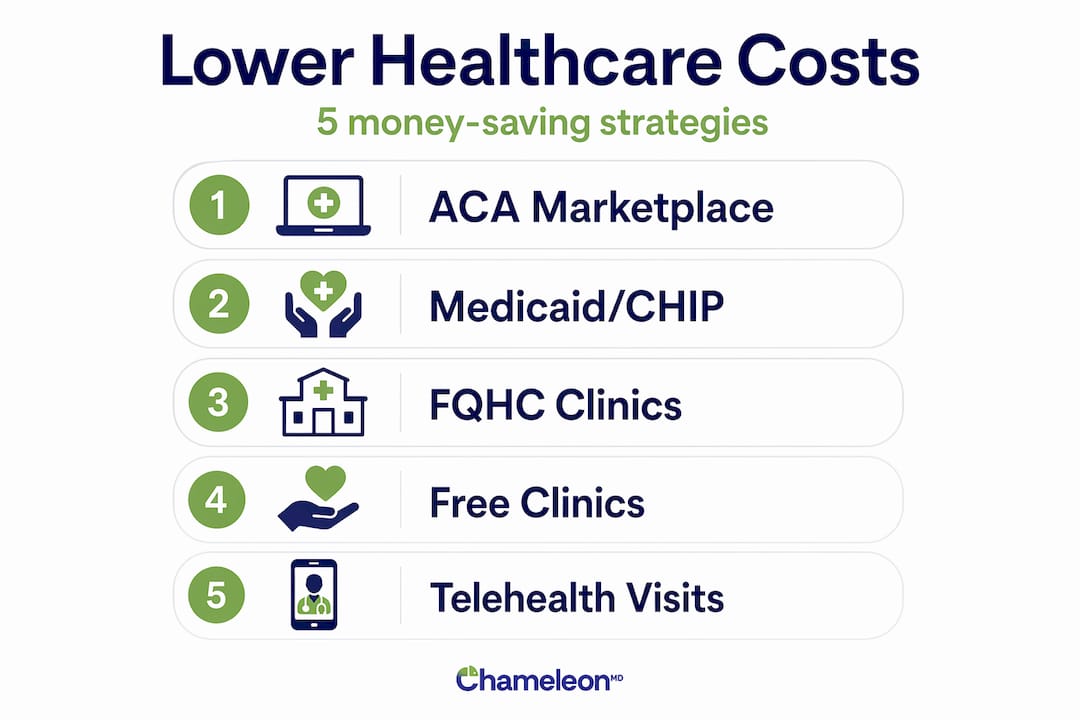
- Affordable healthcare options include ACA subsidies, Federally Qualified Health Centers, free clinics, and telehealth services. Combining these resources and staying informed about eligibility and applying annually can significantly reduce medical expenses. Platforms like Chameleonhc facilitate accessible, insurance-free virtual care with transparent pricing and broad conditions covered.
Healthcare costs have a way of catching you off guard at the worst moments. Whether you’re self-employed, between jobs, or simply tired of watching premiums eat through your paycheck, knowing how to offer affordable healthcare to yourself and your family matters more than most people realize. Out-of-pocket limits remain high even with coverage in place, which means having insurance doesn’t always mean having affordable care. This guide walks you through real, practical options — from federal programs to telehealth solutions — so you can make confident decisions without depending entirely on traditional insurance.
Table of Contents
- Key takeaways
- How to offer affordable healthcare through ACA marketplace options
- Using FQHCs and sliding fee scales
- Free clinics as a low-cost care alternative
- Practical strategies for lowering medical expenses
- My honest take on navigating this system
- How Chameleonhc makes affordable care accessible
- FAQ
Key takeaways
| Point | Details |
|---|---|
| ACA subsidies can cut costs significantly | Premium tax credits and cost-sharing reductions lower both monthly premiums and out-of-pocket expenses for eligible individuals. |
| FQHCs serve patients at any income level | Federally Qualified Health Centers offer sliding scale fees based on income, and no one is turned away due to inability to pay. |
| Free clinics fill important gaps | Charitable and free clinics provide medical and pharmacy services with minimal documentation requirements for uninsured patients. |
| Telehealth reduces costs for individuals | Virtual care visits cost far less than in-person urgent care and are accessible without traditional insurance coverage. |
| Mixing resources works best | Combining ACA options, community health centers, free clinics, and telehealth creates the most resilient, budget-friendly healthcare plan. |
How to offer affordable healthcare through ACA marketplace options
The ACA Marketplace is one of the most underused tools for individuals and families looking for budget-friendly healthcare solutions. The two biggest benefits are premium tax credits and cost-sharing reductions, and they work in different ways.
Premium tax credits lower what you pay each month for your health plan. Cost-sharing reductions lower what you pay at the doctor’s office, including your deductible and copays. Both types of savings work together, but you have to be enrolled in a Silver plan through the Marketplace to access cost-sharing reductions specifically.
Here is what determines your eligibility:
- Household income. Your expected income for the coverage year, not last year’s income, determines your subsidy amount. This trips a lot of people up.
- Household size. More dependents typically mean higher subsidy eligibility thresholds.
- Other coverage. If you have access to affordable employer coverage, you may not qualify for Marketplace credits — but this rule has specific exceptions, including what’s known as the “family glitch,” which the IRS updated in 2023.
- Medicaid and CHIP. If your income falls below certain state thresholds, you may qualify for Medicaid or the Children’s Health Insurance Program (CHIP) instead of a Marketplace plan.
One of the most common and costly mistakes people make is estimating their income incorrectly. Marketplace subsidies depend on projected income, not actual income. If you earn more than estimated, you may owe money back at tax time. If you earn less, you may have left savings on the table all year.
Pro Tip: If your income changes mid-year due to a new job, a raise, or a period of unemployment, log back into your Marketplace account and update your income estimate. Doing this keeps your subsidies accurate and prevents a surprise tax bill.
Medicaid and CHIP are worth checking even if you think you earn too much. Eligibility rules vary by state, and in states that expanded Medicaid under the ACA, the income threshold is higher than most people expect.
Using FQHCs and sliding fee scales
Federally Qualified Health Centers, commonly called FQHCs, are community health clinics funded in part by the federal government. Their purpose is to provide care in areas and to populations that would otherwise go without it. In 2024, over 32 million patients received care at these centers, and 90% of them had incomes at or below 200% of the Federal Poverty Level.

What makes FQHCs especially valuable for families researching cost-effective health care methods is the sliding fee scale. Your fee is calculated based on your income and household size. If your income falls at or below 100% of the Federal Poverty Guidelines, care may be entirely free. Between 101% and 200%, you pay a nominal fee. No one is turned away because they cannot pay.
The services available go far beyond basic checkups. In 2024, 1,400 health centers delivered 139 million visits covering medical, mental health, dental, and substance use services. That breadth is significant. Many people assume FQHCs are walk-in clinics for minor issues. In reality, they are full-service health centers.
Here is how to access sliding fee discounts at an FQHC:
- Find a center near you. Use the Health Resources and Services Administration (HRSA) locator at findahealthcenter.hrsa.gov to search by zip code.
- Call ahead. Confirm that the center accepts new patients and ask what the sliding fee application process looks like before your visit.
- Gather your income documentation. Pay stubs or income statements are typically required to verify eligibility for the discount.
- Apply for the discount at or before your first visit. Discounts may be retroactive to your date of service once approved, so applying promptly protects you financially.
- Update your information annually. Sliding fee eligibility is reviewed each year based on updated Federal Poverty Guidelines.
| Income Level (% of Federal Poverty Level) | Expected Discount |
|---|---|
| At or below 100% FPL | Full discount (care at no cost) |
| 101% to 200% FPL | Nominal fee charged |
| Above 200% FPL | Standard or reduced fee, case by case |
Pro Tip: Even if you have insurance, FQHCs can still be a cost-effective choice. They bill your insurance for covered services, and if you have a high deductible, the sliding fee rate may actually be lower than what your insurer would charge you out of pocket.
Free clinics as a low-cost care alternative
Free and charitable clinics serve a different population than FQHCs, though there is some overlap. These clinics are typically run by volunteer providers and funded through donations and grants. They exist specifically to reach people who are uninsured and have limited income, and care is provided regardless of insurance or income level.
Here is what you need to know before your first visit:
- Services vary by clinic. Some offer only primary care. Others include dental care, pharmacy services, behavioral health support, and specialist referrals. Always call ahead to confirm what is available.
- Documentation requirements are minimal. Most free clinics ask for basic identification. Bringing a medication list and any available medical records makes your visit more productive, but you will not be turned away without them.
- Wait times can be longer. Because these clinics run on limited staff and volunteer hours, same-day or walk-in access is not always guaranteed. Scheduling in advance when possible is a good habit.
- Free clinics are not a substitute for emergency care. If you are dealing with a life-threatening situation, go to an emergency room. Free clinics handle non-emergency and preventive care.
To find a free clinic near you, visit the National Association of Free and Charitable Clinics at nafcclinics.org. You can search by state and filter by services offered. If you need affordable healthcare without insurance, pairing a free clinic with a telehealth service can cover a wide range of your everyday health needs.
Practical strategies for lowering medical expenses
Whether you are an individual looking for cost-effective health care methods or an employer trying to provide better benefits on a tight budget, certain strategies consistently reduce costs without sacrificing access to care.
High-deductible plans paired with savings accounts
High-deductible health plans (HDHPs) carry lower monthly premiums. Paired with a Health Savings Account (HSA) or a Health Reimbursement Arrangement (HRA), they create a way to set aside pre-tax money for medical expenses. Pairing HDHPs with HSAs and encouraging preventive care decreases long-term costs meaningfully, both for individuals and for employers offering coverage. The key is using the savings account consistently, not just when something goes wrong.
Preventive care is free under the ACA
Under the ACA, a broad set of preventive services must be covered at no cost to you, regardless of your deductible. Annual wellness visits, screenings, and vaccines fall into this category. Taking full advantage of free preventive services is one of the most overlooked strategies for cheap healthcare. Catching something early is almost always less expensive than treating it later.
Telehealth as a primary care tool
Virtual visits are consistently less expensive than in-person urgent care visits. For common conditions like sinus infections, rashes, urinary tract infections, and sore throats, a telehealth provider can diagnose and treat you without the overhead costs of a physical clinic. The benefits of telemedicine for affordable care go beyond cost: same-day access, no travel, and no waiting rooms make it realistic to seek care earlier, which often prevents small problems from becoming expensive ones.
| Care Setting | Average Cost Without Insurance | Wait Time |
|---|---|---|
| Emergency room | $1,500 and up | 2 to 4 hours |
| Urgent care clinic | $150 to $300 | 30 to 90 minutes |
| Primary care visit | $150 to $250 | Days to weeks |
| Telehealth visit | $50 to $100 | Minutes to same day |
Pro Tip: If you are uninsured or have a high deductible, always ask providers for their self-pay rate before you are billed. Many clinics offer a significant discount for patients paying out of pocket, and this rate is rarely advertised.
For employers specifically, affordable virtual care plans for teams can reduce the burden of traditional group insurance while still giving employees consistent access to licensed providers.
My honest take on navigating this system
I have seen a lot of people make the same frustrating mistake: they assume their only real option is a traditional insurance plan, so they go without coverage entirely when premiums feel out of reach. That is one of the most expensive decisions a person can make, and it happens more than you would think.
What I have learned is that the system actually has more affordable pathways than most people realize. The challenge is that no single source walks you through all of them together. You have to know that ACA subsidies exist AND that FQHCs exist AND that telehealth can fill the gaps. Using one resource alone often leaves you underserved.
The detail that surprises people most is how the sliding fee program requirements actually work. Many assume they will be automatically enrolled in a discount. They are not. You have to apply, provide documentation, and update it annually. That extra step keeps a lot of people from getting the savings they deserve.
My advice is simple: build a small stack of resources. Know your nearest FQHC. Know what telehealth costs for your most common health concerns. Check your Marketplace eligibility every fall during open enrollment, even if your income has not changed much. Policy details shift, and staying even slightly informed can save you hundreds of dollars.
— Vector
How Chameleonhc makes affordable care accessible
If you are looking for a budget-friendly healthcare solution that does not require insurance, Chameleonhc is built exactly for that. The platform connects you with licensed providers online, usually the same day, for a transparent flat fee. No waiting rooms, no surprise bills, and no insurance card required.
Chameleonhc covers a wide range of conditions, from pink eye and sinus infections to low back pain and more. Individuals and families can explore membership-based virtual care plans that bundle access to care at a predictable monthly cost — making it easy to budget your health expenses the same way you budget everything else. Whether you need a quick check-in for a common condition or ongoing primary care support, Chameleonhc gives you a reliable, accessible option that fits real life.
FAQ
What is the fastest way to find low-cost healthcare?
Use HRSA’s health center locator to find a nearby Federally Qualified Health Center, or connect with a telehealth provider like Chameleonhc for same-day, affordable virtual visits without insurance.
Who qualifies for ACA premium tax credits?
Eligibility is based on your expected household income and size for the coverage year. Most individuals and families who do not have access to affordable employer coverage can qualify, and Marketplace savings are available across a wide income range.
Do free clinics require proof of income?
Most free and charitable clinics require only basic identification. Care is provided regardless of income or insurance status, making them a practical option for uninsured individuals with limited documentation.
How does telehealth lower medical expenses?
Telehealth visits typically cost between $50 and $100, compared to $150 or more for in-person urgent care. Accessing care virtually removes overhead costs and eliminates the practical barriers that cause people to delay treatment.
Can I use an FQHC if I have insurance?
Yes. FQHCs bill your insurance for covered services, and your sliding fee discount may still apply to any out-of-pocket portion. This makes them a cost-effective choice even for patients with high-deductible plans.