

TL;DR:
- Digital urgent care provides real-time, accessible medical help for non-emergency health issues without the need for insurance or wait times. It typically covers common conditions, delivers diagnoses, prescriptions, and follow-up instructions through confidential, licensed clinician online visits. However, it is safest to seek in-person care for serious symptoms like chest pain or severe bleeding, with virtual care functioning best as a timely first step.
You wake up at 10 p.m. with a sore throat that’s getting worse, or your child has a rash spreading on their arm, and you don’t have insurance or a way to pay for a costly ER visit. That’s exactly where digital urgent care steps in: real, live medical help for urgent but non-emergency situations, delivered online through video or phone with a licensed clinician. No waiting rooms. No surprise bills. No insurance required. This guide breaks down what digital urgent care actually covers, how a virtual visit works from start to finish, when it’s the right call, and when you need to head somewhere in person.
Table of Contents
- Understanding digital urgent care: Definition and key features
- How a digital urgent care visit works: Process step-by-step
- What digital urgent care treats and what’s not covered
- Is digital urgent care safe and effective? Real-world results
- Navigating safety, triage, and choosing the right digital urgent care
- Our take: Why digital urgent care works best as a first step, not a universal solution
- Get care fast: Try digital urgent care with Chameleon
- Frequently asked questions
Key Takeaways
| Point | Details |
|---|---|
| Immediate access | Digital urgent care lets you see a clinician online within minutes for most urgent, non-emergency issues. |
| Safe for minor problems | It’s effective for infections, rashes, minor pain, and prescription refills, but not emergencies. |
| Step-by-step process | Online visits use intake forms, live clinician video or phone consultations, and follow-up steps. |
| Know the limits | Serious or complex conditions still require in-person or emergency care for your safety. |
| Choose wisely | The best digital urgent care platforms have real clinicians and strong follow-up protocols, not just automation. |
Understanding digital urgent care: Definition and key features
With that starting point, let’s dig into what exactly digital urgent care offers and how it’s changing access for people who need quick, affordable help.
Virtual urgent care is acute, time-sensitive care delivered via live online visits with a licensed clinician, typically over video or phone. Think of it as the online version of a walk-in clinic, minus the commute and the crowded waiting room. You connect with a provider in real time, describe your symptoms, and receive a diagnosis, treatment plan, or prescription if it’s medically appropriate.
What separates digital urgent care from a regular telehealth appointment is the focus on same-day needs. You’re not scheduling a wellness checkup for next month. You need answers today, and you need them fast.
Key features that define a quality digital urgent care service:
- 24/7 availability: Health problems don’t follow a 9-to-5 schedule, and neither does digital urgent care. Most platforms are available around the clock.
- Licensed clinicians: Visits are handled by board-certified physicians, nurse practitioners, or physician assistants, not chatbots alone.
- No insurance required: Many services offer transparent, flat-rate pricing so you know the cost before you commit.
- Common condition coverage: From sinus infections and UTIs to pink eye and skin rashes, most everyday urgent needs qualify.
- Prescriptions when appropriate: Clinicians can send prescriptions directly to your local pharmacy.
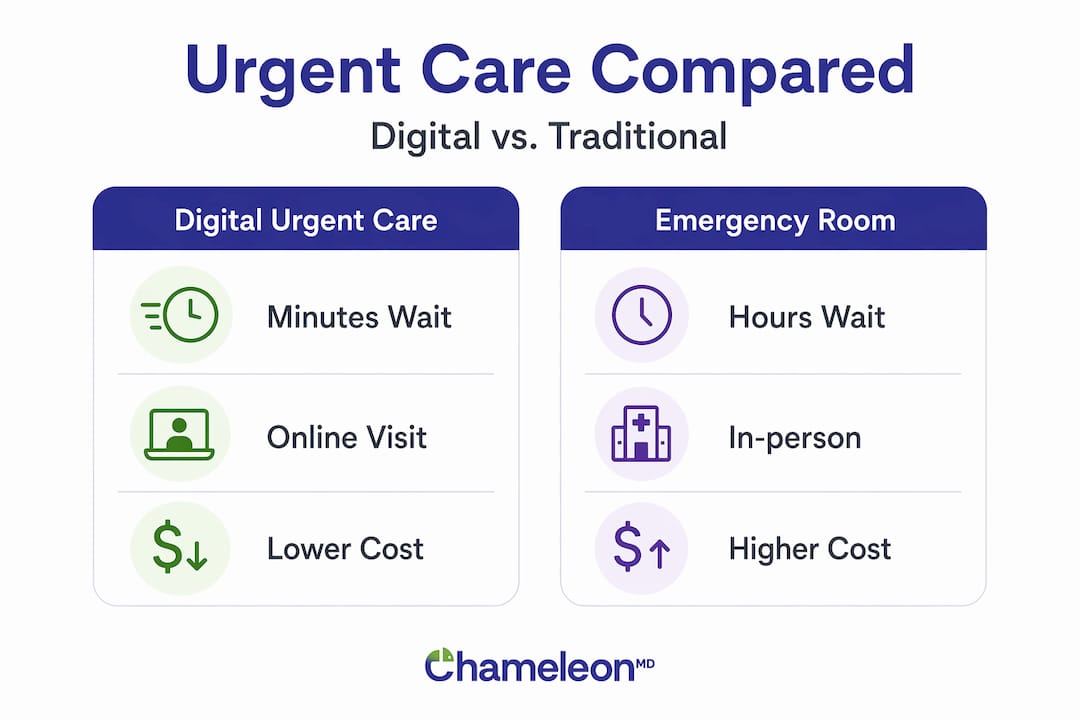
Here’s a quick comparison to put it in context:
| Feature | Digital urgent care | Emergency room | Primary care |
|---|---|---|---|
| Wait time | Minutes | Hours | Days to weeks |
| Cost (uninsured) | Low to moderate | Very high | Moderate |
| Available 24/7 | Yes | Yes | Rarely |
| Handles emergencies | No | Yes | No |
| Prescriptions | Yes | Yes | Yes |
| Insurance required | No | No | Often |
The benefits of telemedicine go beyond simple convenience. For the uninsured and underinsured, digital urgent care is often the most financially realistic option for getting timely help. It removes the geographic and financial barriers that cause people to delay care or skip it entirely, which can turn a manageable problem into a serious one. You can also learn more in our affordable urgent care guide to understand all the options available to you without insurance.
Understanding on-demand healthcare access is especially important for people who live far from clinics or those managing unpredictable schedules. If you want a broader picture of how this all fits together, our virtual healthcare explained resource is a helpful next read.

How a digital urgent care visit works: Process step-by-step
Now that you know what digital urgent care is, here’s how a typical visit actually goes from start to finish.
The process typically involves symptom intake, triage, clinician assessment, and may include prescriptions and follow-up instructions. Here’s how each step usually unfolds:
- Create an account or check in. Most platforms take just a few minutes to set up. You enter basic information like your name, date of birth, and the main reason for your visit.
- Complete a symptom questionnaire. You’ll answer a short series of questions about your symptoms, how long you’ve had them, and any relevant medical history. This step helps the clinician prepare before your visit begins.
- Triage review. Some platforms use AI-assisted tools to flag urgency levels, while others route you directly to a clinician queue. Either way, the goal is to match you with the right level of care quickly.
- Connect with a licensed clinician. Your virtual visit happens via video or phone. The clinician will ask follow-up questions, review your intake information, and assess your situation just like they would in an office.
- Receive your care plan. After the visit, you’ll get a clear diagnosis (when possible), treatment recommendations, and any prescriptions sent directly to your pharmacy of choice.
- Follow-up guidance. The clinician will tell you what to watch for, when to seek additional care, and whether you need any labs or imaging that require an in-person visit.
Pro Tip: Before your visit, jot down your symptoms, when they started, and any medications you’re currently taking. Having this ready cuts your visit time in half and helps the clinician give you a more accurate assessment.
Explore top virtual care treatments to see the full range of what’s covered online. And if you’re dealing with something specific, like a urinary tract infection, see how online UTI treatment can make the whole process even more straightforward.
What digital urgent care treats and what’s not covered
Not every health need is right for digital urgent care. Here’s how to know what’s safely handled online and what needs in-person attention.
Digital urgent care is designed for non-life-threatening conditions that require same-day attention, with clear guidance to direct patients to the ER or an in-person clinic for serious problems. That distinction matters a lot.
Conditions digital urgent care handles well:
- Sore throat, strep throat, and tonsillitis
- Sinus infections and nasal congestion
- Pink eye (conjunctivitis)
- Urinary tract infections
- Ear infections
- Skin rashes, insect bites, and mild allergic reactions
- Flu and cold symptoms
- Fever (without high-risk warning signs)
- Mild headaches and migraines
- Prescription refills for non-controlled medications
- Nausea, vomiting, and mild stomach issues
What digital urgent care cannot safely address:
- Chest pain or pressure
- Difficulty breathing or shortness of breath
- Severe bleeding or deep wounds
- Loss of consciousness or fainting
- Signs of stroke (facial drooping, arm weakness, speech difficulty)
- Severe abdominal pain
- High-impact injuries, broken bones, or head trauma
Online urgent care is simply not appropriate for true emergencies or issues that require physical exams or immediate imaging and procedures. If you’re unsure whether your situation qualifies, err on the side of caution and call 911 or visit your nearest ER.
When a hands-on exam is needed:
Some conditions fall into a gray zone. A sprained ankle may need an X-ray. Chest tightness might require an EKG. Abdominal discomfort could call for bloodwork. Even skilled clinicians working through a screen can’t do a physical examination or order immediate in-person lab work, so these situations typically require escalation.
Pro Tip: Use our urgent care checklist before your visit to help you decide whether digital urgent care, a walk-in clinic, or the ER is the right fit for your symptoms. It’s a fast, practical tool that removes the guesswork.
Understanding when telemedicine is recommended can also help you think proactively about your care options, especially if you’re making decisions for a family member.
Is digital urgent care safe and effective? Real-world results
Given these differences and limitations, you’re probably wondering whether digital urgent care delivers real results. Let’s look at the data.
Research shows that digital urgent care can reduce wait times while maintaining similar quality and 3-day return rates compared to in-person care. That’s a meaningful finding because it suggests virtual care isn’t just convenient; it’s clinically comparable for the right conditions.
“Virtual urgent care visits have demonstrated comparable outcomes to in-person care for low-acuity conditions, with measurably shorter wait times and similar rates of follow-up visits, suggesting effective triage and treatment at the point of first contact.”
Here’s what the data looks like in practice:
| Metric | Digital urgent care | In-person urgent care |
|---|---|---|
| Average wait time | Shorter (up to 21 min less) | Longer |
| 3-day follow-up rate | Comparable | Comparable |
| Patient satisfaction | High | High |
| Prescription accuracy | Clinician-reviewed | Clinician-reviewed |
| Cost per visit (uninsured) | Lower | Higher |
What this means for you: If you have a sinus infection on a Sunday night, you don’t have to choose between suffering until Monday morning or paying hundreds at an ER. Digital urgent care gives you a third, smarter option: a licensed provider, a real diagnosis, and a prescription sent to your pharmacy, all within the same evening.
It’s worth noting that quality does vary across platforms. Not every telehealth service maintains the same standards. Look for services that employ licensed, board-certified providers and follow established clinical guidelines. A fast visit is only valuable if the clinical care behind it is solid.
Navigating safety, triage, and choosing the right digital urgent care
Even with promising outcomes, making digital urgent care safe and effective depends on how triage and clinical judgment are integrated. Here’s how to navigate it smartly.
Symptom checkers and self-triage tools vary in accuracy, and the safest systems embed clinician-led escalation rather than relying solely on automation. In other words, AI alone isn’t enough. The best platforms use automated tools to gather information and identify red flags, but a real clinician makes the final call.
Tele-urgent care performs best for low-acuity conditions, and safety and performance may not be standardized across all vendors. That’s why choosing the right platform matters.
Signs of a reputable digital urgent care platform:
- Clear credentials for all clinicians (licensed, board-certified)
- Transparent pricing before you start your visit
- A defined escalation process for serious symptoms
- Secure, HIPAA-compliant video technology
- Clear follow-up instructions after every visit
- Accessible support if questions arise after your appointment
Questions to ask before committing to a platform:
- Are the providers licensed in my state?
- What happens if the clinician determines I need in-person care?
- Can they send prescriptions to my local pharmacy?
- Is my health information kept private and secure?
- What does the visit cost, and are there hidden fees?
Weighing the virtual healthcare pros and cons for your specific situation is an important step before making digital urgent care your go-to. For most common, non-emergency needs, a well-built platform with licensed clinicians is a genuinely safe and effective choice. The key is knowing what to look for and what questions to ask before your first visit.
Understanding how support networks in virtual care can play a role is also worth exploring, especially for older adults or individuals navigating complex care situations on their own.
Our take: Why digital urgent care works best as a first step, not a universal solution
With this understanding of limits and strengths, here’s our take on where digital urgent care fits in real-world healthcare journeys.
Digital urgent care has genuinely changed what’s possible for people without insurance or those navigating gaps in coverage. For someone dealing with a UTI at midnight, a child with pink eye on a Saturday, or a persistent rash that showed up out of nowhere, this kind of access is not just convenient. It’s meaningful. It keeps people from delaying care, spending unnecessarily at the ER, or going without treatment because a clinic appointment isn’t available for two weeks.
But here’s the honest reality: digital urgent care is a first door, not a final destination. It works best when it connects you to the right level of care quickly, whether that means treating you directly or recognizing when you need something more. A platform that only tells you what you want to hear, without acknowledging its own limits, isn’t serving you well.
We also think there’s an under-appreciated benefit that goes beyond convenience. When you use digital urgent care regularly for minor issues, you build a health record and a relationship with providers who know your history. That continuity matters. It helps you catch patterns, track recurring symptoms, and make more informed decisions over time.
Think of digital urgent care as your healthcare first stop. It’s where most everyday, time-sensitive issues get handled efficiently, affordably, and with clinical confidence. But it should always be paired with the understanding that some problems require escalation, follow-up, or hands-on care. Explore low-cost options for urgent care to build out your broader care toolkit so you’re never caught without a plan.
The bottom line: use it early, use it wisely, and choose platforms that put licensed clinical judgment at the center of every visit.
Get care fast: Try digital urgent care with Chameleon
If you’re ready to experience the convenience and safety of digital urgent care, here’s how to get started.
Chameleon Healthcare makes it simple to get real medical care fast, without insurance, without waiting rooms, and without the financial stress of an ER visit. Our licensed clinicians are ready to help you address common health concerns the same day you reach out.

Whether you need help managing asthma symptoms or you’re looking for a flexible, ongoing care option through one of our telehealth plans, Chameleon is built to meet you where you are. Clear pricing, accessible care, and providers who actually listen: that’s what we’re here for. Start your visit today and get the care you need on your schedule.
Frequently asked questions
What common problems can digital urgent care handle?
Digital urgent care can address infections, rashes, fevers, mild injuries, and common prescription needs, making it a reliable option for a wide range of non-emergency acute conditions.
When should I avoid digital urgent care and go to an ER?
For chest pain, severe bleeding, trouble breathing, or loss of consciousness, always go to the emergency room because these situations require immediate, hands-on medical intervention that online care cannot safely provide.
How quickly can I get help with digital urgent care?
Most services offer prompt access within minutes, and data shows average wait times can be up to 21 minutes shorter than typical in-person urgent care clinics.
Is my information safe during an online urgent care visit?
Reputable digital urgent care platforms follow HIPAA regulations to protect your health information, but you should always confirm a platform’s security practices and privacy policies before sharing personal details.
Can digital urgent care prescribe medication?
Yes, if it’s medically appropriate, licensed clinicians can prescribe medication during a virtual urgent care visit and send it directly to your preferred pharmacy.