

TL;DR:
- Telehealth adoption has increased nearly threefold since 2020, driven by increased convenience, accessibility, and trust. It benefits underserved, busy, and rural populations by reducing costs, travel, and wait times, but faces limitations like digital divides and diagnostic accuracy concerns. Future growth depends on policy support, hybrid care models, and closing internet access gaps to ensure lasting transformation.
Not long ago, getting medical care meant clearing your schedule, sitting in a waiting room, and hoping your appointment didn’t run late. That model worked for decades, but it left a lot of people behind. Today, physician adoption of telehealth sits at 71.4% in 2024, nearly triple pre-2020 levels, and that number tells you something important: the way we access care has fundamentally changed. This guide walks you through why telehealth is growing so quickly, who benefits most, what the regulations actually say now, and where this all goes from here.
Table of Contents
- What’s fueling telehealth’s explosive growth?
- Who benefits most from telehealth—and why?
- How regulation and technology shape telehealth’s expansion
- Where telehealth meets reality: Limitations and new trends
- What most telehealth guides miss: The real secret to lasting change
- Affordable, fast virtual care—see what’s possible with Chameleon
- Frequently asked questions
Key Takeaways
| Point | Details |
|---|---|
| Convenience is key | Telehealth saves significant travel and waiting time for busy individuals and families. |
| Affordability expands access | Subscription and per-visit options make care possible for the uninsured and those seeking flexible, lower-cost solutions. |
| Policy and tech matter | Recent regulatory changes and emerging technology drive telehealth’s continued growth and effectiveness. |
| Know the limitations | While telehealth excels for many needs, risks like misdiagnosis and digital barriers remain for some. |
| Hybrid care is the future | The next phase blends virtual and in-person care for comprehensive, patient-centered health solutions. |
What’s fueling telehealth’s explosive growth?
The most obvious question is simple: why now? Telehealth existed before the pandemic, but it stayed on the margins. What changed wasn’t just necessity during a health crisis. It was the discovery that virtual care works well for a surprisingly wide range of conditions, and once patients and providers experienced it, very few wanted to go back.
The top telehealth trends show several clear growth drivers stacking on top of each other:
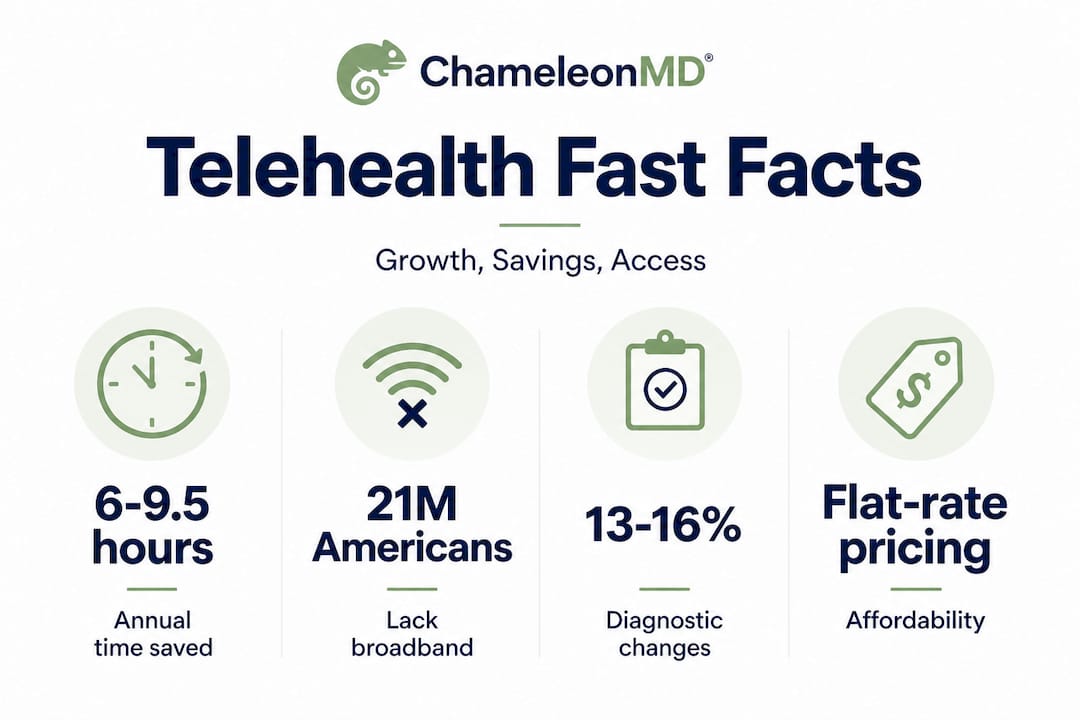
- Convenience and time savings: Patients save between 6 and 9.5 hours per year by skipping travel and waiting rooms. That’s real time back in your life.
- Accessibility for rural and underserved communities: When the nearest specialist is 90 minutes away, a video call isn’t a luxury. It’s a lifeline.
- Chronic disease management: People managing diabetes, hypertension, or asthma can check in regularly without disrupting their entire day.
- Mental health demand: With psychiatry showing an 85.9% telehealth adoption rate, virtual platforms have become the backbone of behavioral health access in the U.S.
- Lower friction for follow-up care: Routine prescription renewals, lab result reviews, and symptom check-ins no longer require an in-person trip.
Beyond convenience, there’s also a trust factor. Patients who used telehealth during the pandemic largely reported positive experiences. That word of mouth, combined with growing provider comfort, accelerated adoption across age groups and income levels faster than most health economists expected.
“Time savings alone don’t explain telehealth’s growth. The real driver is that millions of people who previously skipped care entirely now have a realistic way to access it.”
The data table below shows how key growth factors compare across care settings:
| Growth factor | Traditional in-person care | Telehealth |
|---|---|---|
| Average visit time (with travel) | 2-3 hours | 20-30 minutes |
| Same-day appointment availability | Rare | Common |
| Access for rural patients | Limited | Strong |
| Mental health provider reach | Geographically constrained | National |
| Cost transparency | Often unclear | Usually upfront |
You can also read more about the top telemedicine benefits if you want a deeper look at what makes virtual care worth considering for your own situation.
Who benefits most from telehealth—and why?
With the main drivers laid out, it’s worth zooming in on who’s actually gaining the most. The short answer is that telehealth isn’t equally helpful for everyone, but for specific groups, it’s genuinely transformative.
Uninsured individuals face the highest financial barriers to traditional care. Emergency room visits, specialist consultations, and even basic urgent care can cost hundreds or thousands of dollars without coverage. Telehealth changes that equation. Flat-fee pricing, transparent costs, and subscription models make it possible to get care for a sore throat, a rash, or a sinus infection without financial anxiety. As research shows, telehealth reduces travel, stigma, and cost barriers for uninsured users, and affordable subscription models make consistent care realistic rather than aspirational.
Busy professionals are another group with a lot to gain. If you’re balancing a demanding job, kids, and a packed calendar, finding two hours for a routine checkup feels impossible. Telehealth fits into a lunch break or even a quick pause between meetings. The flexibility to choose appointment times, connect from your car or home office, and receive follow-up notes digitally removes nearly every logistical obstacle.
Rural and underserved patients benefit in a different but equally important way. Provider shortages in rural America are severe, and improving healthcare access for these communities has long been a policy priority without a clear solution. Telehealth, when broadband access is available, bridges that gap meaningfully.
Here’s a quick comparison of how different users experience telehealth benefits:
| User group | Key benefit | Biggest barrier |
|---|---|---|
| Uninsured individuals | Affordable flat-rate pricing | No barrier if internet is available |
| Busy professionals | Flexible scheduling, no travel | None for most |
| Rural patients | Access to specialists | Broadband availability |
| Mental health patients | Reduced stigma, wider provider pool | Preference for in-person for some |
| Elderly users | Reduced mobility challenges | Tech literacy |
It’s worth being honest, though. Telehealth doesn’t reach everyone equally. People without smartphones, reliable internet, or basic digital literacy still face real barriers. Low-income users may lack broadband access, and older adults in certain areas may struggle with video platforms. Those are gaps the healthcare system still needs to address seriously.
Pro Tip: If you’re looking for telehealth with no insurance, search specifically for platforms offering transparent flat fees or membership plans. Many providers also offer mental health alternatives for affordable virtual therapy without insurance.
How regulation and technology shape telehealth’s expansion
Understanding who benefits sets up the next important piece: how government and technology actually made these changes stick. Telehealth’s growth didn’t happen in a vacuum. Specific regulatory decisions opened the door and kept it open.
Here are the most significant regulatory shifts shaping telehealth today:
- Permanent Medicare mental health flexibilities: The federal government made several pandemic-era telehealth waivers permanent for mental health services, allowing patients to receive virtual psychiatric and therapy care without in-person requirements.
- Private insurance parity requirements: Major insurers have expanded telehealth reimbursement significantly. In many states, insurers must now reimburse virtual visits at the same rate as in-person care for covered services.
- State licensing reciprocity agreements: Several states have joined interstate licensing compacts, making it easier for providers to treat patients across state lines without holding multiple licenses.
- Originating site rule changes: Under traditional Medicare, patients could only receive telehealth from specific approved locations. Recent rules have expanded where patients can connect from, including their own homes.
- Extended coverage timelines: Medicare regulations for 2026 have extended telehealth access provisions through 2026 and 2027, with certain services locked in permanently.
One specific number worth knowing: the Medicare originating site facility fee for 2026 is set at $31.85. This small payment goes to the facility where a patient receives telehealth care, and while it sounds technical, it matters because it keeps rural health clinics financially incentivized to offer virtual access points.

For people without insurance, these regulatory changes are indirectly helpful too. When Medicare and large insurers treat telehealth as legitimate and billable, more providers invest in virtual infrastructure. That investment brings costs down and increases the quality and availability of care across the board.
Pro Tip: Review your current health plan’s telehealth coverage before your next visit. Insurance rules around virtual care are changing rapidly, and you may have benefits you haven’t used. If you’re without coverage, explore on-demand healthcare platforms that price services transparently.
To understand more about how telemedicine works from a technical and practical standpoint, it helps to know what goes on behind a typical virtual visit.
Where telehealth meets reality: Limitations and new trends
Before drawing conclusions, it’s important to be honest about where telehealth falls short, and where it’s heading next. No healthcare model is perfect, and virtual care is no exception.
The most significant concern is diagnostic accuracy. Studies indicate that 13 to 16% of telehealth visits may result in misdiagnosis or a diagnostic change, particularly for conditions that require physical examination, lab work, or imaging. A skin rash visible on video, for example, may look different under a clinical light. A sore throat might need a strep test to confirm treatment.
“Telehealth is a powerful tool for a specific set of conditions and follow-ups, but it was never designed to replace the physical exam. The risk isn’t telehealth itself. It’s over-reliance without clear boundaries.”
Other real limitations include:
- The digital divide: An estimated 21 million Americans lack reliable broadband access, meaning telehealth’s reach isn’t universal.
- Privacy and data security: Sharing health information over video platforms raises legitimate concerns, and not all services meet the same security standards.
- Tech limitations for complex cases: Virtual platforms cannot perform physical exams, listen to your heart, or take your blood pressure in real time.
- Physician resistance: Some providers remain skeptical, particularly for specialties requiring hands-on assessment like orthopedics or dermatology.
- Scenarios that require in-person care: Chest pain, injuries, difficulty breathing, and new severe symptoms should always prompt a visit to an urgent care center or emergency room.
On the other side, emerging trends are making telehealth smarter and safer:
- AI-assisted triage: Artificial intelligence tools are helping providers identify which patients need in-person follow-up based on their symptoms and history.
- Wearables and remote monitoring: Devices that track heart rate, blood glucose, and oxygen levels feed real-time data into virtual visits, giving providers meaningful clinical context.
- Hybrid care models: The most promising trend is the combination of virtual and in-person care, where routine check-ins happen online and escalations move quickly to a physical setting.
- Telehealth for behavioral health: Mental health continues to be the strongest fit for virtual care, with evidence-based virtual therapy showing outcomes comparable to in-person sessions for many conditions.
For a balanced view of both sides, exploring telehealth pros and cons can help you decide when virtual care is the right call and when it isn’t.
What most telehealth guides miss: The real secret to lasting change
Here’s the part that most telehealth coverage gets wrong. The conversation focuses almost entirely on convenience, as if fast appointments and no waiting rooms are enough to sustain this transformation. They’re not.
The durability of telehealth depends on something less exciting but far more important: ongoing policy and regulatory support. The evidence is clear that convenience drives adoption for non-acute care, but over-reliance risks real harm if policy support reverses and providers lose access to proper reimbursement. Every time a telehealth extension deadline approaches in Congress, millions of patients face potential disruption. That’s fragile ground to build a healthcare system on.
The second thing guides miss is that hybrid care isn’t a compromise. It’s actually the best version of healthcare we’ve ever had access to. The idea that telehealth will fully replace in-person care is as flawed as the idea that it’s just a pandemic stopgap. The future is a thoughtful combination: virtual for routine care, follow-ups, mental health support, and medication management, and in-person for new symptoms, physical exams, and emergencies. If you want to understand how access affects outcomes, it’s the combination of access points that matters, not any single one.
Finally, the biggest gains in telehealth won’t come from better apps. They’ll come from closing the digital divide. Until rural patients, elderly individuals, and low-income households have reliable internet and basic tech support, convenience is only a partial answer. The technology is ready. The policy and infrastructure work is still catching up.
Pro Tip: Use telehealth for what it does best: routine visits, follow-ups, prescription renewals, and non-emergency concerns. For anything new, severe, or physically complex, see someone in person. That’s not a limitation. That’s smart, layered care.
Affordable, fast virtual care—see what’s possible with Chameleon
If you’ve made it this far, you already understand why virtual care is changing the healthcare experience for millions of people. The next step is knowing where to access it affordably and reliably.
Chameleon virtual care is built specifically for people who need fast, affordable, and accessible care without the hassle of traditional systems. Whether you’re uninsured, managing a busy schedule, or just tired of waiting rooms, Chameleon telehealth plans offer transparent pricing, same-day access, and licensed providers ready to help. You can browse virtual care options for common conditions like sore throats, sinus infections, rashes, UTIs, and more. No insurance required. No waiting. Just care that fits your life.
Frequently asked questions
How much time does telehealth save compared to traditional doctor visits?
Telehealth can save patients 6 to 9.5 hours a year by eliminating travel and waiting room time across multiple visits.
Is telehealth more affordable for people without insurance?
Yes, many telehealth platforms offer lower out-of-pocket costs and subscription models that make regular care realistic for uninsured individuals without unpredictable bills.
Are there risks to using telehealth for diagnosis?
Yes, 13 to 16% of telehealth visits may result in misdiagnosis or a diagnostic change, particularly for conditions that require hands-on physical examination or lab testing.
Will telehealth work if I live in a rural area with limited internet?
Telehealth is less accessible without reliable internet, and 21 million Americans currently lack broadband, making this a real barrier for some rural patients.
How will telehealth change over the next few years?
Hybrid models and AI tools are shaping the future, with wearables supporting chronic care monitoring and permanent policy changes locking in long-term access for virtual mental health services.