

TL;DR:
- Digital healthcare uses digital tools like telehealth, EHRs, wearables, and AI to improve medical care. It offers benefits like better access, cost savings, and enhanced chronic disease management but faces barriers from digital inequality. Success depends on user-centered design, interoperability, and active patient engagement.
Digital healthcare is the use of digital technologies, including telehealth, electronic health records (EHRs), wearable devices, and AI-powered diagnostic platforms, to improve how medical care is delivered and experienced. The industry term for this field is “digital health,” and it spans all stages of care, from prevention and diagnosis to treatment and long-term chronic condition management. If you have ever video-called a doctor, checked lab results through an app, or worn a fitness tracker that flagged an irregular heartbeat, you have already used digital healthcare. This article breaks down what it includes, why it matters, and what still needs to improve.
What is digital healthcare and what does it include?
Digital healthcare is defined as the integration of information and communication technology (ICT) into every layer of health services. It is not a single product or platform. It is a category that covers dozens of tools working across the full care cycle.
The core technologies fall into five groups:
- Mobile health (mHealth) apps: Apps like MyChart or Apple Health let patients track symptoms, schedule appointments, and receive medication reminders directly from their phones.
- Electronic health records (EHRs) and patient portals: EHRs store a patient’s complete medical history in digital form. Patient portals give individuals direct access to their own records, test results, and care notes.
- Wearable health devices: Devices like the Apple Watch, Fitbit, and continuous glucose monitors (CGMs) track heart rate, blood oxygen, sleep, and blood sugar in real time.
- Telehealth and telemedicine: Video visits, asynchronous messaging, and phone consultations connect patients with licensed providers without requiring an in-person trip.
- AI and machine learning platforms: Tools like Google’s Med-PaLM and IBM Watson Health apply algorithms to imaging, lab data, and patient history to support faster, more accurate diagnoses.
True digital transformation requires more than just deploying these tools. Interoperable, user-centered systems are what turn raw data into meaningful clinical decisions. Without interoperability, a wearable device and an EHR system may never communicate, leaving providers with an incomplete picture of a patient’s health.
Pro Tip: When choosing a telehealth platform or health app, check whether it connects directly to your existing EHR or primary care provider. Disconnected tools create extra work for you and your care team.
What are the main benefits of digital healthcare access?
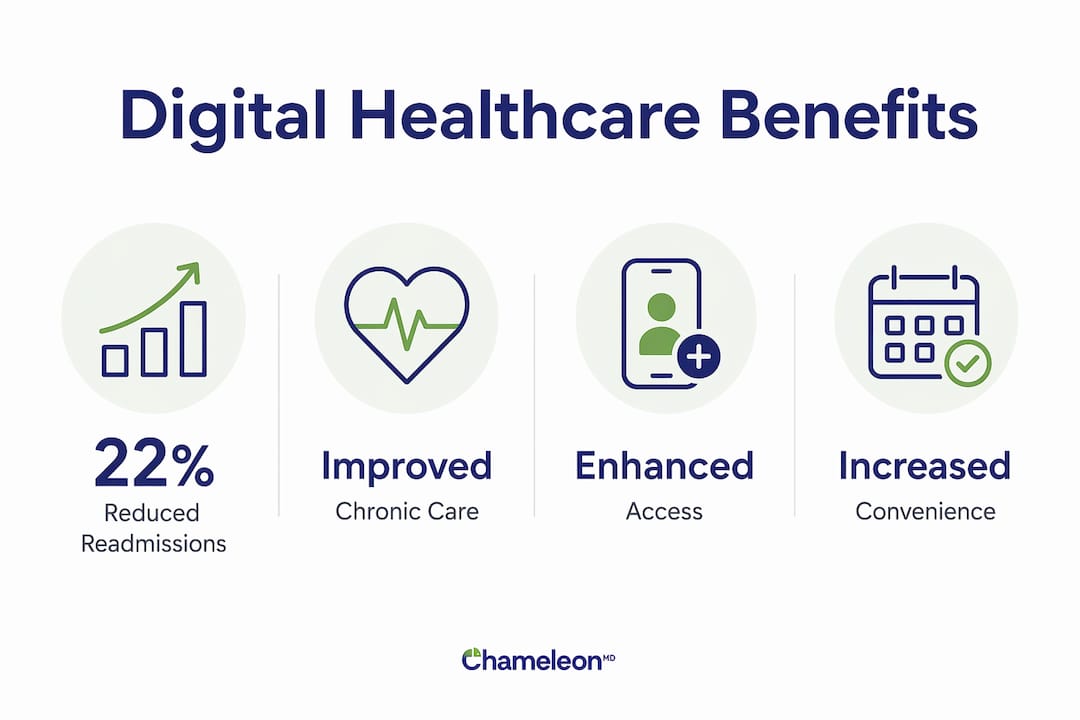
The benefits of digital healthcare access are concrete, measurable, and growing. Research published in 2025 confirms that telehealth models reduce consultation costs and improve chronic disease management outcomes. One of the most cited examples: telehealth programs have demonstrated a 22% reduction in heart failure readmissions. That single statistic represents thousands of avoided hospitalizations and billions in avoided costs.
The broader benefits include:
- Improved access for underserved populations: Patients in rural areas, those with mobility limitations, and people with demanding work schedules can reach a licensed provider without traveling hours to a clinic.
- Cost savings: Eliminating travel time, reducing emergency room visits, and shortening hospital stays all lower the total cost of care for patients and health systems alike.
- Higher patient engagement: Patients with active access to their records report higher satisfaction and a stronger sense of agency in managing their own health.
- Better care coordination: When providers share digital records in real time, handoffs between specialists, primary care physicians, and urgent care teams become faster and safer.
- Proactive chronic disease management: Remote monitoring tools let providers catch warning signs, such as rising blood pressure or irregular glucose levels, before they become emergencies.
The advantages of telemedicine extend well beyond convenience. For patients managing asthma, diabetes, or heart disease, consistent digital touchpoints replace the gaps that used to exist between quarterly in-person appointments.
What challenges and barriers exist in digital healthcare adoption?
Digital healthcare does not reach everyone equally. Access is shaped by digital literacy, community infrastructure, and economic factors. A patient without reliable internet, a smartphone, or the skills to navigate a patient portal is effectively locked out of the benefits described above.
The major barriers include:
- The digital divide: Older adults, low-income households, and rural communities are disproportionately affected by gaps in device access and broadband connectivity. Digital literacy gaps leave some patients unable to use digital health tools effectively, widening existing health disparities.
- Interoperability failures: When hospital systems, clinics, and apps cannot share data, fragmented care results. Patients end up manually carrying records between providers, which increases the risk of errors and delays.
- Usability problems: Many digital health tools are designed for tech-savvy users. Interfaces that are confusing or inaccessible push patients away from tools that could genuinely help them.
- Equity in system design: Health systems that deploy digital tools without accounting for social determinants of health risk building systems that serve the already-healthy and exclude the most vulnerable.
Understanding the equity challenges in healthcare access is a prerequisite for designing digital systems that actually work for everyone. Technology is only as good as the people it reaches.
Pro Tip: If you struggle with a health app or portal, ask your provider’s office about digital navigator support. Many health systems now offer staff or volunteers who help patients get set up and comfortable with digital tools.
How does digital healthcare transform the patient-provider relationship?
Digital healthcare shifts the patient from a passive recipient of care to an active partner in managing their own health. That shift is significant. It changes what providers expect from patients and what patients can expect from the system.
Here is how that transformation plays out in practice:
- Patients manage their own data. Through patient portals and health apps, individuals can review their own lab results, track trends over time, and arrive at appointments prepared with specific questions.
- Care becomes proactive, not reactive. Remote monitoring devices track conditions continuously. Providers receive alerts when readings fall outside safe ranges, allowing intervention before a crisis develops.
- Monitoring requires ongoing participation. Remote monitoring is not a passive technology. It works only when patients actively engage with the devices and respond to provider guidance.
- Coordination improves across care teams. Digital records shared in real time mean a specialist in one city can review the same data as a primary care provider in another, without a fax machine or a phone tag chain.
- Care delivery becomes more efficient system-wide. Fewer unnecessary in-person visits, faster triage, and better-informed clinical decisions reduce strain on hospitals and clinics.
“The future of healthcare is not about replacing the human relationship between patient and provider. It is about giving both sides better tools to make that relationship more effective, more informed, and more continuous.”
The future of healthcare technology points toward systems where digital tools handle the routine so that providers can focus on the complex. That is a meaningful shift for both sides of the exam table.
Key Takeaways
Digital healthcare works best when technology, equity, and human-centered design are treated as equally important priorities, not as separate concerns.
| Point | Details |
|---|---|
| Clear definition matters | Digital healthcare integrates ICT tools like EHRs, telehealth, wearables, and AI across all care stages. |
| Benefits are evidence-based | Telehealth reduces heart failure readmissions and improves chronic disease outcomes with measurable results. |
| The digital divide is real | Gaps in literacy, devices, and broadband exclude vulnerable patients from digital health benefits. |
| Interoperability is non-negotiable | Systems that cannot share data fragment care and shift the burden of coordination onto patients. |
| Patients must be active partners | Remote monitoring and digital tools require ongoing patient engagement to deliver real health improvements. |
My honest read on where digital healthcare actually stands
I have followed digital health closely for years, and the honest truth is this: the technology is not the hard part anymore. The hard part is everything around it.
Most of the tools exist. EHRs are widespread. Telehealth platforms are mature. Wearables are affordable. What consistently fails is the assumption that deploying technology is the same as transforming care. It is not. A patient who cannot read the interface, does not have broadband, or does not trust the system will not benefit from any of it. Human-centered system design is not a nice-to-have. It is the difference between a tool that helps and one that collects dust.
The other thing I think gets underplayed is patient burden. Remote monitoring sounds great in a press release. In practice, it asks patients to wear devices, respond to alerts, log data, and stay engaged with their health every single day. For someone managing a chronic condition while also working, raising children, or dealing with financial stress, that is a real ask. Systems need to be designed with that reality in mind, not the ideal patient who has unlimited time and a strong WiFi signal.
The promise of digital healthcare is genuine. But it will only be realized when health systems stop measuring success by the number of tools deployed and start measuring it by who actually gets better.
— Vector
See digital healthcare in action with Chameleonhc
Chameleonhc puts the core promise of digital healthcare into practice every day. You can connect with a licensed provider from your phone or computer, get a diagnosis, and receive treatment for common conditions like sore throats, sinus infections, rashes, and more, all without insurance or a waiting room. Same-day access, clear pricing, and no unnecessary barriers. Chameleonhc combines urgent care, primary care, and membership-based plans into one straightforward experience. Browse conditions treated online to see what you can address today, or explore telehealth membership plans built for ongoing, affordable care.
FAQ
What is the definition of digital healthcare?
Digital healthcare is the integration of digital technologies, including telehealth, EHRs, wearable devices, and AI platforms, into medical care delivery. It covers prevention, diagnosis, treatment, and chronic condition management.
How does telehealth fit into digital healthcare?
Telehealth is one of the most widely used components of digital healthcare. It connects patients with licensed providers through video, phone, or secure messaging, removing the need for in-person visits for many common conditions.
What are the biggest barriers to digital healthcare adoption?
The digital divide is the primary barrier. Gaps in internet access, device availability, and digital literacy prevent many patients, particularly older adults and low-income households, from accessing digital health tools effectively.
Does digital healthcare improve health outcomes?
Yes. Research shows telehealth models produce a 22% reduction in first-time heart failure readmissions and improve chronic disease management outcomes. Patient engagement also increases when individuals have direct access to their own health records.
Is digital healthcare the same as telemedicine?
No. Telemedicine refers specifically to remote clinical consultations. Digital healthcare is the broader category that includes telemedicine along with EHRs, wearable monitors, mobile health apps, and AI-assisted diagnostics.