

TL;DR:
- Urgent care memberships provide predictable, flat-rate access to routine health services for uninsured or high-deductible patients.
- They are not insurance and do not cover major medical events, hospital stays, or surgeries.
- Using memberships as part of a layered healthcare strategy can reduce bill anxiety and improve timely care.
Getting an urgent care bill with no insurance can feel like spinning a roulette wheel. The same visit for a sinus infection can cost $80 at one clinic or $350 at another, and you won’t know until the bill arrives. That kind of uncertainty makes people skip care entirely, which only leads to bigger problems down the road. Urgent care memberships are changing that dynamic. This guide explains exactly what they are, how they compare to traditional options, and how to decide if one makes sense for you.
Table of Contents
- What is an urgent care membership?
- How urgent care memberships work: Typical features and coverage
- Urgent care membership vs. health insurance: Key differences
- Is an urgent care membership worth it?
- Why urgent care memberships change the healthcare game for the uninsured
- Affordable care at your fingertips: Try a membership today
- Frequently asked questions
Key Takeaways
| Point | Details |
|---|---|
| Predictable costs | Urgent care memberships offer set fees, so you’re not surprised by unexpected charges. |
| Not full insurance | These plans handle minor illnesses and injuries, not hospital stays or surgery. |
| Good for frequent users | Memberships are most cost-effective for those who use urgent care multiple times a year. |
| Pair with other resources | Combine membership with free clinics or telehealth for broader coverage. |
| Review limitations | Always check what’s excluded from coverage before enrolling. |
What is an urgent care membership?
Now that you understand the problem with unpredictable urgent care costs, let’s clarify exactly what an urgent care membership is and why it exists.
An urgent care membership is a subscription-based healthcare plan that gives you access to medical services for a flat, predictable monthly or annual fee. Instead of paying a different amount every single time you walk through the door, you pay one consistent cost and know what you’re getting. Think of it like a gym membership, but for your health.
These plans became popular for a clear reason: the traditional fee-for-service model is confusing and stressful for people without insurance. You often don’t know the price until after the visit. As predictability for uninsured patients becomes a central concern in healthcare access, memberships have stepped in to fill that gap. They take the guesswork out of the process and give you something rare in healthcare: a price you can plan around.
Who benefits most from urgent care memberships?
- People without any health insurance coverage
- Workers with high-deductible plans who pay most costs out of pocket until they hit their deductible
- Freelancers, gig workers, and self-employed individuals
- Families who need frequent care but can’t afford traditional premiums
- Anyone who wants cost transparency before receiving care
“Knowing what you’ll pay before you see a doctor is not a luxury. For millions of uninsured Americans, it’s the difference between seeking care and avoiding it.”
If you’re currently managing urgent care without insurance, an urgent care membership may be one of the most practical tools available to you right now.
Common services included in most urgent care memberships:
- Diagnosis and treatment of minor illnesses like colds, flu, and strep throat
- Wound care and minor injury treatment
- Basic lab work and rapid diagnostic tests
- Treatment for rashes, ear infections, and urinary tract infections (UTIs)
- Prescription writing for common conditions
- Telehealth visits in many modern membership plans
The key word in all of this is predictability. When you know what you’re paying, you’re far more likely to seek care when you actually need it.
How urgent care memberships work: Typical features and coverage
With the basics in mind, let’s look more closely at how these memberships work and what you actually get for your fee.

Most urgent care memberships operate on a simple structure: you pay a monthly or annual subscription fee, and in return you receive either unlimited or discounted access to a defined set of services. Some plans charge a small co-pay per visit even after the membership fee, while others cover visits entirely within the subscription cost.
Here’s what’s typically included:
- Unlimited or discounted visits for common illnesses and minor injuries
- On-site or virtual consultations with licensed healthcare providers
- Basic lab tests such as strep tests, flu swabs, and urinalysis
- Prescription writing for common, short-term medications
- Follow-up visits for the same condition within a set window
What’s typically NOT included:
- Emergency room-level care or trauma treatment
- Advanced imaging like MRIs or CT scans
- Specialist referrals or specialist visits
- Surgeries or hospital admissions
- Ongoing management of complex chronic conditions like cancer or severe heart disease
- Mental health therapy or psychiatric care (unless specifically added)
Understanding these exclusions is just as important as knowing what’s covered. You don’t want to enroll expecting one thing and receive another.
Pro Tip: Before signing up, ask the membership provider for a complete list of covered services and any per-visit fees that apply on top of your subscription. A reputable provider will give you this information clearly and immediately.
Comparison: Urgent care membership vs. pay-per-visit
| Feature | Urgent care membership | Pay-per-visit (no insurance) |
|---|---|---|
| Cost predictability | High | Low |
| Monthly cost | $20 to $100+ | Varies, often $100 to $300 per visit |
| Lab fees | Often included or reduced | Billed separately |
| Telehealth access | Often included | Separate fee |
| Wait time | Same-day or next-day | Varies by clinic |
| Annual value for frequent users | Strong | Costly |
You can also review a detailed urgent care covered services breakdown to compare what specific plans include and exclude before you commit.
The bottom line is that urgent care memberships are built for people who use care regularly or want the peace of mind of knowing what to expect when health concerns show up unexpectedly.
Urgent care membership vs. health insurance: Key differences
Understanding what’s included in a membership sets the stage for this crucial comparison: urgent care memberships versus health insurance.
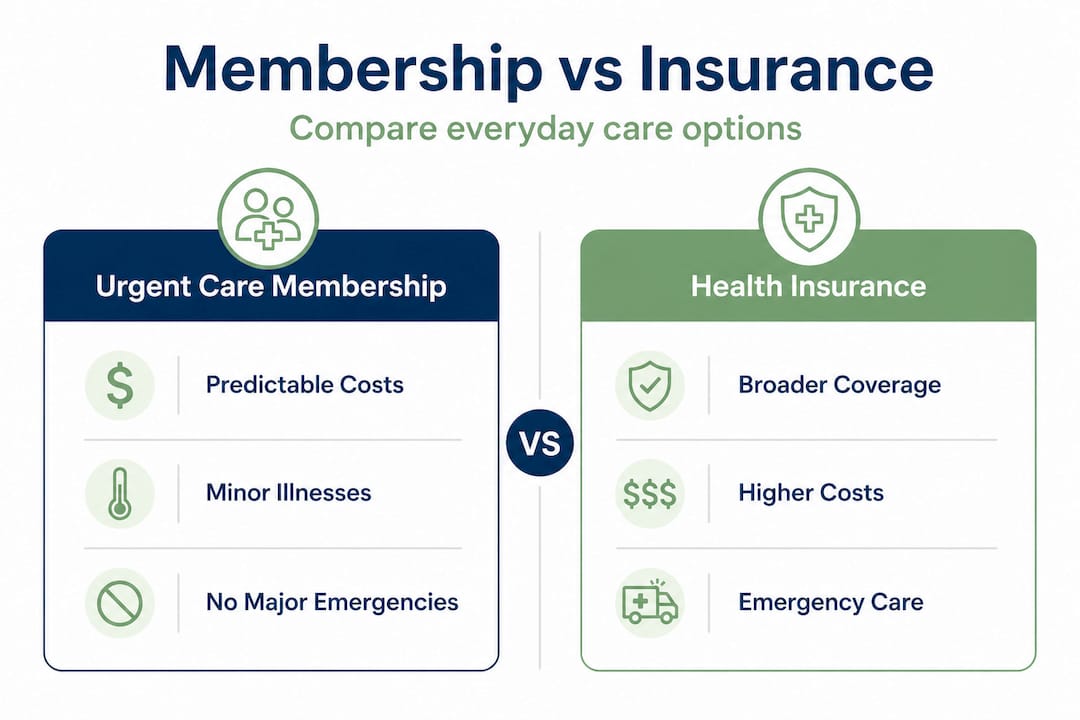
This is where a lot of people get confused, and it’s worth being very clear. An urgent care membership is not health insurance. It does not protect you from catastrophic financial risk the way a full insurance plan does. If you break your leg, need surgery, or end up hospitalized, your urgent care membership will not cover those costs.
What health insurance covers that memberships don’t:
- Hospitalization and surgical procedures
- Specialist visits and referrals
- Catastrophic or emergency events
- Mental health and substance use treatment (required by law under most plans)
- Preventive screenings like mammograms and colonoscopies
- Prescription drug coverage for ongoing medications
What urgent care memberships often do better:
- Transparent, flat-rate pricing for routine care
- No deductibles to meet before care kicks in
- Faster access with shorter wait times
- Simpler enrollment with no underwriting or health history review
- Accessible telehealth options for minor conditions
Pros and cons of urgent care memberships:
- Pro: You know exactly what you’re paying before you go
- Pro: No insurance bureaucracy or claims process
- Pro: Great for frequent, minor health needs
- Con: No coverage for major medical events
- Con: Limited specialist access
- Con: Not a replacement for full coverage if you have complex health needs
Understanding what a telehealth membership offers is a smart next step, especially if virtual care fits your lifestyle. Many modern memberships now blend in-person and telehealth options for added flexibility.
For people who fall into the healthcare “gray area,” meaning they earn too much for Medicaid but can’t afford traditional premiums, affordable healthcare options like memberships paired with other resources can build a reliable safety net. Free and charitable clinics may also provide alternatives for primary or preventive needs, depending on your situation.
Pro Tip: Think of an urgent care membership as the everyday layer of your healthcare strategy, not the whole plan. Pair it with a catastrophic-only insurance policy or use free clinic resources for preventive care to round out your coverage.
Quick comparison: Who should consider each option?
| Situation | Best fit |
|---|---|
| Healthy adult, minor care needs | Urgent care membership |
| Chronic illness, frequent specialist visits | Full health insurance |
| Uninsured, needs affordable routine care | Urgent care membership |
| High risk of hospitalization | Full health insurance |
| Gig worker, unpredictable income | Membership + free clinic combo |
Is an urgent care membership worth it?
Once you recognize the differences, it’s time to answer the personal question: should you join an urgent care membership plan?
The honest answer is: it depends on how often you use care and what kind of care you need. But the numbers tell a compelling story for many people.
Consider a scenario where an uninsured adult visits urgent care three times a year for common issues like a sinus infection, a sprained ankle, and a case of strep throat. Without a membership, each visit might cost $150 to $300, totaling $450 to $900 in a single year. A membership plan priced at $50 per month costs $600 annually, but often includes discounted or zero-cost labs, telehealth visits, and follow-up care that would otherwise add up fast.
When an urgent care membership is most cost-effective:
- You visit urgent care two or more times per year
- You have a family with children who get sick regularly
- You’re an active adult who deals with minor sports injuries
- You manage a manageable chronic condition like seasonal allergies or recurring UTIs
- You want access to telehealth for quick consultations without surprise fees
The benefits of telemedicine are especially relevant here. Many membership plans now include virtual visits as standard, letting you connect with a provider from your phone without leaving home. That adds serious value for anyone with a busy schedule or limited transportation.
Potential downsides to watch for:
- Some memberships have geographic limitations and only work at specific clinic locations
- Plans with very low monthly fees may charge higher per-visit co-pays
- Coverage gaps can leave you with surprise bills if you assume too much is included
- Not all memberships include labs or prescriptions within the base fee
While memberships offer strong predictability, some may be better served by using free or charitable services for routine preventive care alongside a membership for acute (sudden illness or injury) needs.
Ask yourself these questions before enrolling:
- How many times did I visit urgent care in the last 12 months?
- Do I have a condition that causes recurring visits?
- What does this membership actually cover versus what I’ll still pay out of pocket?
- Is telehealth included, and does it cover my most common health concerns?
- Are labs and prescriptions bundled in, or billed separately?
If you’re answering “yes” to the first two questions, a membership is very likely worth the investment.
Why urgent care memberships change the healthcare game for the uninsured
You’ve gotten the facts. Now here’s what those of us who work in this space, and people who’ve lived through coverage gaps, genuinely believe about where urgent care memberships fit in the bigger picture.
The most important thing these memberships do is remove the fear of opening a bill. That fear is real. Millions of people delay or skip care entirely because they don’t know what they’ll be charged. That avoidance leads to small problems becoming serious ones, which ultimately costs more in emergency room visits and complications. Memberships interrupt that cycle.
But here’s what most articles won’t tell you: memberships work best as part of a layered strategy, not as a standalone solution. If you’re uninsured, the smartest move is to treat your membership as your everyday care layer, then build around it. Low-cost urgent care options and free clinics can handle preventive screenings and primary care, while your membership covers the unexpected sick days and injuries.
What most people overlook is that memberships don’t solve the emergency gap. A burst appendix or a car accident will still generate significant bills that a membership won’t touch. That’s not a flaw in the model. It’s just the reality of what these plans are designed to do. Going in with clear expectations means you get genuine value without any unpleasant surprises.
For people in the healthcare gray area, those who make slightly too much for Medicaid but can’t realistically afford marketplace premiums, urgent care memberships combined with free clinic access and even a basic catastrophic insurance plan represent a genuinely smart, practical approach to staying healthy without going broke.
Affordable care at your fingertips: Try a membership today
If you’ve been managing your health without insurance and paying unpredictable bills every time something comes up, there’s a better way to handle it. Chameleon Healthcare offers a telehealth-first membership model that puts licensed providers just a few clicks away, with clear pricing, no waiting rooms, and same-day access for the conditions that matter most.

Whether you’re dealing with a sore throat, a rash, a sinus infection, or something that just doesn’t feel right, our platform connects you with a provider who can diagnose and treat common conditions from your phone or computer. We’ve built our service around transparency and speed because we know that’s what you actually need when you’re not feeling well. Explore Chameleon Healthcare’s membership options today and find a plan that fits your life without the complexity or the surprise bills.
Frequently asked questions
Do urgent care memberships cover pre-existing conditions?
Most urgent care memberships cover standard visits for minor illnesses or injuries, but they may not cover ongoing management or treatments for serious pre-existing conditions. If you need regular care for a complex condition, free or charitable clinics may provide additional support for preventive and primary care needs.
Can I use my urgent care membership at any location?
Urgent care memberships are usually tied to specific clinic networks or locations, so always confirm which facilities are covered before you enroll. Some telehealth-based memberships offer broader access since care is delivered virtually rather than at a fixed clinic.
Are prescription drugs included in urgent care memberships?
Prescription coverage varies significantly by provider. Some memberships include basic, short-term prescriptions as part of the plan, while others require you to pay separately at the pharmacy. As memberships offer predictability for uninsured patients, always read the fine print on prescriptions before signing up.
What if I need care not covered by my membership?
If a service falls outside your membership coverage, you’ll likely pay out of pocket directly or need to seek other resources. Free and charitable clinics are often available for primary or preventive needs that memberships don’t address, and some providers offer sliding-scale fees based on your income.