

TL;DR:
- A large study found that expanding telemedicine did not increase healthcare costs or utilization, highlighting its role as an affordable care pathway. Telemedicine supports diagnosis, treatment, education, and monitoring remotely, improving accessibility especially for underserved populations. Effective virtual care requires proper preparation, understanding policy limits, and integrating hybrid models for optimal health outcomes.
Most people assume that adding a new way to access healthcare must cost more. But a large, multi-payer study covering 2019 to 2023 found that telemedicine expansion did not lead to significant increases in healthcare use or overall spending. That single finding reshapes what telemedicine actually means for you: not a premium add-on, but a practical path to care that fits your life and your budget. This guide breaks down the role of telemedicine in modern healthcare, what it can genuinely do for you, where its limits are, and how to use it well.
Table of Contents
- What is telemedicine and how does it fit into modern healthcare?
- How telemedicine improves affordability and access to care
- The realities and nuances of telemedicine use in practice
- Preparing for your telemedicine visit: what to expect and how to ensure smooth care
- Evaluating telemedicine’s impact: what research says about cost, quality, and patient satisfaction
- A fresh look at telemedicine: balancing technology with human connection
- Explore affordable telemedicine care with Chameleon
- Frequently asked questions
Key Takeaways
| Point | Details |
|---|---|
| Telemedicine definition | Telemedicine uses technology to remotely deliver healthcare services including diagnosis, treatment, and education. |
| Cost and access benefits | Telemedicine improves access for underserved patients and reduces emergency visits without increasing overall spending. |
| Hybrid care approach | Combining virtual and in-person care offers the best balance between convenience and clinical effectiveness. |
| Patient preparation vital | Preparing your technology and communication needs ensures smoother, more effective telemedicine visits. |
| Ongoing research needed | While promising, telemedicine’s long-term impact on health outcomes and costs requires continued study. |
What is telemedicine and how does it fit into modern healthcare?
Telemedicine is not a single product or app. It is a method of delivering care at a distance using technology. The World Health Organization defines it as healthcare delivered remotely using information and communication technology for diagnosis, treatment, prevention, education, and evaluation. That definition is broader than most people expect.
Think about what that covers in practice. A provider reviewing your rash over a video call, a follow-up appointment handled by phone, a prescription sent electronically after a chat consultation. All of that is telemedicine. And it sits within an even larger category called digital health, which also includes electronic health records, mobile apps, wearable devices, and AI tools. Telemedicine is one layer of that system, but it is often the most accessible entry point for patients.
Understanding virtual healthcare helps clarify what telemedicine supports across the care journey:
- Diagnosis: Providers can evaluate symptoms, review photos or videos, and form a clinical opinion remotely.
- Treatment: Prescriptions, care plans, and referrals can all be managed virtually for many common conditions.
- Education: Providers can coach patients on managing chronic conditions, medications, and follow-up steps.
- Monitoring: Remote patient monitoring devices allow ongoing tracking of vitals like blood pressure or blood glucose between visits.
The key insight here is that telemedicine is not a workaround. It is a legitimate, evidence-backed care model that extends what clinics and hospitals can do beyond their four walls.
How telemedicine improves affordability and access to care
Now that we understand what telemedicine is, let’s look at how it makes healthcare more affordable and accessible for many patients.

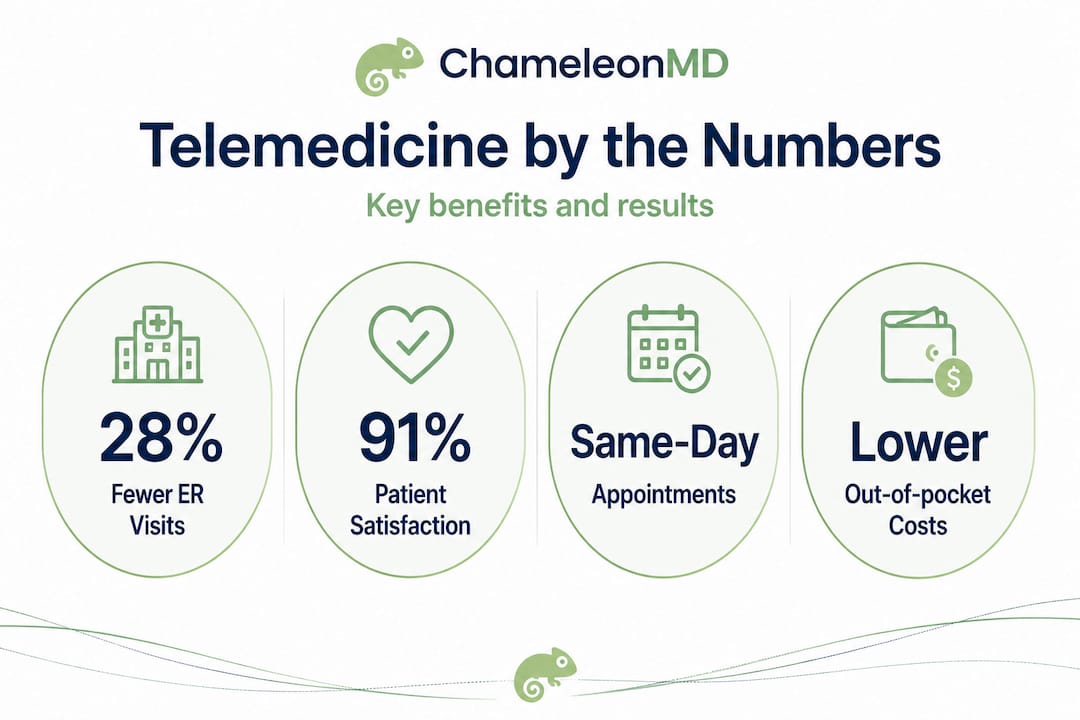
The numbers on this are worth knowing. Telehealth is associated with 28% fewer emergency visits and consistently high patient satisfaction, with 87% of patients reporting satisfaction and 75% saying they would use telehealth again. Fewer emergency room visits is not a small thing. ER visits are one of the most expensive touchpoints in the entire healthcare system, often costing thousands of dollars for conditions that could be managed elsewhere.
Access is the other side of the equation. Telemedicine benefits geographically isolated and underserved populations, enabling chronic disease management and specialty care without requiring patients to travel. For someone in a rural area who would otherwise drive two hours to see a specialist, a video visit is not just convenient. It is the difference between getting care and going without it.
Here is what the benefits of telemedicine add up to in everyday terms:
- No transportation costs: No gas, no parking, no rideshare fare to the clinic.
- No lost wages: Many virtual visits can happen during a lunch break or between meetings.
- Faster access: Same-day or next-day availability is common, especially for common conditions.
- Consistent follow-up: It is easier to keep follow-up appointments when there is no commute involved.
- Reduced exposure: No waiting rooms means less risk of picking up something else while you are already unwell.
For people without employer-sponsored insurance, or those who pay out of pocket, these savings compound quickly. Improving healthcare access through telemedicine is especially meaningful when every appointment comes with a direct cost that you can see and plan for.
Stat spotlight: 87% of patients who used telehealth reported being satisfied with their experience, and three in four said they would use it again.
Pro Tip: If cost transparency matters to you, look for telehealth providers that list their visit prices upfront before you book. Transparent pricing is one of the clearest signs that a platform is designed with the patient in mind, and it makes inclusive telehealth communication much easier to navigate.
The realities and nuances of telemedicine use in practice
While telemedicine offers real benefits, understanding its practical limits and navigating the policies around it is important for setting realistic expectations.
Here is what you need to know before your first (or next) virtual visit:
- Billing depends on how the visit is coded. CMS policies require specific place-of-service codes and provider billing practices that affect what patients pay. If you are on Medicare, the rules around where you can receive telehealth and what services are covered have changed several times in recent years.
- You may still need in-person services. A telehealth visit can diagnose and treat many conditions, but labs, imaging, and certain physical exams still require an in-person visit. Telemedicine reduces costs; it does not eliminate all of them.
- Hybrid care is the most effective model. Hybrid care models that combine virtual and in-person visits preserve the benefits of telemedicine while addressing its clinical limits. Think of telehealth as handling the moments that do not require a physical exam, and in-person care for the moments that do.
- Policies are still evolving. Telehealth coverage rules, especially for Medicare and Medicaid, have been extended and modified repeatedly since 2020. Staying current matters, both for patients budgeting care and for providers setting up their services.
| Care type | Best suited for telemedicine | Needs in-person visit |
|---|---|---|
| Sore throat, sinus infection | Yes | No (typically) |
| Rashes and skin concerns | Yes (with photos) | Sometimes |
| Mental health and therapy | Yes | Rarely |
| Blood work or imaging | No | Yes |
| Physical injury assessment | Limited | Yes |
| Chronic disease management | Yes (monitoring) | Periodic check-ins |
Understanding telemedicine pros and cons before you book helps you choose the right type of appointment and avoid surprises when a referral comes through.
Pro Tip: Before a telehealth visit for a condition that might need labs, ask your provider upfront whether any follow-up tests are likely. Knowing ahead of time lets you budget for the full episode of care, not just the virtual visit.
Preparing for your telemedicine visit: what to expect and how to ensure smooth care
With a clear picture of how telemedicine works, let’s look at how to prepare for your visit so it goes smoothly and delivers real value.
Good preparation makes a meaningful difference. Telehealth providers are required to supply effective communication aids, including qualified interpreters and accessibility tools, to avoid disruptions. Knowing your rights here matters, especially if you need language support or have hearing or vision accommodations.
Here is a practical checklist to get ready:
- Test your device and connection at least 15 minutes before the appointment. Camera, microphone, and internet speed all matter.
- Download or log into the platform ahead of time. Most platforms have a test function; use it.
- Write down your symptoms in order of when they started and how severe they feel. Providers can assess you faster when you describe clearly.
- Have your medication list ready. If you take any prescriptions or supplements, have them nearby or photographed so you can share them quickly.
- Request accommodations in advance if you need an interpreter or communication aid. Do not wait until the appointment starts.
- Find a private, quiet space where you can speak openly without interruption.
For more on getting the most from your appointment, the guides on telehealth visit preparation and telemedicine visit tips walk through common scenarios in practical detail.
Preparation also reduces the chance of reschedules, which matter both for your care and for continuity. When a provider has complete, accurate information from the start, they can make better decisions and you leave with a clearer plan. That is true whether you’re managing a sudden illness or checking in on a chronic condition. Knowing what to expect, and showing up ready, is one of the simplest ways to get more out of every virtual visit. And platforms that emphasize communication aids in telehealth can make that process feel a lot less complicated.
Evaluating telemedicine’s impact: what research says about cost, quality, and patient satisfaction
Having outlined patient preparation, now we turn to what research tells us about telemedicine’s real-world impact on health costs and quality.
The fear that telemedicine would flood the system with unnecessary visits turned out to be largely unfounded. A major study covering 2019 to 2023 found that telemedicine did not significantly increase healthcare utilization or spending. The data suggests that people use telemedicine as a substitute for care they would have sought anyway, not as an excuse to book more appointments.
| Research finding | What it means for you |
|---|---|
| No significant cost increase from telemedicine | You are not adding to your spending by switching to virtual care |
| 28% fewer ER visits with telehealth use | Virtual care intercepts expensive emergency use |
| 87% patient satisfaction rate | The experience consistently meets patient expectations |
| Telemedicine substitutes rather than supplements care | Usage reflects real need, not convenience-driven overuse |
“Telemedicine has not significantly increased healthcare utilization or spending.” This finding from a large, multi-payer study matters because it directly addresses the assumption that convenience leads to overuse. It does not, at least not at the population level.
The research on telemedicine research findings continues to grow, and the evidence so far is reassuring. But experts are clear that continued monitoring is needed, especially as policies evolve and usage patterns shift. What is certain is that telemedicine patient satisfaction remains high enough to indicate this is not a trend that will reverse itself. Patients value it because it works.
A fresh look at telemedicine: balancing technology with human connection
Here is a perspective that does not get said often enough: telemedicine is only as good as the intention behind its use.
Technology does not replace clinical judgment. It extends it. A provider who listens carefully, asks the right questions, and follows up appropriately delivers great care on a video call. A provider who rushes through a list of checkboxes does not, regardless of the medium. The platform is not the point. The relationship and the quality of communication are.
This matters most when you are thinking about cost. It is easy to calculate the price of a virtual visit. It is harder to account for what comes after it. CMS reimbursement policies shape what services can realistically be delivered remotely, and those boundaries influence cost predictability in ways that patients often do not see until after the fact. A transparent provider will tell you upfront when a virtual visit is likely to lead to an in-person follow-up. That kind of honesty is worth more than any promotional claim about savings.
The broader truth is that optimizing for cost in telehealth requires thinking about the full episode of care. Labs, imaging, referrals, and prescriptions are all part of what a visit might generate. The virtual consultation is the entry point, not the whole story. When you understand that, you can plan smarter and avoid the feeling of surprise that undermines trust in healthcare.
Hybrid care models, explored in detail in the hybrid care perspectives guide, represent the most honest answer to the question of what telemedicine can do. Not everything. But a lot. And when combined thoughtfully with in-person care, it becomes a genuinely better system than either approach alone.
Explore affordable telemedicine care with Chameleon
If what you’ve read here resonates, you are probably looking for a healthcare experience that respects both your time and your budget. Chameleon Healthcare is built exactly for that.
Chameleon’s virtual care plans are designed with transparent pricing and same-day access, so you know what you’re paying before you book and you do not spend your afternoon in a waiting room. Whether you need treatment for asthma or relief for a sprain or strain, licensed providers are ready to help from your phone or computer. No insurance required. No surprises. Just straightforward care that fits into real life, delivered by people who take your health seriously.
Frequently asked questions
Does using telemedicine mean my overall healthcare costs will increase?
No. Telemedicine has not led to increased healthcare use or higher costs, according to a large multi-payer study, and may actually help reduce expensive emergency visits.
What kinds of healthcare services can I get through telemedicine?
Telemedicine supports a wide range of services, including diagnosis, treatment, chronic disease management, behavioral health, specialty consultations, and follow-up care. Research confirms it effectively serves many care needs that previously required an in-person visit.
How should I prepare for a telemedicine visit to ensure it goes smoothly?
Test your device and internet connection ahead of time, log into the platform early, and request any necessary communication aids in advance to avoid disruptions during your appointment.
Can I use telemedicine for mental health care from my home?
Yes. Behavioral health telehealth can be delivered at home with no geographic restriction, and audio-only options remain available for eligible patients through at least 2027 under current CMS policy.
Will telemedicine fully replace in-person healthcare visits?
No, and it should not. Experts recommend hybrid care models that combine virtual and in-person visits to balance convenience with the clinical effectiveness that some conditions still require.