

If you need care right now, on-demand telehealth typically connects you with a provider within minutes. If you’re booking a scheduled virtual visit, plan for same-day to a few days for primary care, and anywhere from two to several weeks for specialty or mental health care. Across the board, telehealth tends to shorten your wait compared to in-person scheduling, and a recent systematic review backs that up with real numbers.
TL;DR:
- Telehealth’s on-demand urgent care typically connects patients within 5 to 20 minutes, serving as the closest alternative to walk-in clinics.
- Scheduled primary care appointments are usually booked within 1.8 to 2.3 days, which is significantly faster than in-person visits averaging 3.5 days.
- Median wait times for mental health and specialty telehealth range from 5 to 36 days depending on regional factors, with some states experiencing longer delays.
- Operational improvements like virtual text invites, flexible scheduling, and proactive communication significantly reduce waiting times and improve patient experience.
- Patients can often shorten wait times by choosing audio-only options, being established patients, and clearly communicating urgency during booking.
Table of Contents
- How Long Are Telehealth Wait Times, Really?
- What Actually Determines Your Telehealth Wait Time?
- How Do Providers Actually Cut Telehealth Wait Times?
- How Can You Get a Faster Telehealth Appointment?
- When Does Telehealth Still Mean a Long Wait?
- Why We Built Chameleon Healthcare Around These Bottlenecks
- Setting Realistic Expectations for Your Next Telehealth Visit
- Get Same-Day Telehealth Access With Chameleon Healthcare
- Sources
- FAQ
How Long Are Telehealth Wait Times, Really?
The honest answer depends entirely on what kind of visit you’re booking, so let’s break down what the research actually shows instead of relying on vague marketing promises.
On-demand urgent care telehealth, the kind where you open an app and get in a queue for the next available provider, generally runs 5 to 20 minutes from request to connection. That’s the closest thing telehealth offers to walk-in urgent care, minus the actual waiting room chairs.
Scheduled visits work differently, and the numbers get more interesting. A large-system analysis found that telephone visits averaged about 1.8 days between scheduling and appointment, video visits averaged roughly 2.3 days, and in-person visits averaged around 3.5 days. That gap between telephone and in-person, nearly two full days, shows up consistently in systems where the same clinicians offer both formats with comparable availability.
The most compelling evidence comes from a 2025 systematic review and quantitative analysis that pooled results across multiple studies. It found telemedicine interventions were associated with significant reductions in waiting times compared to conventional in-person care, with clinical specialty and surgical patients benefiting to differing extents. That’s not a rounding error. That’s the difference between waiting through an entire month or getting seen before the month is half over.
By the numbers: Telemedicine interventions cut waiting times by a weighted mean of 25.4 days overall, according to a pooled analysis of outpatient telemedicine studies, with clinical specialties seeing the largest average gains at 34.7 days.
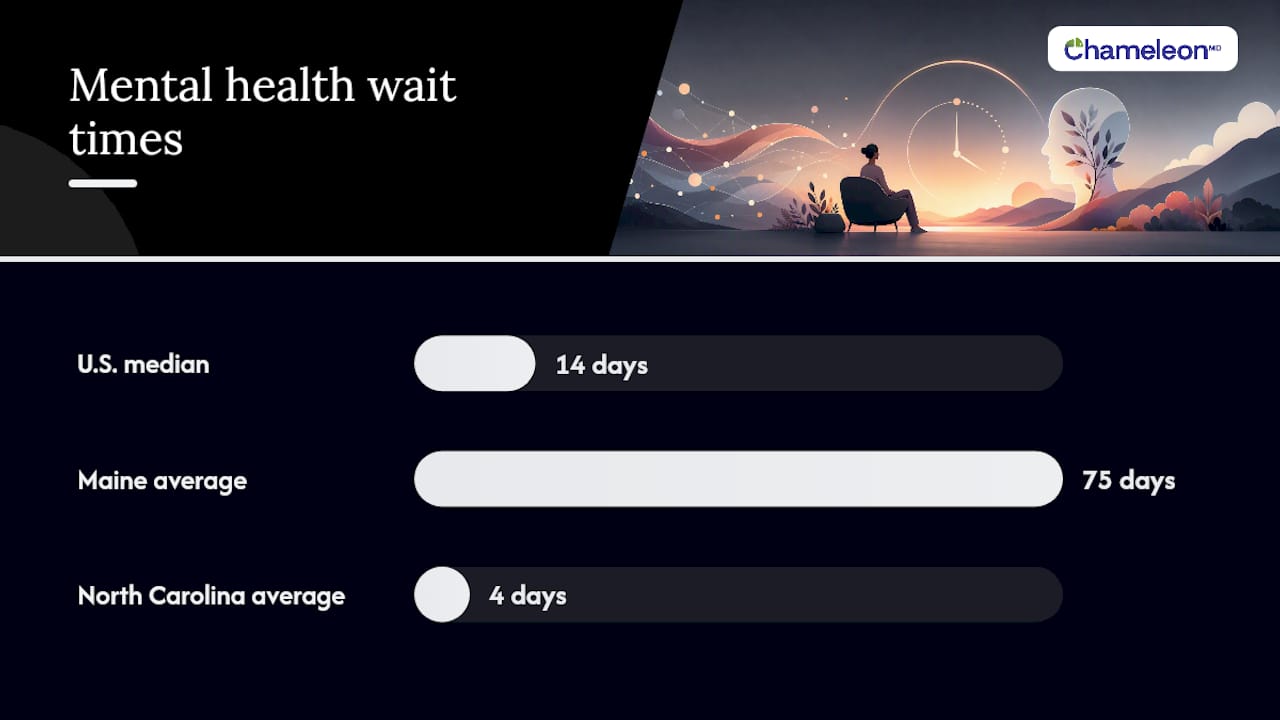
Mental health and specialty telehealth tell a more complicated story. A national secret-shopper survey of mental health treatment facilities found a median wait of 14 days for a first telehealth appointment, with an interquartile range stretching from 5 to 36 days. State-level variation was dramatic: some facilities in Maine reported waits as long as 75 days, while facilities in North Carolina averaged just 4 days. Telehealth clearly helps, but it doesn’t erase every regional bottleneck.
Here’s a quick breakdown of what the data suggests across common visit types:
- On-demand urgent telehealth: 5 to 20 minutes from request to provider connection
- Scheduled primary care (video or phone): roughly 1.8 to 2.3 days on average
- In-person primary care for comparison: around 3.5 days on average
- Specialty and mental health telehealth: median around 14 days, with a range of 5 to 36 days depending on location
- Post-telemedicine-intervention wait reduction: 25.4 days on average, with surgical patients gaining about 17.3 days
One distinction matters here, and it trips people up constantly: “time to appointment” and “wait during the visit” are two different clocks. Time to appointment is the calendar gap between when you book and when your visit happens, often measured in days. Wait during the visit is what happens once you’ve logged in and the provider is running a few minutes behind, typically measured in single-digit minutes. Both matter, but they answer different questions, and confusing them is why some patients feel misled by “fast” telehealth that still made them wait three days to get on the calendar in the first place.
What Actually Determines Your Telehealth Wait Time?
Wait times aren’t random. They’re shaped by a handful of factors you can usually spot before you even book, which means you can often predict, and sometimes influence, how long you’ll wait.
Visit type and clinical urgency set the baseline. An on-demand urgent care visit for a sore throat or sinus infection is built for speed, minutes, not days. A scheduled primary care checkup or a specialty consult follows a calendar, not a queue, so it inherits whatever lead time that provider’s schedule already has.
New versus established patient status changes everything. If you’re a returning patient with a file already on record, many systems can slot you in faster because the administrative groundwork is done. New patients often face longer lead times because intake paperwork, insurance verification, and history-taking add steps before a provider ever sees you. Rural telehealth research shows this gap clearly: established patients tend to get seen faster and no-show less often than first-time telehealth users.
Provider scheduling structure matters more than people realize. Clinics that rotate the same doctors between in-person and virtual duties often have less predictable virtual availability than clinics with dedicated telehealth clinicians. If a provider is squeezing video visits into gaps in an in-person day, expect more variability in when slots open up.
Technology and virtual waiting-room design shape your actual experience. A standard virtual waiting room, where you log in and stare at a static screen until someone lets you in, feels slower even when the underlying wait is short. Newer workflows, like the text-to-video invite model UCSD piloted, skip that holding pattern entirely by texting you a join link only when the provider is actually ready.
Policy, licensing, and connectivity create quiet regional disparities. State licensing rules limit which providers can treat you depending on where you’re physically located, which narrows your options in some states more than others. Broadband access plays a role too, since a shaky connection can turn a five-minute visit into a frustrating string of reconnect attempts.
Pro Tip: If a clinic’s booking page lets you filter by “next available” instead of a specific provider, use it. You’ll almost always get seen faster than if you wait for one particular doctor’s calendar to open up.
How Do Providers Actually Cut Telehealth Wait Times?
Some of the wait-time improvement you read about isn’t accidental. It’s the result of deliberate operational choices that clinics make, and understanding them helps you evaluate whether a provider’s “fast telehealth” claim is backed by real workflow changes or just marketing language.
-
Tele-Untethered scheduling. UCSD’s pilot program replaced the traditional virtual waiting room with a text-to-video invite system, where patients go about their day and get a link only when the provider is ready. The case study reported meaningful time savings per half-day session in a low-volume clinic setting, along with better patient flexibility since nobody had to sit frozen in front of a screen.
-
Schedule stacking. Instead of rigid, fixed-length appointment blocks, some clinics mix scheduled visits with flexible “untethered” slots that let providers absorb early cancellations or move faster through simple cases. This keeps clinician time from sitting idle when a scheduled visit runs short.
-
eConsults and nurse triage. Routing simple questions to a nurse or asynchronous messaging system before they ever need a full appointment reduces the volume competing for provider calendar slots. That frees up appointment availability for patients who genuinely need a live visit.
-
Asynchronous messaging for follow-ups. Not every concern needs a real-time video visit. Portal messaging for prescription refills, lab result questions, or minor follow-ups keeps low-acuity requests from clogging the same queue as urgent cases.
-
Clear, proactive communication. A survey of telehealth operations found that a meaningful share of virtual visits experience some delay, and many patients report hitting at least one friction point during a virtual visit. Clinics that send status updates, whether that’s a text saying “running 5 minutes behind” or a countdown in the app, measurably reduce how frustrating that wait feels, even when the actual delay doesn’t change.
If you want to see how these principles apply on the provider side, our telemedicine best practices checklist breaks down the specifics clinics use to keep patient flow moving.
How Can You Get a Faster Telehealth Appointment?
You have more control over your wait time than most people assume. Here’s what actually moves the needle, based on how these systems are built.
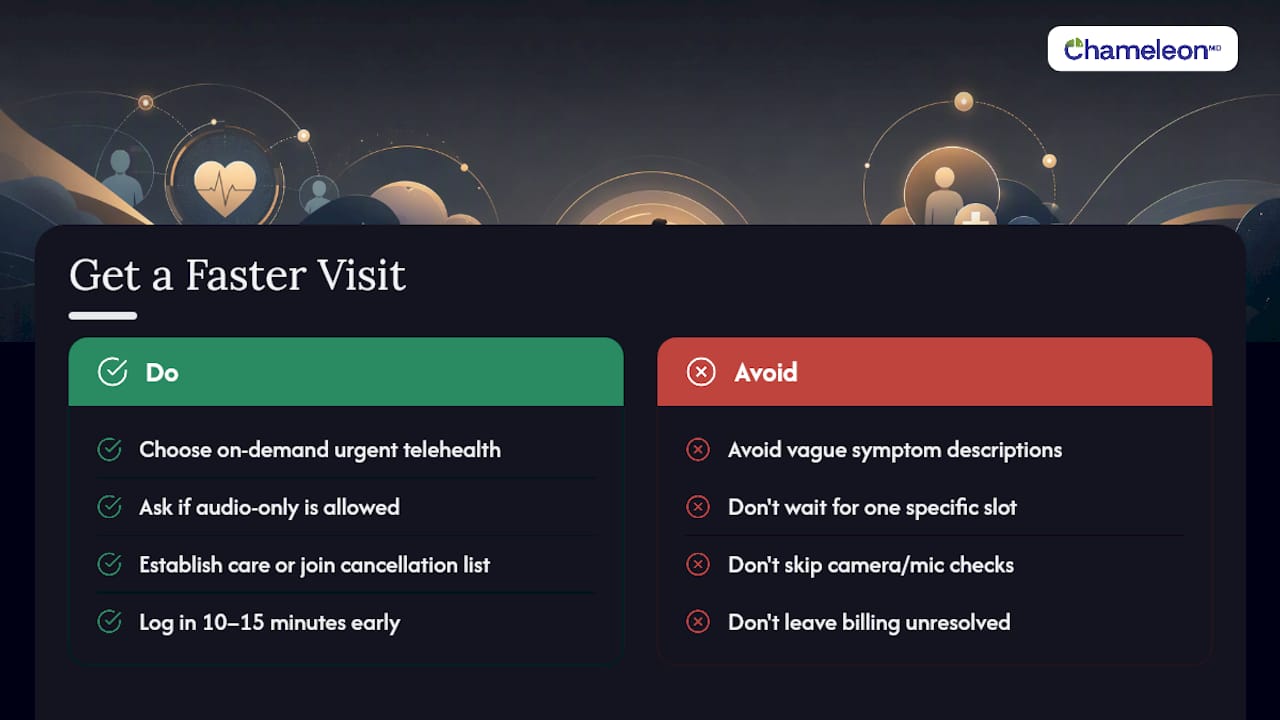
If you need care today, choose on-demand urgent telehealth over a scheduled visit whenever your symptoms are mild to moderate. On-demand queues are designed for speed, while scheduled calendars are designed for planning, and mixing up which one you need is the single most common reason people wait longer than necessary.
Ask directly whether audio-only is an option for your visit. Large-system data shows telephone visits sometimes carry shorter scheduling lead times than video visits, likely because phone slots are easier to fit into a provider’s day than video sessions that require more setup. If your concern doesn’t require a visual exam, audio-only can be your fastest path in.
Becoming an established patient with a provider or platform pays off the next time you need care. Systems tend to move returning patients through faster since the administrative work is already done. If a first-choice provider is booked out, ask the scheduler about a cancellation list or the next-available opening instead of holding out for one specific slot.
Be explicit about urgency when you book. Schedulers and intake systems often triage based on what you tell them, so vague descriptions get vague scheduling. Say clearly if you’re in pain, running a fever, or worried about something spreading.
Finally, treat your own tech setup as part of the appointment. HHS’s patient guidance recommends logging in 10 to 15 minutes early, testing your camera and microphone, and making sure your app is updated, since a failed connection is one of the most preventable reasons visits get delayed or rescheduled entirely. Confirm pricing and insurance details ahead of time too, since billing confusion at the start of a visit eats into your actual appointment time. If you’re not sure how the booking process works step by step, our guide on booking a telehealth appointment walks through it.
Pro Tip: Save a screenshot of your insurance card and ID in your phone before your appointment. Fumbling to find them mid-visit is a small thing, but it eats real minutes off a short appointment window.
When Does Telehealth Still Mean a Long Wait?
Telehealth narrows a lot of gaps, but it doesn’t erase geography, workforce shortages, or specialty bottlenecks. Knowing where the exceptions live helps you set expectations that match reality instead of marketing copy.
State-level variation is real and sometimes extreme. The same national mental health survey that found a 14-day median wait also found facilities in Maine averaging 75 days, compared to just 4 days in North Carolina. Broadband access, provider licensing rules that vary state to state, and how thinly specialists are spread across a region all factor into these gaps. Telehealth removes some geographic friction, but it can’t manufacture providers where none exist, and licensing restrictions across state lines still shape who you can actually see.
Mental health care is the clearest specialty exception. Despite widespread telehealth availability, demand for mental health services often outpaces provider capacity, which keeps median waits in the range of two weeks even when the appointment itself happens entirely online. The bottleneck isn’t the technology, it’s the number of licensed providers available to take new patients.
Equity concerns run underneath all of this. Telehealth adoption assumes reliable internet, a private space to talk, and comfort using a smartphone or laptop, none of which are universal. Patients in rural areas or lower-income households sometimes face a tougher tradeoff: telehealth might be faster on paper, but only if the connection holds and the device works.
A few situations call for skipping telehealth altogether:
- Chest pain, difficulty breathing, or signs of a stroke belong in an emergency room, not a video queue
- Injuries needing imaging, stitches, or a physical exam should go to urgent in-person care
- If a telehealth provider recommends escalation, don’t delay following through with a specialist or your primary care office
Telehealth is a strong first stop for most everyday concerns, but it’s a tool, not a replacement for judgment about when a situation needs hands-on care.
Why We Built Chameleon Healthcare Around These Bottlenecks
The research is consistent: patients wait less when clinics remove unnecessary steps between “I need care” and “a provider sees me.” Chameleon Healthcare’s model reflects that finding directly. Same-day access, no traditional waiting rooms, and membership or single-visit pricing exist because the biggest wait-time drivers in the data, scheduling friction, unclear pricing, and static virtual waiting rooms, are largely operational choices, not unavoidable facts of healthcare.
The parallels to the research are direct. Just as Tele-Untethered scheduling replaced static waiting rooms with on-demand invites, a telehealth-first model that doesn’t juggle in-person and virtual duties on the same calendar can offer more predictable same-day slots. Just as transparent pricing prevents the billing confusion that eats into appointment time, upfront costs remove one more friction point before you ever log in.
None of this means every visit is instant, and specialty referrals or complex cases may still require added time regardless of platform. But for the everyday concerns that make up most telehealth demand, sore throats, sinus infections, rashes, and similar common conditions, a model built specifically to avoid the scheduling and pricing friction the research identifies is a meaningful advantage over systems still bolting telehealth onto legacy in-person workflows.
Setting Realistic Expectations for Your Next Telehealth Visit
The evidence points to a clear pattern: minutes for on-demand urgent care, days for scheduled primary care, and potentially weeks for specialty or mental health visits, with telehealth generally coming out ahead of in-person scheduling across the board.
Choose on-demand telehealth when your need is immediate and your symptoms are common. Choose scheduled virtual visits when you’re managing something ongoing with a provider who knows your history. And don’t hesitate to escalate to an in-person referral when a telehealth provider tells you to, since knowing when to leave the video call is as important as knowing how to book one.
If you’re navigating a scheduling system, communicate your urgency clearly and ask specifically about telehealth-first options before assuming a long wait is your only choice. The data suggests you have more room to shorten that wait than you might think.
— Vector
Get Same-Day Telehealth Access With Chameleon Healthcare
A telehealth-first model that eliminates days-long waits for scheduled visits in favor of faster, same-day access can simplify care for common conditions, avoiding traditional insurance authorizations and virtual waiting rooms that keep patients waiting.
Pricing is upfront and simple: a Single Visit runs $55 with no membership required, or you can join the Single Adult Membership for $25 a month for ongoing unlimited virtual access, with a Family Membership available at $45 a month for households that want coverage for everyone. If your business is exploring coverage for a team, the Employer Plan extends the same same-day model to employees. Check Chameleon Healthcare’s plans page to compare options and get connected with a provider today.
This article is general information, not a substitute for advice from a qualified doctor. Consult a qualified healthcare professional about your own circumstances before acting on anything here.
Sources
- Reducing outpatient wait times through telemedicine: a systematic review and quantitative analysis
- Tele-Untethered: Telemedicine Without Waiting Rooms
- Association between visit type (telemedicine or in-person) and appointment timeliness in a large integrated system
- Availability and wait times for telehealth for mental health treatment facilities in the US
- Telehealth
FAQ
How long do I typically wait for a telehealth appointment?
It depends on the visit type: on-demand urgent telehealth usually connects you in 5 to 20 minutes, while scheduled primary care visits average 1.8 to 2.3 days and specialty or mental health visits can median around 14 days.
How long do you wait once you’re logged into a telehealth visit?
Most patients wait only a few minutes once they’ve joined the virtual session, though delays can happen if a provider is running behind on prior appointments, similar to an in-person clinic.
What is the 7-day rule for telehealth?
There’s no single, universal rule in telehealth about follow-up scheduling timing. Requirements for follow-up scheduling, prescription renewals, or referral timing vary by state, payer, and clinic policy, so check directly with your provider or platform for their specific timeline.
How long is too long to wait for a doctor’s appointment?
There’s no fixed universal standard, but research shows scheduled in-person visits average around 3.5 days to get on the calendar, compared to roughly 1.8 to 2.3 days for telehealth, so a multi-week wait for a common condition is a signal to consider a faster telehealth option.
Does Chameleon Healthcare offer same-day telehealth appointments?
Yes. Chameleon Healthcare is built around same-day access to licensed providers, with a $55 Single Visit option or memberships starting at $25 a month for individuals, detailed on the plans page.