

TL;DR:
- Effective telemedicine requires strict compliance, reliable technology, structured workflows, and strong communication to ensure safe and quality virtual care. Building staff confidence through phased implementation and ongoing training reduces errors and fosters patient trust in a virtual setting. Success depends more on people and processes than on advanced technology alone.
Telemedicine best practices are defined as the clinical, operational, and technical standards that ensure virtual healthcare delivery is safe, effective, and legally compliant. Following a structured telemedicine best practices list helps your team reduce compliance risk, improve patient outcomes, and maintain the same standard of care you would deliver in person. The most critical areas to address include HIPAA-compliant platforms, CMS billing standards like POS 10, state licensing requirements, and pre-visit patient preparation. Whether you are launching a new telehealth program or refining an existing one, these practices give you a clear framework to work from.
1. Meet licensing, legal, and compliance requirements first
Compliance is not a background task. It is the foundation every effective telemedicine strategy is built on, and skipping it creates legal and financial exposure that no amount of good technology can fix.
Start with state licensing. Providers must hold an active license in the state where the patient is physically located at the time of the visit, not where the provider practices. If your patient panel crosses state lines, look into the Interstate Medical Licensure Compact, which accelerates multi-state licensure for eligible physicians.
On the billing side, CMS policy currently permits Medicare telehealth services in patient homes with no geographic restrictions through December 31, 2027, using Place of Service code 10 for in-home visits. That extension gives your practice time to build compliant billing workflows, but the coding must be accurate from day one.
Key compliance steps to build into your workflow:
- Document the patient’s physical location at the start of every session. Healthcare legal experts identify this as one of the most common and costly compliance gaps in telehealth billing.
- Obtain and document telehealth-specific informed consent before the first visit.
- Use only HIPAA-compliant video platforms. Generic tools like FaceTime or Zoom’s free tier do not meet the standard.
- Confirm your malpractice coverage explicitly includes telehealth services. Many standard policies do not.
- Keep emergency protocols on file, including the patient’s physical address and local emergency contacts, for every active telehealth patient.
2. Build a reliable, HIPAA-compliant technology setup
Your technology setup either supports your clinical work or gets in the way of it. The goal is a configuration that runs quietly in the background so you can focus on the patient.
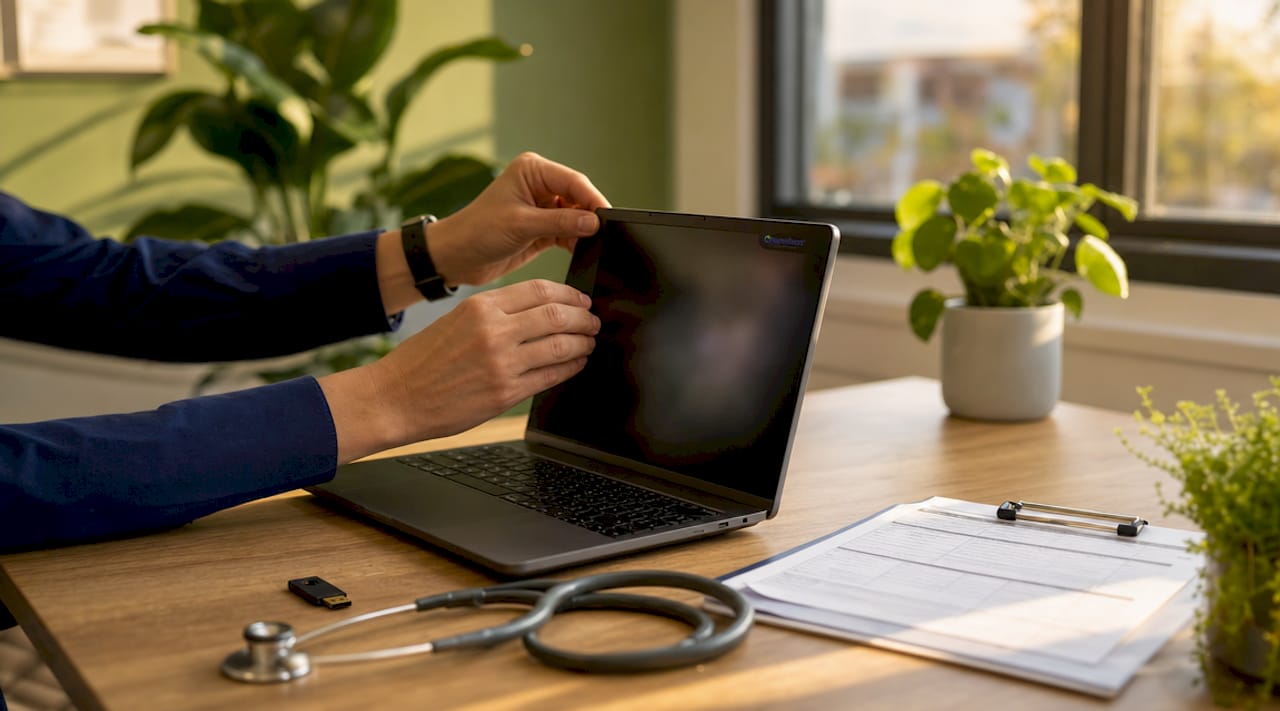
At minimum, your setup needs a HIPAA-compliant video platform with EHR integration, a stable internet connection of at least 10 Mbps for both upload and download, and a dedicated mobile hotspot as a backup in case your primary connection drops mid-session. Losing a connection during a sensitive conversation is disruptive and erodes patient trust.
For hardware, prioritize in this order:
- Audio first. A noise-canceling headset in the $50 to $100 range delivers the single biggest quality improvement for patients. Audio clarity ranks above video resolution in patient satisfaction, so this is the investment that pays off fastest.
- Camera second. A 1080p webcam positioned at eye level creates a natural, professional appearance.
- Lighting third. A simple ring light or a window positioned in front of you eliminates shadows and improves video quality without any technical complexity.
- Background and privacy. Use a clean, neutral background and conduct sessions from a private room with a closed door.
On the security side, activate two-factor authentication on all platforms, keep antivirus software current, and use encrypted connections for every session. These are non-negotiable under HIPAA.
Pro Tip: Run a full test session with a colleague before seeing your first real patient. Verify your video, audio, documentation workflow, and billing process all work together before you go live.
3. Standardize your clinical workflows for virtual visits
A telehealth visit without a defined workflow is just a phone call with a camera. Structured workflows are what separate a professional virtual care experience from an improvised one.
The most effective approach follows a team-based model. Assign a dedicated staff member to handle virtual rooming, which includes confirming the patient’s technology is working, collecting a chief complaint, verifying the patient’s current location, and reviewing medications before the provider joins. This mirrors the in-person rooming process and sets the provider up for a focused clinical encounter.
Team-based telemedicine workflows improve visit quality and reduce clinician burnout by distributing the administrative load. In safety-net clinics specifically, this model has been shown to improve preventive care metrics while reducing provider fatigue.
Build standardized documentation templates for your most common telehealth visit types. A sore throat visit, a medication refill, and a mental health check-in each have predictable documentation needs. Templates reduce cognitive load and improve consistency across your team.
- Create a pre-visit checklist for staff covering location verification, tech check, and chief complaint.
- Build visit-type templates in your EHR for the ten most common telehealth diagnoses.
- Define a clear escalation protocol for visits that need to transition to in-person care.
- Schedule a brief post-visit documentation window so providers do not carry charting into the next appointment.
4. Use communication strategies that build real patient rapport
Strong communication is what makes a telehealth visit feel like care rather than a transaction. Research confirms that interpersonal and team communication strategies are the primary drivers of patient engagement in virtual care, more so than the technology itself.
One of the most practical techniques is the dialogic loop. After explaining a diagnosis or treatment plan, ask the patient to repeat back their understanding in their own words. This confirms comprehension, surfaces misunderstandings early, and gives patients a sense of active involvement in their care.
Nonverbal communication still matters on a screen. Maintain eye contact by looking at your camera, not the patient’s image on your monitor. Nod to signal you are listening. Avoid typing while the patient is speaking, since the sound and visual distraction signals inattention even when you are documenting accurately.
Tailor your communication style to the patient’s comfort with technology. Some patients need a slower pace and simpler instructions. Others are confident and prefer efficiency. Reading that difference quickly is a skill worth developing.
“Providers often over-focus on technology but find that nonverbal and tailored communication drives successful telehealth sessions.” — Journal of Medical Internet Research
Send automated pre-visit reminders at least 24 hours before each appointment. This single step significantly reduces no-show rates and gives patients time to troubleshoot any technology issues before the session begins.
5. Reduce barriers for patients with limited digital access
Digital access is not equal across your patient population, and assuming it is will quietly undermine your telehealth program’s reach and equity.
Assign a digital navigator or trained staff member to support patients who are new to telehealth or who have limited comfort with technology. Dedicated orientation staff improve access for digitally underserved populations and reduce the likelihood of failed visits due to technical confusion rather than clinical need.
Offer a brief pre-visit orientation call for first-time telehealth patients. Walk them through how to join the session, what to have ready, and what to do if they lose connection. This takes five minutes and prevents a significant percentage of avoidable no-shows and failed visits.
Consider the telemedicine accessibility benefits that make virtual care so valuable for patients in rural areas, those with mobility limitations, and those without reliable transportation. Your workflows should be designed to serve these patients, not just the ones who are already comfortable with technology.
6. Follow a phased launch plan for new telemedicine programs
Rushing a telemedicine launch is one of the most common and most avoidable mistakes in telehealth implementation. A structured 12-week plan gives your team time to build correctly rather than fix problems after they affect patients.
| Phase | Timeline | Key activities |
|---|---|---|
| Licensing and compliance | Weeks 1 to 2 | State licensing, HIPAA review, malpractice confirmation |
| Platform and technical setup | Weeks 3 to 6 | Platform selection, EHR integration, hardware procurement |
| Staff training | Weeks 5 to 8 | Workflow training, documentation templates, communication protocols |
| Soft launch | Weeks 9 to 10 | Test sessions, small patient cohort, feedback collection |
| Full rollout | Weeks 11 to 12 | Full patient volume, metrics tracking, iterative review |
After launch, schedule a formal review at the 30-day and 90-day marks. Collect feedback from both patients and providers. Track metrics like no-show rates, visit completion rates, documentation accuracy, and patient satisfaction scores. Use that data to adjust workflows before scaling volume.
Pro Tip: Before your soft launch, run a complete test session that covers technology, documentation, billing, and patient onboarding from start to finish. Identify every gap before a real patient encounters it.
7. Invest in ongoing staff training and provider support
A well-trained team is what keeps a telemedicine program running well after the initial excitement fades. Technology changes, regulations update, and patient needs shift. Training cannot be a one-time event.
Build quarterly training refreshers into your calendar. Cover platform updates, coding changes, and any new telehealth guidelines from CMS or your state medical board. Providers who feel confident in the technology and the compliance requirements deliver better care and experience less frustration.
Create a clear internal resource library. This should include quick-reference guides for common billing codes, documentation templates, escalation protocols, and the contact information for your IT and compliance support. When a provider has a question mid-session, they need a fast answer, not a search through email threads.
Recognize that provider burnout in telehealth often comes from documentation burden and technology friction, not from the clinical work itself. Reducing those friction points through good training and workflow design protects your team and your program’s long-term sustainability. For a broader look at how telemedicine benefits translate into real operational value, the connection between staff confidence and patient outcomes is direct and measurable.
Key takeaways
Effective telemedicine requires compliance, technology, workflow, and communication to work together from the start, not as separate initiatives added over time.
| Point | Details |
|---|---|
| Compliance comes first | Document patient location, use HIPAA-compliant platforms, and confirm malpractice coverage before seeing any patients. |
| Audio quality drives satisfaction | A $50 to $100 noise-canceling headset improves patient experience more than any camera upgrade. |
| Team-based workflows reduce burnout | Dedicated virtual rooming staff improve visit quality and protect providers from administrative overload. |
| Communication beats technology | The dialogic loop and nonverbal attentiveness build more trust than any platform feature. |
| Phased launches prevent costly mistakes | A 12-week structured rollout reduces errors and builds provider confidence before full patient volume begins. |
What I have learned from watching telemedicine programs succeed and fail
The programs that struggle most are not the ones with bad technology. They are the ones that treated telemedicine as a feature to add rather than a care model to build. The compliance shortcuts, the skipped training sessions, the assumption that providers would figure out the communication piece on their own. Those are the patterns I see repeated.
What actually works is less glamorous than most implementation guides suggest. It is a staff member who calls a nervous first-time patient the day before their visit. It is a provider who looks at the camera instead of the screen and makes a patient feel genuinely heard. It is a billing coordinator who checks the place of service code on every claim because they understand what is at stake.
The technology matters, but it is a floor, not a ceiling. Once you have a HIPAA-compliant platform and a reliable connection, the quality of your telemedicine program is determined almost entirely by your people and your processes. The practices on this list are not complicated. They are consistent. And consistency is what builds patient trust in a virtual setting, where the usual cues of a physical office are absent.
If you are a healthcare administrator evaluating your current program, start with the compliance audit and the workflow review before you invest in any new technology. In my experience, most programs do not need better tools. They need better habits.
— Vector
Start delivering better virtual care with Chameleonhc
If you are looking for a telehealth model that puts these practices into action from day one, Chameleonhc is built around exactly that. The platform combines HIPAA-compliant virtual visits, same-day access, and transparent pricing into a care model designed for real clinical use.
Chameleonhc’s telehealth subscription plans give patients and providers a clear, affordable framework for ongoing virtual care without the friction of traditional insurance billing. Whether you are managing common acute conditions or supporting patients with chronic needs, the platform is designed to make virtual care feel as straightforward as it should be. Explore how Chameleonhc supports compliant, accessible telehealth for your patients today.
FAQ
What is the most important item on a telemedicine best practices list?
Compliance documentation is the most critical starting point. Documenting the patient’s physical location at every session start and using a HIPAA-compliant platform prevents the most common and costly telehealth errors.
How do you reduce no-show rates in telemedicine?
Sending automated reminders at least 24 hours before appointments is one of the most effective strategies for reducing telemedicine no-shows and giving patients time to resolve any technology issues in advance.
What internet speed is needed for reliable telemedicine?
A minimum of 10 Mbps for both upload and download is recommended for stable telehealth sessions, along with a dedicated mobile hotspot as a backup in case your primary connection fails.
How long does it take to launch a telemedicine program?
A structured 12-week implementation plan covers licensing, platform setup, staff training, and a soft launch phase, giving your team time to build correctly before reaching full patient volume.
Do providers need separate malpractice coverage for telehealth?
Yes. Standard malpractice policies often do not cover telehealth services. Providers should confirm with their insurer that virtual care is explicitly included in their coverage before seeing patients remotely.