

TL;DR:
- Technology in healthcare uses digital tools to improve patient outcomes, reduce errors, and increase access. It enhances care by centralizing data, speeding up diagnosis, and supporting clinicians with AI and telemedicine. However, successful adoption depends on addressing human factors, system design, and equity beyond technical implementation.
Technology in healthcare is defined as the application of digital tools, data systems, and clinical software to improve patient outcomes, reduce errors, and expand access to care. Electronic health records (EHRs), artificial intelligence (AI), and telemedicine now form the backbone of modern medical delivery. Together, they shape how providers diagnose, treat, and communicate with patients every day. Understanding the role of technology in healthcare helps you make smarter decisions, whether you are a clinician adopting new tools or a patient navigating a changing system.
How does technology in healthcare improve patient care?
Technology in patient care works by centralizing information, reducing manual tasks, and connecting people to providers faster than traditional systems allow. Before digital tools, a patient seeing three specialists might carry paper records between offices, with no guarantee that each provider had the full picture. Today, EHRs, AI-assisted diagnostics, and telehealth platforms work together to close those gaps.
The clearest benefit is speed. A licensed provider using an EHR can review a patient’s medication history, allergies, and recent lab results in seconds. That same provider can use an AI tool to flag a potential drug interaction before writing a prescription. These are not theoretical gains. They show up in fewer adverse events, shorter visits, and better follow-through on care plans.
For patients, the shift feels like finally being heard. When your provider already knows your history, you spend less time repeating yourself and more time discussing what actually matters.
What are electronic health records and why do they matter?
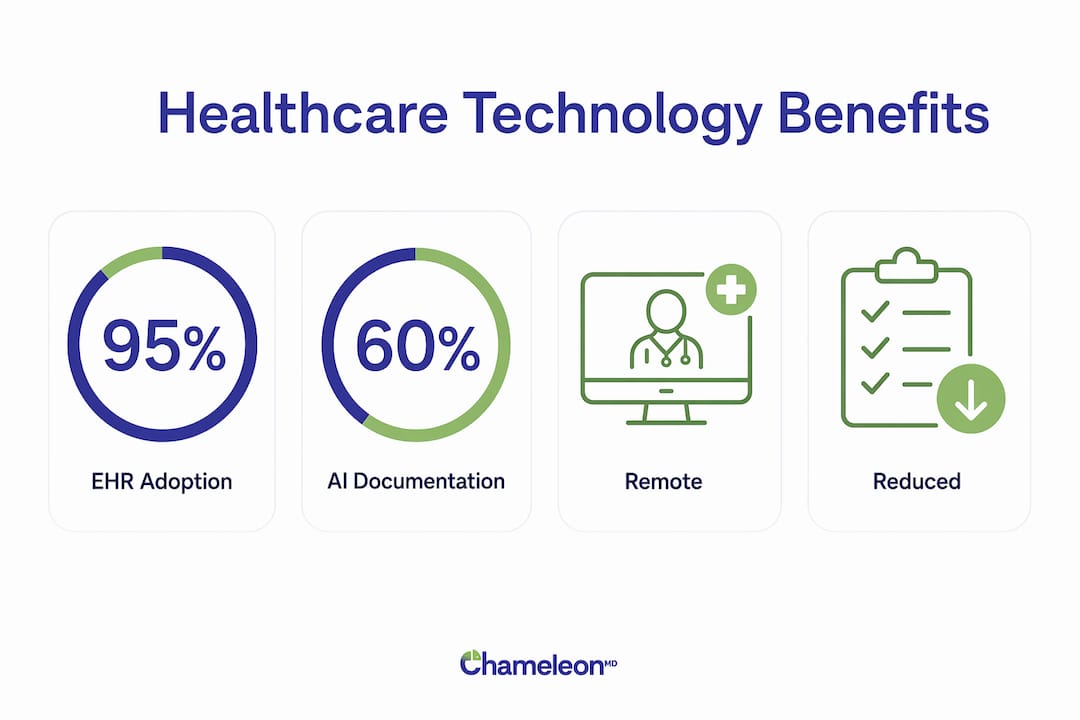
EHR adoption has reached at least 95% of healthcare practices in many developed countries. That near-universal uptake reflects how central digital records have become to clinical workflows. Yet the same data reveals a striking gap: only 18% of patients know they can access their own records online. High adoption on the provider side has not translated into patient engagement.
What ehrs actually do for clinicians
EHRs do more than store data. They provide clinical decision support, alerting providers to abnormal lab values, contraindicated medications, and overdue screenings. They also create an auditable record that protects both patient and provider. When care teams share access to the same record, coordination improves and duplicate testing decreases.
The interoperability problem is real, though. Lack of interoperability between different healthcare systems forces patients to act as manual data carriers between disconnected providers. A patient discharged from one hospital who sees a specialist at another may still need to hand-carry a printed summary. That is a system design failure, not a patient failure.
| EHR Benefit | Clinical Impact |
|---|---|
| Centralized patient data | Reduces duplicate testing and information gaps |
| Clinical decision support | Flags drug interactions and overdue screenings in real time |
| Shared care team access | Improves coordination across specialists and primary care |
| Audit trail | Supports accountability and legal documentation |
Pro Tip: If you are a clinician, make it a habit to walk patients through their portal during the visit. A 60-second demo at checkout dramatically increases the chance they will log in later and stay engaged with their care plan.
How is AI changing clinical practice?
AI in healthcare is not a single tool. It is a category of technologies that includes ambient listening, predictive analytics, imaging analysis, and natural language processing. Each application targets a different friction point in clinical work.

The most immediate impact for most clinicians is documentation. AI ambient listening automates clinical note generation, cutting the administrative burden that drives burnout. When providers spend less time typing, they spend more time with patients. That shift matters for care quality and for clinician retention.
Predictive analytics takes AI a step further. AI models can forecast patient outcomes and disease progression by analyzing historical and current data. A hospital using predictive tools can identify patients at high risk for readmission before discharge and intervene early. That is a concrete, measurable improvement in outcomes.
Here is where the nuance matters most:
- AI deployed to reduce repetitive tasks can rehumanize care by freeing clinicians to focus on the patient in front of them.
- AI used to replace clinical judgment creates risk. Algorithms trained on biased datasets can produce biased recommendations.
- Clinicians and patients should view AI as a support tool, not a substitute for human connection and judgment.
- Workflow design determines outcomes. AI that fits naturally into existing processes gets used. AI that disrupts workflow gets ignored.
Pro Tip: Before adopting any AI tool, ask the vendor one question: “What does the model do when it is uncertain?” A good AI system surfaces its own confidence level. A poor one presents every output with equal authority.
Does telemedicine actually expand healthcare access?
Telehealth uses digital communication technologies to allow remote healthcare access and management, expanding patient options well beyond traditional in-person visits. For rural communities, homebound patients, and people with demanding work schedules, that expansion is not a convenience. It is the difference between getting care and going without it.
The role of technology in healthcare access becomes most visible when you look at who benefits most from telehealth. Patients in areas without nearby specialists, people managing chronic conditions like asthma, and individuals who cannot take time off work all gain meaningful access through virtual visits.
Equity, though, is not automatic. Digital health systems must be designed with usability in mind, including multilingual support and low digital literacy accessibility, to truly improve equity. A telehealth platform that only works well on a fast internet connection with a modern smartphone excludes the populations that need it most.
Four practical steps improve telehealth equity:
- Design for low bandwidth. Platforms that function on slower connections reach more patients in rural and lower-income areas.
- Offer multilingual interfaces. Language barriers reduce engagement and increase the risk of miscommunication during virtual visits.
- Provide digital literacy support. Brief onboarding videos or live tech support lines reduce drop-off among first-time users.
- Meet patients where they are. Offering both synchronous video and asynchronous messaging gives patients flexibility based on their situation and comfort level.
The telemedicine benefits extend beyond convenience. When patients can see a provider from home, they are more likely to follow up on referrals, manage chronic conditions consistently, and catch problems early.
What barriers slow down digital health implementation?
Non-technical barriers such as organizational fragmentation, interoperability issues, and low digital literacy are the primary reasons digital health implementations fail. The technology itself is rarely the problem. The system around it usually is.
Understanding these barriers helps you anticipate where a rollout will struggle before it does:
- Fragmented governance. When no single authority owns the digital health strategy, decisions stall and funding gaps appear. Sustainability requires clear ownership.
- Low digital literacy. Patients and clinicians who are not comfortable with technology will avoid or misuse tools, regardless of how well those tools are designed.
- Cultural misalignment. A tool built for one population’s health behaviors and communication norms may not translate to another. Socio-cultural and organizational barriers affect sustainability and equity in ways that technical fixes cannot address.
- Trust deficits. Patients who do not trust that their data is secure will not engage with digital health platforms. Transparent data practices are a prerequisite for adoption.
- Interoperability gaps. Disconnected systems create fragmented care. When a primary care EHR cannot communicate with a hospital system, the patient pays the price in repeated tests and delayed decisions.
Patient engagement methods that account for these barriers from the start produce better adoption rates than those that treat technology as a neutral, universally accessible resource.
Key takeaways
Technology improves healthcare outcomes only when implementation accounts for human factors, system design, and equitable access alongside the technical tools themselves.
| Point | Details |
|---|---|
| EHR adoption is high but patient awareness is low | Only 18% of patients know they can access their records online, creating an engagement gap clinicians can close. |
| AI reduces documentation burden | Ambient listening tools free clinicians from note-taking so they can focus on patient interaction. |
| Telemedicine expands access with conditions | Equity requires multilingual, low-bandwidth design, not just a video link. |
| Non-technical barriers drive implementation failure | Governance gaps, low digital literacy, and cultural misalignment matter as much as software quality. |
| Interoperability is unfinished work | Disconnected systems still force patients to carry their own data between providers. |
Technology is a tool, not a guarantee
I have spent years watching healthcare organizations invest heavily in digital platforms and then wonder why adoption stalls six months after launch. The pattern is almost always the same. The technology works. The implementation does not.
What gets missed is the human layer. A clinician who feels like AI is watching over their shoulder will find ways to work around it. A patient who does not understand why their provider is looking at a screen instead of them will disengage. These are not edge cases. They are the norm when technology gets deployed without genuine attention to the people using it.
The most effective digital health deployments I have seen share one quality: they were designed with the end user in the room from the beginning. Not as an afterthought. Not as a focus group after the product was built. Clinicians and patients shaped the workflow before a single line of code was written.
AI is the area where I feel most strongly about this. The promise of AI rehumanizing care is real. Successful AI integration depends on designing workflows where AI handles administrative tasks so clinicians can focus on patients. But that only happens when the AI is built around the clinical relationship, not bolted on top of it.
The equity piece keeps me up at night more than anything else. Technology alone does not guarantee health equity. It must simplify access and usability to effectively reach underserved populations. Right now, too many digital health tools are built for the median user, which means they work well for people who already have good access and poorly for those who do not. That is the opposite of progress.
The path forward is context-sensitive implementation, continuous evaluation, and the humility to redesign when something is not working.
— Vector
See how Chameleonhc puts this into practice
Chameleonhc is built on the same principles this article describes: fast access, clear information, and care that fits your life. Whether you are managing a recurring condition like heartburn or reflux or dealing with something that came on suddenly, you can connect with a licensed provider from your phone or computer without a waiting room or insurance requirement.
Chameleonhc combines urgent care, primary care, and membership-based healthcare into one transparent model. Same-day access, clear pricing, and providers who actually have time to talk. Explore virtual care plans to find the option that fits your schedule and budget. Getting care should feel simple, and with the right technology behind it, it can.
FAQ
What is the role of technology in healthcare?
Technology in healthcare is defined as the use of digital tools, including EHRs, AI, and telemedicine, to improve patient outcomes, reduce errors, and expand access to care. It supports both clinical decision-making and patient engagement across every care setting.
How does telemedicine improve healthcare access?
Telemedicine uses digital communication to deliver remote care, removing geographic and scheduling barriers that prevent many patients from seeing a provider. Platforms designed for low bandwidth and multiple languages extend that access to underserved populations.
What are the biggest barriers to digital health adoption?
Non-technical barriers including organizational fragmentation, low digital literacy, and interoperability gaps are the leading causes of digital health implementation failure. Addressing governance and user experience is as important as choosing the right software.
How does AI support clinicians without replacing them?
AI handles repetitive tasks like documentation through ambient listening, freeing clinicians to spend more time with patients. When deployed thoughtfully, AI augments clinical judgment rather than substituting for it.
Why do so few patients access their EHR records online?
Despite near-universal EHR adoption among providers, only 18% of patients know they can view their records online. Closing this gap requires active clinician education and simpler portal onboarding, not just technical availability.