

TL;DR:
- Primary care offers ongoing health management, preventive care, and long-term condition tracking.
- Urgent care provides quick treatment for acute, non-life-threatening issues outside regular hours.
- Using a mix of both and telehealth options leads to better, cost-effective healthcare tailored to needs.
Choosing between primary care and urgent care feels straightforward until you’re actually sick and need answers fast. Many people assume these two options are basically the same, just different clinic names. But your choice affects how much you pay, how quickly you’re seen, and whether your long-term health improves or just gets patched up visit by visit. If you’re navigating healthcare without traditional insurance, understanding this difference isn’t just helpful; it’s essential. This article breaks down both models clearly, compares them side by side, and helps you figure out which one fits your situation and your budget.
Table of Contents
- What is primary care? Benefits and limitations for ongoing health
- What is urgent care? When convenience and speed matter
- Primary care vs urgent care: Side-by-side comparison
- How to choose: Matching your needs and scenarios
- What about telehealth? A modern affordable alternative
- Why flexible care models matter more than ever
- Explore affordable care options with Chameleon
- Frequently asked questions
Key Takeaways
| Point | Details |
|---|---|
| Primary care is essential | Ongoing, preventive relationship-based care leads to better health and fewer emergencies. |
| Urgent care offers speed | For acute, non-emergency medical issues, urgent care provides rapid, affordable care after-hours or without an appointment. |
| Telemedicine is flexible | Virtual care can meet many needs typically handled by primary or urgent care, especially when insurance isn’t available. |
| Choose according to scenario | Use primary care for ongoing needs, urgent care for immediate issues, and telehealth for convenience. |
What is primary care? Benefits and limitations for ongoing health
Primary care is your medical home. It’s where you go for the full picture of your health, not just one problem at a time. A primary care provider (PCP) knows your history, manages your long-term conditions, helps you stay well through preventive screenings, and connects you to specialists when needed. Think of it as the foundation your health is built on.
Here’s what primary care typically covers:
- Chronic disease management (diabetes, high blood pressure, asthma)
- Preventive care (annual physicals, vaccinations, cancer screenings)
- Wellness visits and health counseling
- Prescription management and refills
- Referrals to specialists
The benefits of having a regular PCP go beyond convenience. Continuity of care means your provider spots patterns, catches issues early, and helps you avoid expensive emergencies. Research shows that seeing a family physician rather than a walk-in clinic reduces emergency department visits by 10% within 7 days when something goes wrong. That’s a meaningful difference, both for your health and your wallet.
But primary care has real limitations. Most offices run on appointment schedules during standard business hours. If you’re sick on a Saturday night or need care the same day, your PCP may not be available. Building a relationship with a provider also takes time, which can feel like a barrier if you’re new to an area or haven’t had regular coverage.
Pro Tip: Even if you can’t see a PCP right away, the benefits of telemedicine include getting connected to a provider who can start building your health history from day one, no waiting room required.
What is urgent care? When convenience and speed matter
Urgent care is built for the moments when something can’t wait but isn’t a 911 emergency. These are walk-in clinics that treat acute, non-life-threatening conditions quickly and without requiring you to have an established relationship with a provider.
Common conditions treated at urgent care include:
- Infections: sinus, ear, urinary tract, strep throat
- Minor injuries: sprains, strains, cuts needing stitches
- Illness outside of office hours: fever, vomiting, rashes
- Diagnostics: X-rays, basic lab work
The advantages are real. Urgent care centers often have extended evening and weekend hours, no appointment needed, and upfront pricing. For people without insurance, that transparency matters. You’re not left guessing what the bill will look like. Check an urgent care checklist before your visit to make sure the clinic handles your specific need.

However, urgent care has clear limitations. Providers there don’t know your full history. They treat what’s in front of them. That’s fine for a sprained ankle but not ideal for managing a complex condition like diabetes or following up on a specialist’s recommendation. Research also shows that lacking a regular PCP increases walk-in and emergency department use by 17 times. Using urgent care as your only source of care isn’t a long-term strategy.
Pro Tip: If you don’t have a regular provider yet, explore affordable urgent care options to understand what’s covered and how to get quality care without overpaying.
Primary care vs urgent care: Side-by-side comparison
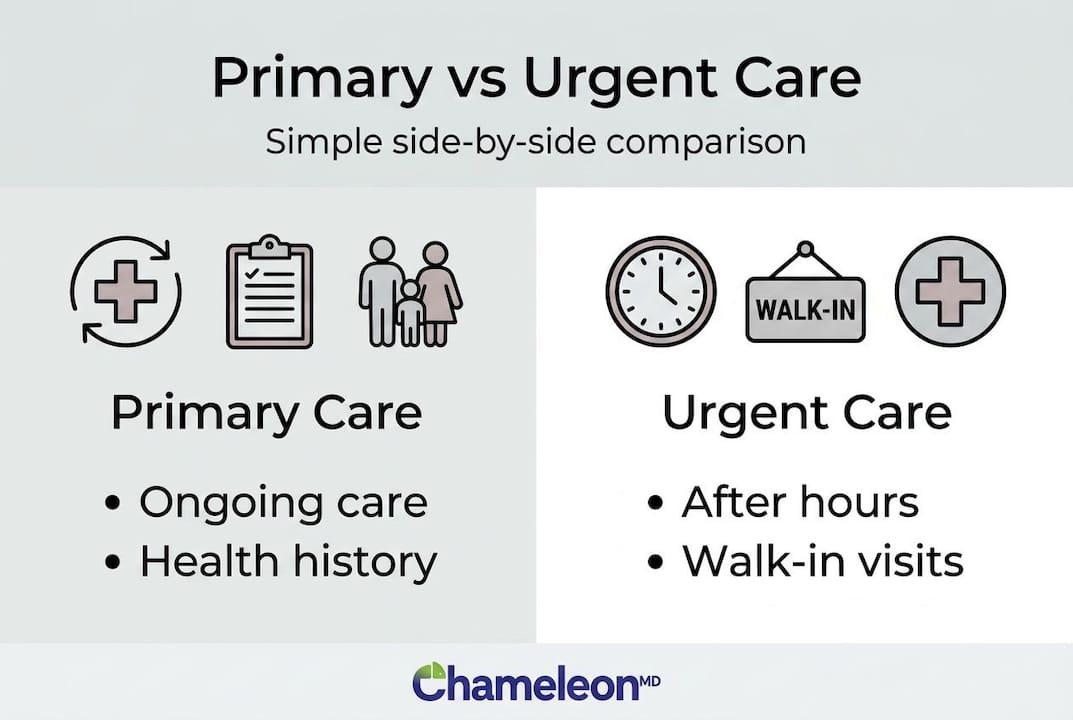
With both models explained, it’s worth seeing how they actually stack up against each other. Here’s a clear comparison across the factors that matter most.
| Factor | Primary care | Urgent care |
|---|---|---|
| Access | Appointment required, business hours | Walk-in, extended/weekend hours |
| Cost (no insurance) | Varies; often lower per visit with membership | Fixed, transparent pricing |
| Continuity | Strong; provider knows your history | None; each visit is standalone |
| Scope | Preventive, chronic, referrals | Acute, non-emergency conditions |
| Wait time | Can be days for appointment | Same day, typically under an hour |
| Best for | Long-term health, ongoing conditions | Sudden illness, after-hours needs |
One common myth is that urgent care is always more expensive than primary care. That’s not always true. Many low-cost urgent care clinics post flat fees that are far lower than a traditional doctor’s office visit billed through insurance overhead.
Another myth: primary care always requires a long-term relationship before you can be seen. Telehealth platforms and direct-pay practices are changing that.
Key stat: 30% of ER visits are preventable with timely access to primary or urgent care. Choosing the right setting not only saves you money but reduces strain on the entire system.
Where primary care clearly wins:
- Managing asthma, hypertension, or diabetes over time
- Getting referrals to specialists
- Preventive screenings and immunizations
Where urgent care clearly wins:
- Injuries or illness that happen on evenings or weekends
- When your primary care provider isn’t available and symptoms can’t wait
- Conditions needing quick diagnostics like X-rays
How to choose: Matching your needs and scenarios
A side-by-side view is helpful, but applying these choices to your real life makes all the difference. Here’s a simple way to think through your decision before you pick up the phone or drive to a clinic.
- Ask yourself: Is this urgent, semi-urgent, or preventive? If you’re running a high fever at 10 PM, that’s urgent. If you need a prescription refill and feel fine, that’s preventive. The severity and timing of your concern should guide your first step.
- Consider your symptoms: A sprained ankle after a weekend hike points to urgent care. Ongoing shortness of breath or recurring headaches point to primary care.
- Think about continuity: If this is a new issue that might need follow-up, primary care is better positioned to track your progress over time.
- Factor in cost and access: If you need care now and can’t wait, urgent care or telehealth keeps you from defaulting to an expensive ER visit.
- Check availability: Know which clinics are near you, their hours, and whether they accept direct-pay patients without insurance.
“Having a provider on record, even a virtual one, changes how quickly you can get the right care when something unexpected happens.”
Pro Tip: Learn how to schedule visits online before the weekend, especially if you manage a recurring condition. Being proactive saves you the stress of scrambling when symptoms flare.
Remember, lacking a regular PCP increases urgent care and ER use by 17 times. Even a simple virtual care plan can count as your medical home.
What about telehealth? A modern affordable alternative
In addition to in-person care, many people wonder if telemedicine offers a third option. It does, and for a growing number of situations, it’s the smartest one.
Telehealth connects you with licensed providers through your phone or computer. No commute, no waiting room, and often a fraction of the cost of an in-person visit. Here’s where it fits best:
- Common infections: sinus infections, UTIs, strep throat, pink eye
- Prescription refills for ongoing medications
- Skin concerns: rashes, acne, minor skin reactions
- After-hours questions that need a provider’s input, not an ER
- Mental health support and follow-up care
Here’s a quick cost comparison to give you a clearer picture:
| Care type | Typical cost (no insurance) | Wait time |
|---|---|---|
| Emergency room | $1,500 and up | Hours |
| Urgent care (in-person) | $100 to $200 | 30 to 60 minutes |
| Primary care (in-person) | $150 to $300 | Days for appointment |
| Telehealth visit | $40 to $75 | Minutes |
Patients using virtual urgent care platforms report higher satisfaction with wait times compared to emergency room visits, and the cost savings are significant. Telehealth also offers a level of privacy and convenience that traditional settings can’t always match, especially for conditions people feel uncomfortable discussing in person.
For those without insurance, telemedicine advantages extend beyond cost. Virtual care plans can serve as your ongoing primary care connection, giving you continuity without requiring you to set foot in a clinic.
Why flexible care models matter more than ever
The old debate of “primary care versus urgent care” assumes you have to pick a lane and stay in it. That framing doesn’t serve you well. In reality, the most effective approach is to treat your care options as a toolkit, not a tournament.
For people without traditional insurance, this mindset is especially valuable. You can use telehealth for after-hours questions, urgent care for same-day physical needs, and a virtual primary care plan to maintain continuity over time. None of these options cancel the others out. They complement each other.
We’ve seen that when people think of care as all-or-nothing, they delay treatment or default to expensive emergency rooms. But when they understand that access, speed, and continuity can all be prioritized with the right mix of options, they make better decisions and stay healthier for less money. The smart move isn’t choosing one model. It’s knowing which tool fits the moment.
Explore affordable care options with Chameleon
If you’re ready to apply what you’ve learned, Chameleon Healthcare makes it simple to access the right care at the right time, without the insurance headaches.
Whether you need a same-day telehealth visit for an infection, help managing a chronic condition, or want to explore virtual care plans that give you an ongoing medical home, Chameleon has you covered. You can also find specific support for conditions like asthma care or sprains and strains, all with transparent pricing and no waiting room. Getting care that fits your life shouldn’t be complicated. With Chameleon, it isn’t.
Frequently asked questions
What is the main difference between primary care and urgent care?
Primary care focuses on long-term, ongoing health needs, while urgent care treats immediate, non-life-threatening issues quickly. Patients without a regular provider are significantly more likely to rely on urgent care or the emergency department for conditions that could have been managed earlier.
When should I choose urgent care instead of primary care?
Urgent care is the right call for injuries or illnesses that happen after hours or when you can’t wait for a next-day appointment. After-hours needs or procedures like X-rays or stitches are exactly where urgent care is built to help.
Is urgent care more expensive than primary care if I don’t have insurance?
Not necessarily. Urgent care often has transparent, flat-rate pricing that can be more predictable than a traditional office visit. Virtual urgent care patients also report strong satisfaction with cost and wait time compared to emergency room visits.
Do I need a regular primary care provider if I use urgent care often?
Having a primary care provider, even a virtual one, improves your long-term outcomes and helps prevent costly emergencies. Patients without a regular provider are far more likely to end up in urgent care or the ER for conditions that routine care could have caught sooner.