
TL;DR:
- Digital tools are transforming preventive healthcare by providing accessible, affordable, and personalized support beyond traditional face-to-face visits. These online platforms enhance care through reminders, telemedicine, and wearable devices, though challenges like the digital divide and user engagement remain. The future emphasizes personalized, hybrid, and inclusive designs, giving patients greater choice and control over their health management.
Most people assume that staying on top of their health requires a waiting room, a clipboard, and a drive across town. That assumption is quietly becoming outdated. A growing body of evidence shows that digital tools are reshaping how people engage with preventive care, and the results are measurable. In fact, automated notifications boosted preventive visits by 9% in one study, challenging the idea that only face-to-face visits move the needle. This article explores how online preventive healthcare works, what it genuinely delivers, where it still has room to grow, and how you can use it to take better care of yourself without the usual hassle.
Table of Contents
- What is preventive healthcare online?
- Practical benefits: Access, affordability, and transparency
- How online interventions boost preventive care—and where they fall short
- Challenges: Digital divide, adherence, and technology limits
- The future: Personalization, hybrid models, and inclusive design
- Why the real power of online preventive care is choice, not just technology
- Explore affordable online preventive care solutions
- Frequently asked questions
Key Takeaways
| Point | Details |
|---|---|
| More accessible care | Online platforms let you access preventive healthcare when and where you need it, often at lower cost. |
| Improved engagement | Digital reminders and outreach measurably increase rates of preventive visits and screenings. |
| Cost transparency | Membership and direct-care models offer simple, flat-rate pricing for better cost predictability. |
| Digital divide remains | Some people are left out due to technology barriers, making inclusive design and support essential. |
| Personalization is key | Tailored digital tools and hybrid approaches are shaping the future of preventive health online. |
What is preventive healthcare online?
Now that you see the impact, let’s clarify what actually qualifies as online preventive healthcare.
Online preventive healthcare covers a wide range of digital tools and services designed to help you stay healthy before problems develop. It is not just video calls with a doctor. It is a connected system that can include reminders, screenings, monitoring, and health tracking, all accessible from your phone or computer. If you are new to the concept, learning virtual healthcare basics can help you understand how these tools fit together.
According to research, online preventive healthcare uses telemedicine platforms, digital reminders, patient portals, SMS messaging, wearable devices, and AI-driven apps to support screenings, monitoring, and early detection. These tools span two main models:
- Real-time care: Live video visits with a licensed provider, instant messaging, or telehealth consultations where you interact with someone in the moment
- Asynchronous care: Patient portals that store your records, automated text or email reminders for upcoming screenings, and wearable devices that track your vitals around the clock
- Hybrid approaches: A combination of digital reminders plus a scheduled in-person test when lab work is needed
- AI-assisted platforms: Tools that analyze your health data and flag potential risks before your next appointment
“The most powerful shift in preventive healthcare is not the technology itself. It is the ability to reach people where they already are, on their phones, in their homes, at times that work for their lives.”
This wider definition matters because it reframes what “going to the doctor” even means. You do not always need to travel somewhere to receive meaningful preventive guidance or follow-up.
Practical benefits: Access, affordability, and transparency
With a clear definition in mind, let’s look at why so many individuals are shifting to online platforms.
The appeal of online preventive care comes down to three things that traditional healthcare has historically struggled with: convenient access, lower cost, and billing you can actually understand. Research consistently shows that virtual visit cost savings are real and meaningful, especially for people without employer-sponsored insurance.
Here is a side-by-side look at how the two models compare:
| Feature | Traditional in-person care | Online preventive care |
|---|---|---|
| Scheduling | Days to weeks out | Same-day or next-day |
| Wait time | 30 to 90 minutes on average | Little to none |
| Cost transparency | Bills often arrive weeks later | Flat-rate or upfront pricing |
| Copays or fees | Variable, often surprise costs | Predictable, sometimes zero |
| Location requirement | Must travel to clinic | Any device, any location |
| After-hours access | Rarely available | Often 24/7 |
The benefits go beyond convenience. Online platforms support people who work irregular hours, care for children or elderly relatives, live in rural areas, or simply cannot afford to take half a day off work for a routine check-in. The telemedicine benefits extend even further when you factor in transportation costs and lost wages from missed work.
Key advantages worth highlighting:
- 24/7 access to providers or automated health tools means you are not waiting until Monday morning to address a concern
- Lower out-of-pocket costs compared to urgent care or specialist visits
- No surprise billing on platforms that use flat-rate or subscription pricing
- Easier follow-through on screenings because reminders come to you automatically
- Better health literacy through patient portals that explain your results in plain language
Affordable care options are especially critical for uninsured or underinsured patients. Platforms built around direct primary care and memberships offer transparent flat-rate pricing with no copays or surprise bills, making it much easier to budget for your health throughout the year.
Pro Tip: When comparing online preventive care plans, ask specifically about flat-rate pricing or membership models. Predictable monthly or annual fees make it far easier to stay engaged with your health instead of avoiding care because you fear an unexpected bill.
How online interventions boost preventive care—and where they fall short
With benefits established, do these methods actually produce better health results? Let’s examine the evidence.
The research paints an encouraging but nuanced picture. Digital outreach and telehealth tools do improve preventive care completion rates, but the size of the improvement varies by intervention type and patient population. Here is a snapshot of the data:
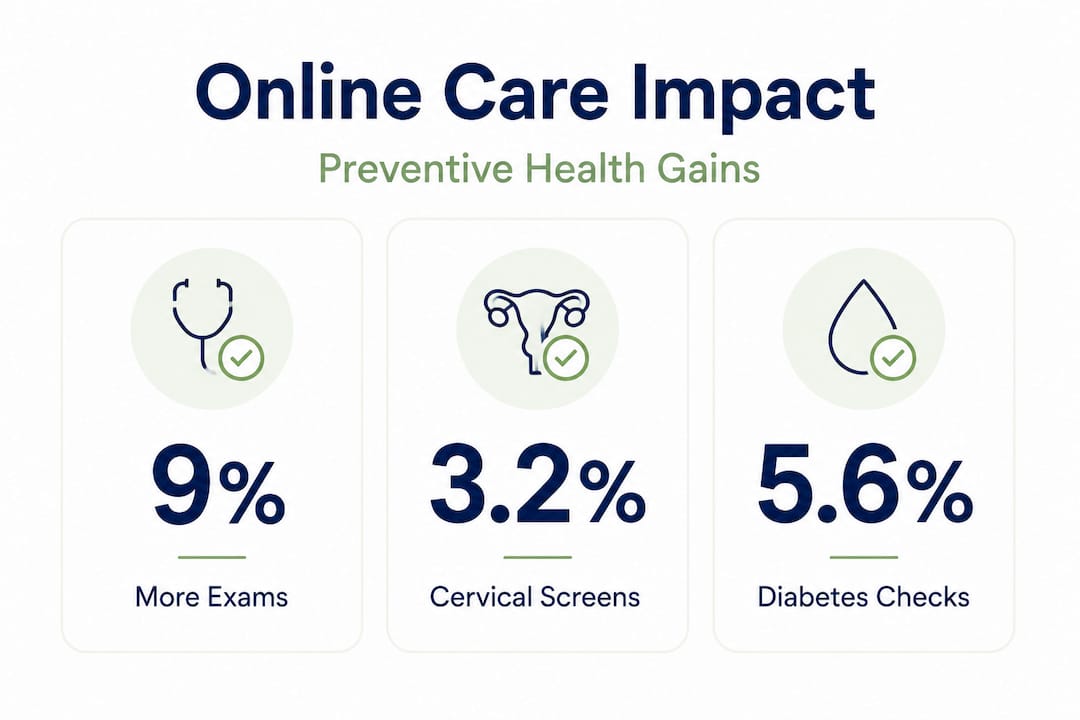
| Intervention type | Improvement observed |
|---|---|
| Annual preventive exam completion | Up 9% with automated outreach |
| Cervical cancer screening | Up 3.2% with digital reminders |
| Diabetes lab completion | Up to 20.8% with personalized outreach |
| Colon cancer screening referrals | Higher completion via telehealth |
| Mammography (remote vs. in-person) | 68.2% remote vs. 76.3% in-person |
As you can see, preventive exam completion rose by 9% for annual exams, cervical screening improved by 3.2%, and diabetes labs jumped by as much as 20.8% with personalized digital outreach. That diabetes number is striking. It suggests that when reminders and follow-ups are tailored to the individual, people actually follow through.
That said, modest improvements in older adults show that not everyone benefits equally, and personalization matters a great deal for making digital interventions work across different age groups and health backgrounds.
Here is how you can put these tools to work for yourself right now:
- Opt in to reminders through your provider’s patient portal or telehealth app to stay on top of upcoming screenings
- Set annual health goals and use a digital health tracker to measure progress between appointments
- Use secure messaging with your provider to ask quick follow-up questions instead of booking a full visit each time
- Request personalized outreach if your platform offers it, especially for chronic conditions like diabetes or high blood pressure
- Schedule digital check-ins around major life events, like turning 40 or starting a new medication
Exploring the telehealth pros and cons helps you set realistic expectations. The tools work best when you stay engaged and treat them as an ongoing part of your health routine rather than a one-time fix. Also, understanding access and equity challenges in digital health gives important context for why these interventions do not yield the same results for everyone.
Challenges: Digital divide, adherence, and technology limits
Improvement is real, but it is not universal. What obstacles are slowing progress, and how do you avoid them?
Even the most well-designed telehealth tool cannot help someone who cannot access it. The digital divide is one of the most significant barriers to equitable online preventive care, and it shows up in several interconnected ways. Research confirms that digital divide risks include low digital literacy, limited device or internet access, and low engagement among vulnerable groups, all of which can worsen existing health inequalities.
Here are the core barriers patients and providers face:
- Device access: Not everyone owns a smartphone or reliable computer, especially older adults or individuals in low-income households
- Internet connectivity: Rural and underserved communities often lack the broadband speeds needed for stable video visits
- Digital literacy: Navigating patient portals, apps, and telehealth platforms requires a level of tech comfort that not all patients have
- Low engagement: Even when tools are available, people with complex health needs or limited support systems are less likely to use them consistently
- Language and accessibility gaps: Many platforms are designed primarily in English with limited accommodation for other languages or disabilities
“Even the most advanced technology misses the people most excluded by tech gaps. A reminder sent to someone without a smartphone is not a reminder at all.”
Wearable devices add another layer of complexity. While fitness trackers and smartwatches hold real promise for continuous health monitoring, wearables face translation barriers including accuracy concerns, low adherence over time, regulatory challenges, and the reality that consumer-grade devices are not held to the same standards as medical equipment. This does not make wearables useless, but it does mean you should treat them as supplementary tools rather than clinical-grade diagnostics.
It is also worth reviewing digital safety guidelines to make sure any platform you use takes your privacy and data security seriously.
Pro Tip: If you are less comfortable with technology or prefer talking to a real person, look for online care platforms that offer live chat support, phone-based options, or hybrid models with in-person follow-up. The best platforms meet you where you are, not where the app assumes you should be. You can also explore direct primary care models that combine digital tools with genuine human support.
The future: Personalization, hybrid models, and inclusive design
So how can online care become even better and more accessible moving forward? Here is what is on the horizon.
The future of online preventive healthcare is not just more technology. It is smarter, more flexible technology designed with a wider range of patients in mind. Three trends are shaping that future right now.

Personalization is quickly becoming the most important driver of preventive care success. Generic reminders get ignored. Personalized outreach, including tailored calls for older adults, has shown meaningfully stronger results than one-size-fits-all digital nudges. As AI improves, expect platforms to get much better at understanding your specific health history and sending you the right message at the right moment.
Hybrid care models combine digital convenience with in-person precision when it matters most. The ideal setup lets you handle routine check-ins, follow-ups, and monitoring online, while reserving in-person visits for tests that require physical examination or lab equipment. This approach captures the best of both worlds without sacrificing quality. You can learn more about what a solid telehealth membership features typically include to understand what to look for when choosing a plan.
Inclusive design means building platforms that actually work for older adults, non-native English speakers, individuals with disabilities, and people with limited tech experience. This includes larger text options, multiple language settings, phone-based alternatives to app-only access, and community support programs that help bridge the gap. Exploring wellness pathway approaches gives you a sense of how integrated, patient-centered design can make a real difference.
Here is what you can do right now to push for more inclusive care:
- Ask potential providers whether they offer phone or non-app alternatives alongside their digital platform
- Look for platforms with clear, easy-to-read pricing and support resources in your preferred language
- Advocate for yourself by requesting personalized follow-up rather than accepting generic automated messages
- Choose services that offer real human support alongside their tech tools
Why the real power of online preventive care is choice, not just technology
With these trends in mind, let’s pull back and reconsider what is really valuable for patients seeking preventive care online.
Here is a perspective that does not get enough attention: the most transformative thing about online preventive healthcare is not the technology itself. It is the choice it gives you. For the first time, many patients can choose the price point, the access model, the communication style, and the level of involvement that actually fits their life. That is a fundamental shift in power.
Most healthcare discussions focus on which app has the best features or which platform uses the most advanced AI. But we find that what makes the biggest difference for patients is transparency and flexibility. Can you see the cost before you commit? Can you reach someone when you need to? Can you switch plans if your needs change? Those questions matter more than whether the interface looks modern.
One piece of advice that many guides miss: read the fine print on any online health plan before signing up. Look for whether the flat-rate pricing actually covers the services you need, whether there are hidden fees for labs or referrals, and whether you can access care through more than one channel. Do not be afraid to call or chat with the support team before you pay a cent. A trustworthy provider will answer those questions clearly and without pressure.
We also believe strongly that measurable telemedicine gains come from consistent use, not occasional check-ins. The patients who benefit most from online preventive care are those who treat it as an ongoing relationship rather than a one-time transaction. Show up for your reminders. Follow through on your screenings. Use the messaging tools between visits. That steady engagement is what moves the health needle over time.
Pro Tip: Before committing to any online preventive care platform, ask for a trial period, request a full breakdown of pricing, and confirm there are multiple ways to get support including phone, chat, and video. Flexibility is not a luxury. It is a sign of a platform built with real patients in mind.
Explore affordable online preventive care solutions
Ready to put these insights into action? Here are paths to affordable and convenient care.
If you have been putting off a health check-in because of cost, scheduling headaches, or just not knowing where to start, you are not alone. The good news is that there are straightforward, transparent options available right now.
At Chameleon virtual health, we make it simple to connect with licensed providers from your phone or computer, with clear pricing and no surprise bills. You can review online care plan options to find a membership or pay-per-visit model that fits your budget and your life. If you are managing a specific condition like asthma, our virtual asthma support gives you fast access to guidance without a waiting room. Whether you need ongoing preventive support or help with an issue that comes up today, we are here to make quality care feel accessible, affordable, and genuinely stress-free.
Frequently asked questions
How do online preventive health visits work?
Online preventive visits use telemedicine platforms, digital reminders, and secure patient portals to let you consult with a provider, track your screenings, and stay on top of your health from anywhere with an internet connection.
Is online preventive care as effective as in-person care?
Online reminders and outreach clearly boost preventive visit rates, but some screenings still see higher completion in person. For example, mammography completion rates were 68.2% via remote care compared to 76.3% for in-person visits.
Can I get affordable online preventive care without insurance?
Yes. Direct primary care and membership platforms offer flat-rate preventive coverage with no copays or hidden fees, making it a practical option whether or not you have traditional insurance.
What are the main challenges with online preventive healthcare?
The biggest barriers include limited internet access, low digital literacy, and uneven results among older or vulnerable patients, all of which exacerbate existing health inequalities if platforms are not designed with inclusion in mind.
How is online preventive healthcare evolving?
Platforms are moving toward personalized reminders and tailored outreach that perform better than generic digital nudges, with hybrid models combining digital tools and in-person follow-up becoming the new standard for effective preventive care.