

TL;DR:
- Virtual primary care offers quick, affordable access to non-emergency health issues from home.
- It is suitable for minor conditions, prescriptions, and follow-ups, but not emergencies or complex cases.
- Many platforms provide transparent pricing, no insurance required, and rapid connects with licensed providers.
Getting timely, affordable care for something as common as a sore throat or sinus infection can feel unnecessarily complicated. Between scheduling delays, insurance requirements, and long waiting room times, the traditional system often creates more stress than relief. Virtual primary care changes that equation. It brings licensed medical providers directly to your phone or computer, without the wait and without the paperwork. This guide walks you through what virtual primary care actually is, how it works step by step, who it fits best, and how to get started today.
Table of Contents
- What is virtual primary care?
- How virtual primary care works: Step-by-step process
- Virtual vs. traditional care: Benefits and trade-offs
- Who should use virtual primary care (and when to seek other options)?
- Our take: What most people miss about virtual primary care
- Ready for fast, affordable care? Explore your virtual options
- Frequently asked questions
Key Takeaways
| Point | Details |
|---|---|
| Fast, accessible care | Virtual primary care lets you quickly access healthcare for most routine illnesses and concerns. |
| Affordable without insurance | You can often get care at a low cost even without traditional health insurance coverage. |
| Know when to use it | Virtual care is great for common conditions, but emergencies and complex issues still need in-person visits. |
| Simple step-by-step process | Signing up, scheduling, meeting your provider, and getting prescriptions are all streamlined online. |
What is virtual primary care?
Let’s start with the basics. Primary care refers to everyday, non-emergency medical attention. Think annual checkups, common infections, minor skin issues, or a persistent cough. A primary care provider is your first point of contact when something feels off. Virtual simply means it happens online, through your phone, tablet, or computer, rather than in a clinic.
Telehealth is the broader term for using technology to deliver healthcare remotely. Virtual primary care falls under this umbrella. It uses secure video calls, phone consultations, or even text-based messaging to connect you with a licensed provider from wherever you are.
Here’s what a typical virtual primary care platform can help you with:
- Sore throats and strep testing guidance
- Sinus infections and congestion
- Urinary tract infections (UTIs)
- Skin rashes, acne, or eczema flare-ups
- Allergies and seasonal symptoms
- Cold, flu, and COVID-19 symptoms
- Mental health check-ins and mild anxiety support
- Prescription refills for ongoing conditions
- Follow-up care after previous treatment
As explained in how virtual healthcare works, virtual primary care can handle most common non-emergency conditions remotely via video, phone, or text. That covers the vast majority of reasons people visit a doctor in a given year.
“Most people don’t realize how much of everyday healthcare can be resolved without ever leaving home. Virtual primary care isn’t a workaround. It’s a legitimate, fully supported model of modern medicine.”
The key difference from traditional care is access. You’re not waiting two weeks for an opening or driving across town. You connect when you need care, often the same day.
How virtual primary care works: Step-by-step process
Understanding the basic idea is one thing, but it helps to see what actually happens step by step. Here’s a simple walkthrough of what you can expect when you use a virtual primary care service.
- Create your account. Sign up on the platform with your basic personal and health information. Most platforms take just a few minutes to get started.
- Describe your symptoms. You’ll fill out a short intake form explaining what you’re experiencing, how long it’s been happening, and any relevant health history.
- Choose your visit type. Depending on your situation, you may select a video call, phone call, or messaging-based visit. Video is the most common for new symptom evaluations.
- Meet with your provider. A licensed physician, nurse practitioner, or physician assistant will review your information and connect with you at your scheduled time, often within hours.
- Receive your care plan. After the visit, your provider will discuss their assessment and recommend next steps. This could include lifestyle advice, a prescription, or a referral for in-person testing.
- Get your prescription (if needed). Prescriptions are sent electronically to your preferred pharmacy. Many platforms also offer home delivery options.
- Follow up as needed. Most platforms allow you to message your provider after the visit with questions or updates.
As noted in a review of telemedicine benefits, virtual visits typically involve secure digital platforms allowing rapid scheduling, interaction, and prescription delivery. The whole process is built to remove friction.
Pro Tip: Before your virtual visit, write down your symptoms, when they started, and any medications you’re currently taking. Having this ready saves time and helps your provider give you a more accurate assessment.
Virtual vs. traditional care: Benefits and trade-offs
Now let’s see how this new model stacks up against traditional care in ways that matter most.

| Feature | Virtual primary care | Traditional in-person care |
|---|---|---|
| Wait time | Same day, often within hours | Days to weeks for appointments |
| Cost per visit | Typically lower, often $50 to $100 | Higher, especially with specialist fees |
| Insurance required | No, many accept self-pay | Often required for affordable access |
| Accessibility | Available from home, any location | Requires travel and scheduling |
| Scope of care | Non-emergency conditions, prescriptions | Broader, including physical exams and imaging |
| Privacy | High, from your own space | Shared waiting rooms |
The benefits of virtual care are real and practical:
- No travel required. You skip the commute, parking, and waiting room entirely.
- Flexible scheduling. Many platforms offer evenings, weekends, and same-day slots.
- Lower costs. Without the overhead of a physical office, providers can charge less.
- Greater privacy. You discuss your health from a space where you’re comfortable.
- Less exposure. No sitting in a waiting room with other sick patients.
As outlined in the pros and cons of virtual care, virtual primary care offers quicker access and lower costs for non-urgent conditions, but may be less suited for complex issues. That’s the honest trade-off.
“Virtual care is not a replacement for every type of medicine. But for the everyday issues that fill most people’s healthcare needs, it removes every major barrier that usually gets in the way.”
When should you choose in-person care instead? For virtual versus in-person care decisions, emergencies, suspected fractures, or situations requiring physical examination and imaging should always be handled in person or at an emergency room.
Who should use virtual primary care (and when to seek other options)?
Even with its advantages, virtual care isn’t a one-size-fits-all solution. Here’s how to make the right choice for your situation.
Virtual primary care is a strong fit for several groups:
- Working parents who can’t take time off to sit in a waiting room
- Students managing tight budgets without employer-sponsored insurance
- Uninsured adults looking for transparent, affordable options
- Remote workers or rural residents with limited clinic access nearby
- People with mild, recurring conditions like allergies or UTIs who know their symptoms well
Here’s a quick reference for deciding what type of care fits your situation:
| Symptom or condition | Best care option |
|---|---|
| Sore throat, suspected strep | Virtual primary care |
| Sinus infection, congestion | Virtual primary care |
| Skin rash, mild allergic reaction | Virtual primary care |
| UTI symptoms | Virtual primary care |
| Prescription refill needed | Virtual primary care |
| Chest pain or difficulty breathing | Emergency room immediately |
| Suspected broken bone | Urgent care or emergency room |
| Severe abdominal pain | Emergency room immediately |
| Ongoing or complex chronic conditions | In-person specialist |
According to coverage of common conditions for virtual care, virtual primary care is ideal for a wide range of non-emergency illnesses such as infections, minor injuries, and follow-up visits. The key is knowing the limits. If your symptoms are worsening rapidly, involve the chest or difficulty breathing, or feel like a true emergency, skip the virtual platform and get to an emergency room.
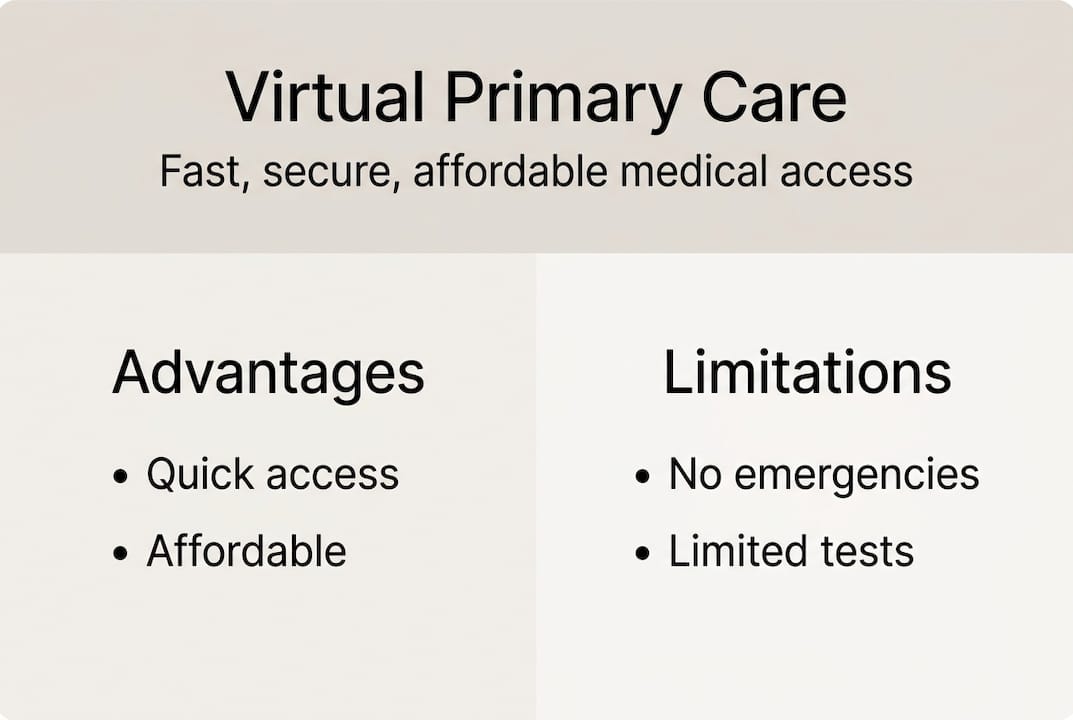
For guidance on handling everyday health online, most platforms will also flag when your situation exceeds what they can safely manage and guide you toward the right next step.
Pro Tip: When you sign up for a virtual care platform, look for their escalation policy. A good platform will have a clear process for directing you to urgent or emergency care if your symptoms fall outside virtual scope.
Our take: What most people miss about virtual primary care
All these details explain how virtual care works, so now let’s get real about what most articles don’t say.
The most overlooked part of virtual primary care isn’t the convenience. It’s the empowerment. When you can connect with a licensed provider within hours, without worrying about insurance rejections or billing surprises, you’re more likely to address health issues early. That’s better for your long-term wellbeing and your wallet.
A lot of people still assume virtual care means impersonal care. That’s simply not true. Providers on these platforms take your concerns seriously, ask thoughtful follow-up questions, and often deliver more focused attention than a rushed in-person visit allows.
Another myth: that affordable healthcare without insurance isn’t possible. Virtual platforms have broken that assumption. Many offer flat-rate visits with no hidden fees, so you know exactly what you’re paying before you book.
Our honest advice? If you’ve been putting off addressing a health concern because of cost or access barriers, try a virtual visit. Evaluate how you feel after. Most people are surprised by how supported they feel.
Ready for fast, affordable care? Explore your virtual options
If you want to take the next step and experience the benefits of virtual primary care yourself, here’s how.
At Chameleon Healthcare, getting care is simple and transparent. Browse the conditions we treat online to see if your symptoms are a match for a virtual visit. You don’t need insurance, and there’s no waiting room.
Choose from flexible virtual care plans designed to fit different needs and budgets, whether you’re looking for a one-time visit or an ongoing care option. Same-day access, clear pricing, and licensed providers are ready when you are. Learn more about Chameleon and find the care option that works for your life.
Frequently asked questions
Is virtual primary care safe for diagnosing new health conditions?
For most non-emergency conditions, virtual primary care is safe and uses secure, HIPAA-compliant technology. As confirmed by guidance on telemedicine accessibility, virtual primary care safely manages most common non-life-threatening symptoms, though serious or complex conditions may still require in-person evaluation.
Do I need insurance to use virtual primary care?
No. Many virtual care services offer low-cost visits with transparent flat-rate pricing. Coverage on affordable care without insurance confirms that virtual care is accessible regardless of your insurance status.
Which common illnesses can virtual primary care treat?
Conditions like infections, allergies, rashes, UTIs, and minor injuries are well-suited for virtual primary care. Resources on fast affordable virtual treatments confirm that virtual care safely treats many of the most common everyday conditions.
What if I need tests or imaging that can’t be done online?
Your virtual provider can issue referrals for labs or imaging, which you’ll complete at a local facility. Details on everyday virtual medical care note that some diagnostic tests require in-person visits, but virtual doctors can provide the necessary referrals to keep your care moving forward.