

TL;DR:
- Managing healthcare costs in 2026 requires evaluating your actual needs, income, and coverage options thoroughly.
- Choosing plans based solely on premiums often leads to unforeseen expenses from high deductibles and out-of-pocket costs.
Healthcare costs have never been harder to manage on your own. With the average deductible rising to $3,786 per person in 2026, many families are left wondering how to access affordable healthcare step by step without breaking the budget. Whether you are uninsured, underinsured, or simply looking for a better plan, this guide walks you through every decision point, from knowing what you need to activating coverage and finding care when insurance is not in the picture.
Table of Contents
- Key takeaways
- Affordable healthcare step by step: start with your needs
- Government and marketplace coverage options
- Comparing budget-friendly medical plans
- Enrolling and activating your coverage
- Accessing care without insurance
- My honest take on healthcare costs in 2026
- Start getting affordable care with Chameleonhc
- FAQ
Key takeaways
| Point | Details |
|---|---|
| Assess your needs first | Know your family size, health frequency, and income before comparing any plan or program. |
| Silver plans can save more | Silver plans offer cost-sharing reductions that significantly lower deductibles and copays beyond what premiums suggest. |
| Enrollment timing matters | Missing Open Enrollment can lock you out for months unless you have a qualifying life event. |
| Telehealth fills the gap | Virtual care platforms provide same-day access to licensed providers at a fraction of urgent care costs. |
| Hidden costs are real | Provider network gaps and out-of-pocket maximums matter more than monthly premiums when comparing budget-friendly medical plans. |
Affordable healthcare step by step: start with your needs
Before you compare a single plan or fill out an application, you need a clear picture of your current situation. This is the step most people skip, and it is the reason they end up with coverage that does not actually work for them.
Start by answering these questions honestly:
- How often does your household use medical care? A healthy 28-year-old with no prescriptions has very different needs than a family with a child managing asthma or a parent with diabetes.
- What is your household income? This number directly determines which programs you qualify for, including Medicaid, the Children’s Health Insurance Program (CHIP), and Affordable Care Act (ACA) premium subsidies.
- Do you have chronic conditions that require regular care? Ongoing prescriptions, specialist visits, and lab work add up fast and should factor into any plan decision.
- What kind of care might you need this year? Separate urgent care from routine checkups and potential emergencies so you can estimate realistic costs.
- Are there any current coverage gaps? If you recently lost employer coverage or aged off a parent’s plan, knowing your gap length helps you pick the right enrollment pathway.
Identifying these answers also helps you access the right programs faster. Government eligibility tools use income and family size as the primary filters, so going in prepared saves real time.
Pro Tip: Write down your most recent tax return’s adjusted gross income before you visit any marketplace or government portal. It is the single number that drives almost every eligibility decision.
Government and marketplace coverage options
This is where the real step-by-step healthcare guide begins for most people. You have more publicly funded options than you probably realize.
Step 1: Check Medicaid and CHIP eligibility
Medicaid covers adults with low incomes and families who fall below a certain percentage of the Federal Poverty Level (FPL). CHIP covers children in households that earn too much for Medicaid but still struggle to afford private insurance. Medicaid approval can happen the same day, with coverage sometimes retroactive to the month you applied. That is a significant advantage over marketplace plans, which have waiting periods before coverage starts.
Step 2: Explore ACA Marketplace plans and subsidies
If your income is above the Medicaid threshold, the ACA Marketplace at HealthCare.gov is your next stop. Premium tax credits reduce your monthly premium based on your income, and cost-sharing reductions (CSRs) lower your deductibles and copays. There is one critical detail many people miss: CSRs are only available on Silver plans. Choosing a Bronze plan when you qualify for CSRs means leaving significant savings on the table.
Step 3: Apply through HealthCare.gov or your state exchange
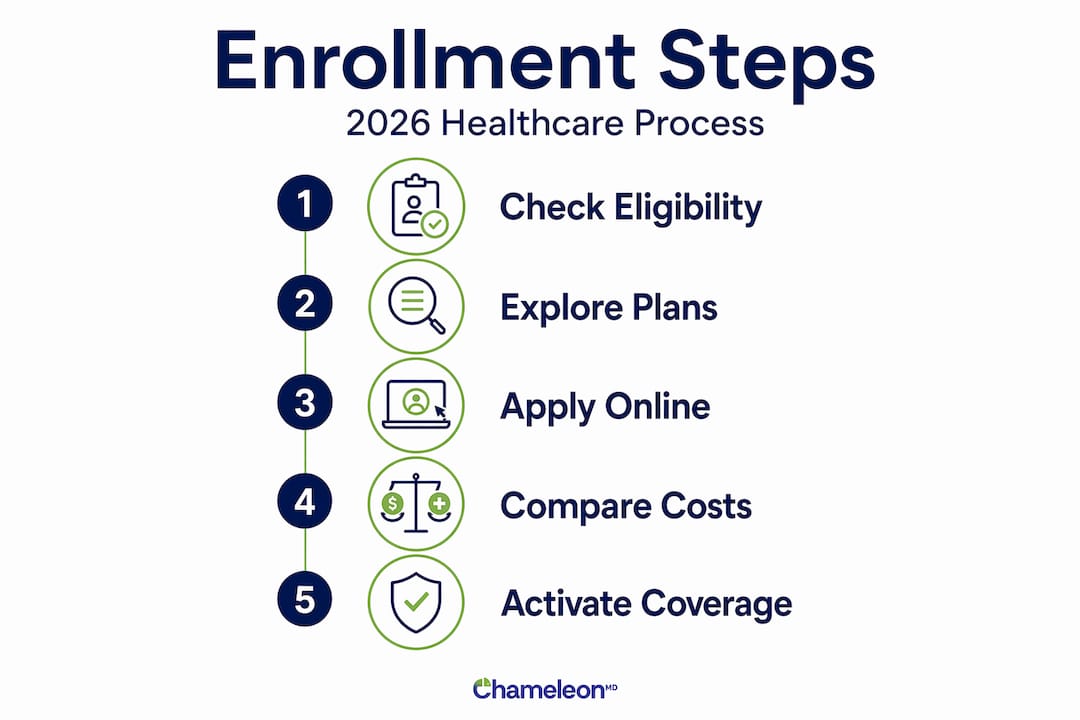
The application process follows a consistent sequence:
- Create an account at HealthCare.gov or your state’s exchange.
- Enter household income, family size, and residency information.
- Review your eligibility determination for Medicaid, CHIP, or premium tax credits.
- Compare available plans side by side using the filter tools.
- Select your plan and complete enrollment before the deadline.
- Pay your first premium to activate coverage.
Open Enrollment runs from November 1 through January 15 in most states. If you miss it, a qualifying life event like job loss opens a Special Enrollment Period with a 60-day window to apply.
The table below shows how subsidy types affect your actual costs:
| Subsidy type | Who qualifies | What it lowers |
|---|---|---|
| Premium tax credit | 100% to 400%+ FPL | Monthly premium |
| Cost-sharing reduction | 100% to 250% FPL on Silver plans | Deductibles, copays, out-of-pocket max |
| Medicaid | Up to 138% FPL (expansion states) | Most or all out-of-pocket costs |
Pro Tip: If your income fluctuates, estimate conservatively when applying. Overestimating income and receiving fewer credits is far easier to manage than owing back subsidies at tax time.
Comparing budget-friendly medical plans
Once you have your options in front of you, the next task is comparing them with clear eyes. Monthly premium is the number most people focus on. It is also the one that most often misleads them.

High-deductible bronze plans can carry deductibles of $7,500 or more. If you need care before hitting that threshold, every dollar comes out of your pocket. Families without emergency savings can face real financial strain from a single urgent visit or minor procedure.
Here is how the main plan tiers compare:
| Plan tier | Monthly premium | Typical deductible | Best for |
|---|---|---|---|
| Bronze | Lowest | $5,000 to $7,500+ | Healthy adults with savings |
| Silver | Moderate | $1,500 to $4,000 | Most families, especially with CSR eligibility |
| Gold | Higher | $500 to $1,500 | People with regular medical needs |
Beyond the tier, check these details before you commit:
- Provider network: Confirm your current doctor, any specialists you see regularly, and the hospitals near you are all in-network.
- Prescription drug coverage: Look up your specific medications in the plan’s formulary before enrolling.
- Out-of-pocket maximum: This is the ceiling on what you can pay in a year. Lower is better if you anticipate significant care.
- Ancillary provider network: Many surprise bills come from anesthesiologists, radiologists, and labs that are out-of-network even when the main provider is not.
Short-term plans and off-exchange plans may look attractive due to low premiums. They often exclude pre-existing conditions, cap total benefits, and leave you exposed in ways standard marketplace plans do not.
Pro Tip: Use the plan’s Summary of Benefits and Coverage document, not just the summary page, to verify actual deductibles and copay amounts for the services you use most.
Enrolling and activating your coverage
Getting through the enrollment process without mistakes is what separates people who have active coverage from those who think they do but do not.
Follow this sequence carefully:
- Gather documents before you start: You will need proof of income (pay stubs, tax returns, or a self-employment statement), government-issued ID, and Social Security numbers for all household members.
- Submit your application within the enrollment window: Do not wait until the last day. Technical issues on exchange websites are common near deadlines.
- Review your eligibility notice carefully: If Medicaid is offered, accept it promptly since same-day approval is possible and coverage can start immediately.
- Pay your first premium on time: Coverage does not activate until payment is received. A missed first payment can void your enrollment entirely.
- Update your income or household changes throughout the year: Marriage, a new child, a job change, or a significant income shift can all affect your subsidy amount. Report changes within 30 days to avoid an unexpected tax bill.
Common enrollment mistakes that cause coverage gaps include selecting a plan but never paying, assuming the application alone activates coverage, or forgetting to re-enroll during the next Open Enrollment period.
Pro Tip: Set a calendar reminder for October 15 each year. That gives you two weeks to review your current plan before Open Enrollment begins, so you are not making rushed decisions under pressure.
Accessing care without insurance
Even if you cannot secure a plan right now, you still have practical options for finding affordable care. This is where a step-by-step approach to low-cost access makes the biggest difference day to day.
- Federally Qualified Health Centers (FQHCs): These community clinics use a sliding-scale fee based on your income. A visit can cost as little as $20 for someone with a very low income.
- Telehealth and virtual care services: Telehealth provides affordable access to licensed providers for a fraction of what an in-person urgent care visit costs. Many platforms charge flat fees with no insurance required.
- Retail health clinics: Located in pharmacies and grocery stores, these clinics handle common conditions like strep throat, UTIs, and minor injuries at transparent, lower prices.
- Negotiating medical bills: Most hospitals have financial assistance programs. If you receive a large bill, call the billing department and ask about income-based discounts or payment plans before paying anything.
- Preventive care: Managing chronic conditions like high blood pressure or diabetes with consistent, low-cost primary care prevents the expensive hospitalizations that create medical debt.
When it comes to emergency rooms, understanding your rights matters. EMTALA requires hospitals to screen and stabilize every patient regardless of ability to pay. However, you will still receive a bill after stabilization. Emergency rooms are appropriate for genuine emergencies, not for situations that a telehealth visit or urgent care center can handle for far less.
Getting care you can afford starts with knowing where to go before you actually need it. Doing that research now, when you are not sick or stressed, means you make better decisions when it counts.
Pro Tip: Save the address and phone number of your nearest FQHC and a reliable telehealth service in your phone contacts today. When you need care, you will not have time to search.
My honest take on healthcare costs in 2026
I have seen a lot of people make the same mistake: they pick the plan with the lowest monthly premium and feel like they made the smart financial move. Then they get a bill for $2,000 after a single urgent care visit because their deductible was untouched.
With 55% of marketplace enrollees now saying they plan to cut back on food and basic expenses to afford coverage, this is not an abstract concern. It is the reality families are living with right now.
What I have learned is that the monthly premium is the beginning of the story, not the whole story. The deductible, the network restrictions, and the out-of-pocket maximum are where the real financial exposure lives. Cost-sharing copays can create genuine barriers for low-income households, delaying care until a minor issue becomes a costly one.
My strongest advice is to think through your actual expected healthcare use before you compare premiums. Then verify the network. Then look at the deductible relative to what you have in savings. A Silver plan with a higher premium but a CSR-lowered deductible will often save a family more money across a full year than a Bronze plan with the lowest monthly cost. Plan selection is not just math. It is timing, risk tolerance, and knowing how your household actually uses care.
— Vector
Start getting affordable care with Chameleonhc
If you are still searching for how to find affordable care while your coverage is pending, lapsed, or simply not covering what you need, Chameleonhc is built for exactly that situation.

Chameleonhc connects you with licensed providers online, same day, with clear flat-rate pricing and no waiting rooms. You can get treated for common conditions like heartburn and reflux, pink eye, sinus infections, rashes, and more, all from your phone or computer. No insurance required. No surprise bills.
For those who want a consistent, affordable health services option throughout the year, Chameleonhc’s telehealth plans offer membership-based access that combines urgent care and primary care in one simple model. It is the kind of coverage that fits real life, whether you are between plans, self-employed, or just looking for a more flexible way to get care. Visit Chameleonhc to explore your options today.
FAQ
What is the first step to finding affordable healthcare?
Assess your household income and how often you need medical care. These two factors determine whether you qualify for Medicaid, ACA subsidies, or need to explore alternative affordable health services options like telehealth or community clinics.
Which ACA plan tier is best for low-income families?
Silver plans are typically the best choice for low-income families because they are the only tier that qualifies for cost-sharing reductions, which can significantly lower your deductible and copay amounts beyond what the premium reflects.
Can I get coverage outside of Open Enrollment?
Yes. Special Enrollment Periods allow you to enroll after a qualifying life event such as losing a job, getting married, or moving. You have a 60-day window from the event date to apply.
Is the emergency room free if I don’t have insurance?
No. While federal law requires hospitals to screen and stabilize you regardless of your ability to pay, you will still receive a bill after treatment. Using telehealth or urgent care for non-emergency situations is significantly more affordable.
How does telehealth help with affordable care without insurance?
Telehealth platforms connect you with licensed providers online at flat, transparent rates with no insurance required. They are well-suited for treating common conditions quickly and affordably, making them a reliable part of any low-cost health insurance alternative strategy.