

TL;DR:
- Accessible healthcare in 2026 ensures all individuals can receive care without barriers by meeting digital, physical, and administrative standards. Compliance with WCAG 2.1 and regular audits are essential, but systemic barriers like facility inaccessibility and cost delays also persist. Organizations that treat accessibility as an ongoing operational practice will deliver truly equitable, patient-centered care.
Accessible healthcare in 2026 is defined as equitable, barrier-free access to health services for all individuals, shaped by legal compliance, digital standards, and disability accommodations. The term “healthcare accessibility” covers physical facilities, digital tools, communication support, and administrative processes. In the U.S., this definition is anchored by Section 504 of the Rehabilitation Act, HHS regulations, and WCAG 2.1 digital standards. Globally, the EU AccessibleEU guidelines launched in April 2026 to address systemic gaps. Understanding what accessible healthcare means today requires looking at all three layers: the technology patients use to reach care, the environment they enter, and the administrative systems they must navigate.
What is accessible healthcare in 2026?
Accessible healthcare in 2026 means every patient, regardless of disability, income, or location, can reach and receive care without unnecessary barriers. The digital front door concept, which includes websites, patient portals, mobile apps, and check-in kiosks, must now meet WCAG 2.1 Level AA standards under HHS Section 504. Larger providers with 15 or more employees face a compliance deadline of May 11, 2027, with smaller providers receiving extended timelines.
This is not a minor technical update. WCAG 2.1 success criteria cover screen reader compatibility, keyboard navigation, color contrast, and captioning for video content. A patient who is blind, deaf, or has a motor disability must be able to schedule an appointment, review test results, and complete intake forms using assistive technology. If your portal fails those tests, it is not compliant, and it is not accessible.
The compliance scope is broader than most providers realize. 92% of doctors and all hospitals receive federal funding and must comply, including digital tools provided by contracted vendors. The obligation cannot be transferred to a third-party software company. If a vendor’s product fails WCAG 2.1 criteria, the healthcare organization is still liable.
- Patient portals must support screen readers like JAWS and NVDA
- Telehealth platforms must offer captioning and audio description
- Online scheduling tools must be keyboard-navigable without a mouse
- Kiosks must include audio output and accessible height options
- All video content must include accurate closed captions
Pro Tip: Run quarterly WCAG audits using tools like Axe, WAVE, or Deque’s accessibility testing suite. A one-time audit at launch does not satisfy ongoing compliance requirements, since regression testing after every software update is required.
What non-digital barriers still block healthcare access?
Digital compliance is only one part of the picture. Physical facilities, communication practices, and day-to-day workflows during a visit create equally significant barriers for patients with disabilities. The EU’s AccessibleEU guidelines, launched in April 2026, were a direct response to data showing that persons with disabilities face four times more unmet healthcare needs than the general population due to inaccessible facilities, long wait times, and inadequate staff training.
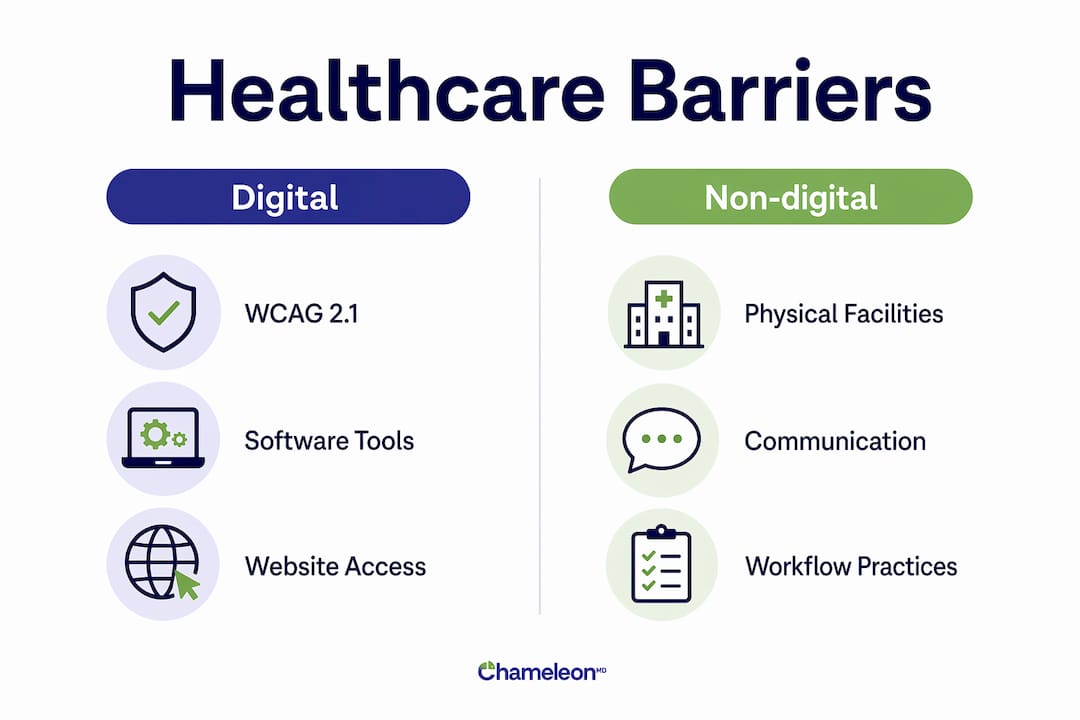
That figure reflects a systemic failure, not individual cases. It means that for every unmet need a non-disabled patient experiences, a disabled patient experiences four. Addressing this requires changes at every point of contact.
Here are the core non-digital accommodations that define accessible care delivery in 2026:
- Accessible equipment: Exam tables that lower to wheelchair height, accessible weight scales, and adjustable imaging equipment allow patients with mobility impairments to receive standard care without improvisation.
- Auxiliary communication aids: Sign language interpreters, real-time captioning services, and written materials in plain language or Braille fulfill the effective communication requirements under Section 504.
- Disability-sensitive check-in workflows: Allowing patients to wait in their car instead of a crowded waiting room, offering extended appointment times, and providing sensory-friendly spaces reduce barriers for patients with autism, chronic pain, or anxiety disorders.
- Staff disability training: Providers who receive regular training on disability etiquette, communication accommodations, and legal obligations deliver measurably better care. The Disability Equity Collaborative implementation guide identifies staff training as a foundational program component, not an optional add-on.
- Documentation of accommodation needs: Recording a patient’s accommodation preferences in their chart and acting on them at every visit removes the burden of patients having to re-explain their needs repeatedly.
Pro Tip: Ask patients directly during intake whether they need any accommodations for their visit. A simple, standardized question removes the stigma of self-advocacy and gives your team time to prepare before the patient arrives.
How do cost and administrative complexity affect access?
Administrative friction is one of the most underreported barriers to healthcare access. Insurance verification errors, prior authorization delays, and unclear cost estimates cause patients to delay or abandon care entirely. The State of Patient Access 2026 survey from Experian Health reveals a sharp disconnect: 46% of providers report improved patient access in 2026, but only 18% of patients agree. That gap reflects how differently the two groups experience the same system.

The implication is significant. Providers are investing in digital tools and measuring process improvements internally, while patients are still hitting walls around cost transparency and authorization delays. Improving healthcare accessibility cannot stop at the front door.
| Access barrier | Provider view | Patient view |
|---|---|---|
| Insurance verification accuracy | Largely automated and improved | Still causes delays and denials |
| Prior authorization speed | Faster with AI-assisted tools | Frequently cited as a top frustration |
| Cost transparency before visits | Estimates available in most portals | Unclear or confusing to most patients |
| Appointment availability | Expanded with telehealth options | Still limited in rural and underserved areas |
| Administrative burden overall | Reduced through self-service tools | Perceived as high and stressful |
Automation and AI are helping on the provider side. Tools that handle insurance eligibility checks, intake forms, and appointment reminders reduce manual errors and speed up access. However, AI-driven intake tools can exclude disabled patients if they are not tested with assistive technology before deployment. Speed gains for the majority can create new exclusions for patients who rely on screen readers or voice navigation.
Financial clarity remains a separate, unresolved challenge. Knowing what a visit will cost before you arrive is a basic patient need, and it directly affects whether people seek care at all. Platforms that offer transparent, upfront pricing remove one of the most consistent reasons patients delay treatment.
How do healthcare organizations build sustainable accessible care programs?
Accessible healthcare does not happen through a single policy update or a website redesign. The organizations delivering it consistently treat accessibility as an operational program with defined components, assigned ownership, and regular review cycles. The Disability Equity Collaborative implementation guide describes this as combining infrastructure development, active accommodation workflows, and continuous staff training rather than isolated efforts.
Here is what a structured accessibility program looks like in practice:
- Designated accessibility coordinator: One person or team owns compliance tracking, accommodation requests, and staff training schedules. Without clear ownership, accessibility tasks fall through the gaps between departments.
- Procurement requirements: Every new digital tool, from scheduling software to telehealth platforms, must meet WCAG 2.1 criteria before purchase. Accessibility requirements belong in vendor contracts, not as an afterthought after deployment.
- Accommodation request and fulfillment workflow: Patients can request accommodations before their visit through the portal or by phone. The request is documented, fulfilled, and reviewed after the visit to identify gaps.
- Cross-domain coordination: The digital team, facilities team, clinical staff, and administrative staff must operate from the same accessibility standards. Siloed compliance creates inconsistent patient experiences.
- Regular compliance audits: Both digital and physical accessibility require scheduled reviews. Digital audits should follow every major software update. Physical audits should occur annually or after facility changes.
The healthcare access challenge in 2026 is not a lack of awareness. Most providers understand the legal requirements. The gap is in execution, specifically in maintaining compliance across a complex, constantly changing environment of tools, staff, and facilities. Organizations that treat accessibility as a continuous operational discipline, rather than a compliance checkbox, are the ones actually delivering equitable care.
Key takeaways
Accessible healthcare in 2026 requires simultaneous compliance across digital standards, physical accommodations, and administrative systems, and no single fix addresses all three.
| Point | Details |
|---|---|
| WCAG 2.1 compliance is mandatory | Larger providers must meet digital accessibility standards by May 11, 2027, covering all patient-facing tools. |
| Non-digital barriers are equally serious | Disabled patients face four times more unmet needs due to facility, communication, and training gaps. |
| Patient and provider views diverge sharply | Only 18% of patients report improved access in 2026, compared to 46% of providers. |
| AI tools require accessibility testing | Automated intake and AI front-door tools can exclude disabled patients if not tested with assistive technology. |
| Sustained programs outperform one-time fixes | Structured accessibility programs with assigned ownership and regular audits deliver consistent, equitable care. |
The real challenge with accessible healthcare in 2026
The most honest observation I can offer is this: the gap between what providers believe they are delivering and what patients actually experience is the defining problem of healthcare accessibility right now. That 28-point gap between provider optimism and patient reality from the Experian Health data is not a measurement error. It is a structural blind spot.
Most organizations are measuring inputs, such as tools deployed, audits completed, and policies written, rather than outcomes. A portal that passes a WCAG audit on launch day can fail six months later after a software update. A staff training completed in January does not guarantee a patient with a hearing impairment receives an interpreter in October. Accessibility requires the same continuous attention as infection control or billing compliance.
What gives me genuine optimism is the expanding scope of the conversation. The EU AccessibleEU guidelines and the HHS Section 504 digital rule both signal that governments are treating accessibility as a measurable, enforceable standard rather than a goodwill gesture. That shift matters. When compliance is testable and penalties are real, organizations build systems instead of making promises.
The solutions for healthcare challenges that will define the next few years are not primarily technological. They are organizational. The providers who close the access gap will be the ones who assign ownership, build workflows, and measure patient outcomes rather than process completion.
— Vector
How Chameleonhc makes accessible care real for you
Chameleonhc was built around the idea that getting care should not require navigating a complicated system. No insurance required, no waiting rooms, and no surprise bills. You connect with a licensed provider from your phone or computer, get a diagnosis, and move forward with a clear plan. That is what accessible healthcare looks like in practice.
Whether you are managing a condition like asthma or dealing with a sudden illness, Chameleonhc offers same-day access with transparent pricing. The platform is designed to remove the friction that keeps people from seeking care when they need it. If you want healthcare that works around your life, Chameleonhc is ready when you are.
FAQ
What does accessible healthcare mean in 2026?
Accessible healthcare in 2026 means every patient can reach and receive care without barriers related to disability, cost, or administrative complexity. It covers digital tools, physical facilities, communication accommodations, and financial transparency.
Who must comply with WCAG 2.1 under HHS Section 504?
Healthcare providers receiving federal funding, which includes 92% of doctors and all hospitals, must comply with WCAG 2.1 Level AA for all patient-facing digital tools. Larger providers face a compliance deadline of May 11, 2027.
What are the biggest barriers to healthcare access in 2026?
Cost and administrative delays are the top barriers, with only 18% of patients reporting improved access despite 46% of providers claiming progress. Insurance authorization, unclear pricing, and inaccessible digital tools remain the most cited frustrations.
How does telehealth improve healthcare accessibility?
Telehealth removes geographic and mobility barriers by allowing patients to connect with licensed providers from home. Platforms that combine same-day access with transparent pricing address both the convenience and cost barriers that prevent people from seeking care.
What is the difference between accessible and equitable healthcare?
Accessible healthcare focuses on removing specific barriers to reaching and receiving care. Equitable healthcare goes further, addressing systemic disparities in outcomes across race, income, disability, and geography to produce fair results, not just equal access.