

TL;DR:
- Patient-centered care online goes beyond politeness by actively incorporating your values, preferences, and circumstances into clinical decisions. Digital tools like portals, health apps, and feedback measures facilitate this approach, improving adherence, communication, and emotional support. However, true responsiveness requires systems that listen, adapt, and close the feedback loop to deliver genuinely patient-focused care.
Most people assume patient-centered care just means a friendly doctor with good bedside manner. That assumption misses the point almost entirely. What is patient-centered care online, and why should it matter to you right now? It goes far deeper than politeness. It’s a structural approach to medicine where your values, preferences, and life circumstances actively shape every clinical decision. As healthcare moves online, this model is evolving in ways that directly affect how you get diagnosed, treated, and supported from your phone or laptop.
Table of Contents
- Key Takeaways
- What patient-centered care actually means
- Digital tools that power patient-centered online care
- How patient-centered online care improves your health
- Common pitfalls and misconceptions to watch for
- How to engage effectively with online healthcare services
- My take on where patient-centered care online is headed
- Experience patient-centered care with Chameleonhc
- FAQ
Key Takeaways
| Point | Details |
|---|---|
| More than kindness | Patient-centered care is a research-backed model where your values guide clinical decisions, not just provider preferences. |
| Eight core domains matter | Respect, communication, coordination, and emotional support are formal components of patient-centered care, not soft extras. |
| Portals are a starting point | Digital tools give you access, but true patient-centered care online requires systems that respond to your feedback. |
| You have a role to play | Asking the right questions and using portals proactively puts you in the driver’s seat of your own care. |
| Equity gaps still exist | Not all patients benefit equally from online tools; knowing this helps you advocate for what you deserve. |
What patient-centered care actually means
The Institute of Medicine defines patient-centered care as care that is respectful and responsive to individual patient preferences, needs, and values, and that the patient’s values guide all clinical decisions. That’s the official patient-centered care definition, and it’s worth sitting with for a moment. It does not say care that patients enjoy. It says care that is guided by your values.
The traditional medical model placed physicians at the center of every decision. You showed up, received a diagnosis, got a prescription, and left. Your job was to comply. The patient-centered healthcare model flips that entirely. It shifts clinical authority into a collaborative partnership where your input is not optional, it’s required.
That shift is grounded in eight validated domains from the Picker Institute:
- Respect for patient preferences: Your priorities shape the care plan.
- Coordination of care: Providers share information and work together on your behalf.
- Clear communication: You get information you can actually understand and use.
- Physical comfort: Pain management and physical needs are addressed, not minimized.
- Emotional support: Anxiety, fear, and stress are treated as legitimate health concerns.
- Family and caregiver involvement: Your support network is welcomed, not sidelined.
- Continuity of care: Care does not stop when you leave an appointment.
- Access to care: You can reach your providers and services when you need them.
These eight core domains apply whether your visit happens in a clinic or on a screen. The online context simply changes the tools used to honor them.
Digital tools that power patient-centered online care
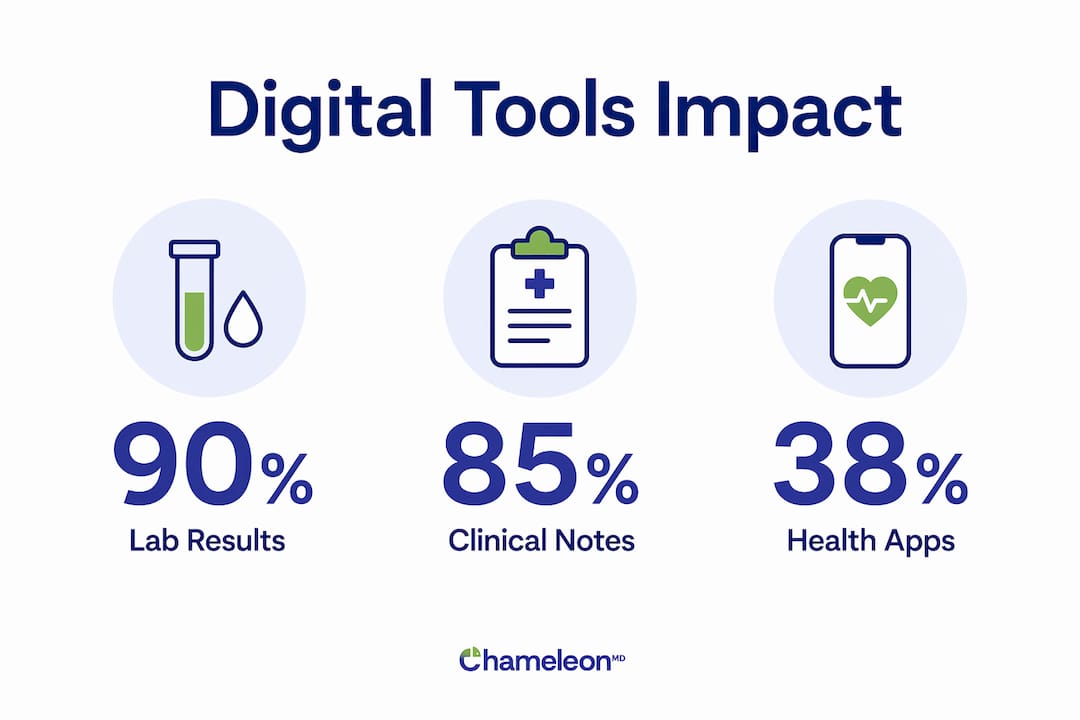
Patient portals are the most visible face of online patient-centered services. They give you a window into your electronic health record, where you can view lab results, read clinical notes your providers have written, send messages, and schedule appointments. As of 2022, portal adoption reached 68% among adults who had recent healthcare visits, up from just 37% in 2019. That’s a significant shift in how people interact with their care.

The table below shows what portal users typically access and how widely each function is used:
| Portal Function | Reported Usage |
|---|---|
| Viewing lab results | 90% of portal users |
| Reading clinical notes | 80% of portal users |
| Messaging providers | 79% of portal users |
| Scheduling appointments | 77% of portal users |
Source: 2024 portal usage data
Beyond portals, 38% of individuals now use smartphone health apps to track and manage their health. The Cures Act also gives you the right to aggregate your records from multiple providers into a third-party app of your choice, which makes care coordination across different health systems much more realistic.
One emerging tool worth knowing about is the Patient-Reported Experience Measure, or PREM. Unlike a standard satisfaction survey that asks how happy you were, a PREM captures concrete facts about care processes. Did your provider explain your medication clearly? Did someone follow up after your visit? These answers give healthcare teams specific information they can actually use to improve care, rather than a general rating that tells them very little.
Pro Tip: If a healthcare system sends you a survey after a visit, check whether it asks you about specific experiences or just general satisfaction. Systems using PREMs are demonstrating a more serious commitment to learning from your feedback.
How patient-centered online care improves your health
The practical benefits of this model are well-supported and worth understanding before you choose where to get care. When treatment aligns with your values and preferences, you’re more likely to follow through with it. That’s not a small thing. Medication adherence, lifestyle changes, and follow-up visits all improve when you feel like a participant rather than a passenger.
Here’s what a genuinely patient-centered online experience can do for you:
- Reduce anxiety: Knowing what to expect, having clear communication, and being able to message your provider between visits significantly lowers the stress that often comes with health concerns.
- Improve care for chronic conditions: For things like asthma or ongoing pain management, digital access supports coordination across multiple specialists and providers in ways that in-person visits alone cannot.
- Support your mental and emotional health: Patient-centered online platforms address emotional needs alongside physical symptoms, which is where the real quality-of-life improvements often show up.
- Speed up decisions: When you have access to your own records and can communicate quickly with a licensed provider online, you’re not waiting days to understand what’s happening with your health.
- Keep your care connected: Good online patient engagement in care means information flows between your providers, so you don’t have to repeat your full history every time you see someone new.
The bottom line is that learning how to implement patient-centered care as a patient means choosing providers and platforms that treat your preferences as a clinical input, not an afterthought.
Common pitfalls and misconceptions to watch for
Not every online healthcare experience lives up to the patient-centered label. Knowing where the gaps are helps you protect yourself and get more from your care.
- Messaging may not reach your doctor directly. Many portals route messages to a triage team first. This is normal, but patients often expect to be speaking directly with their physician. Clarify this routing with your provider’s office so you know what level of response to expect and when.
- Satisfaction surveys are not the same as patient experience data. A provider might score well on happiness ratings while still delivering care that doesn’t reflect your preferences or needs. PREMs offer specificity that satisfaction surveys simply cannot.
- Digital access does not equal patient-centered care. Giving you a portal login is not the same as listening to your feedback and changing how care is delivered. True responsiveness is structural, and not all systems have built it in yet.
- Equity gaps are real. Telehealth adoption and portal use have grown, but disparities still exist for older adults, lower-income populations, and communities with limited internet access. If you or someone you care for faces these barriers, you have every right to request accommodations.
- Not all telehealth is equal. Some platforms connect you with a licensed provider who reviews your full history. Others may offer scripted encounters with minimal personalization. Ask before you commit.
Pro Tip: Before signing up for any online care service, ask whether they use patient-reported experience measures and how they incorporate your feedback into care improvement. The answer tells you a lot about their actual commitment to patient-centered values.
How to engage effectively with online healthcare services
The patient-centered healthcare model works best when you show up prepared and willing to participate. Here’s how to get the most out of what’s available:
- Use your portal actively. Don’t just log in to check lab results. Read your clinical notes, review care summaries, and flag anything that doesn’t match what you understood during your visit. Errors in records are more common than people realize.
- Prepare for online visits the same way you would in-person. Write down your symptoms, how long they’ve been present, any medications you’re taking, and what concerns you most. This preparation ensures your preferences drive the visit.
- Ask about how your feedback is used. A provider committed to patient-centered care should be able to tell you how they collect patient experience data and what they do with it.
- Take advantage of the Cures Act. You have the legal right to access your health information through apps of your choice. This means you can aggregate records from your GP, a specialist, and an urgent care visit into one place for a clearer picture of your overall health.
- Know when to escalate. If online care isn’t meeting your needs or a situation feels urgent, don’t hesitate to ask for a same-day appointment or seek a different provider. Accessibility is a core part of the model.
For a broader look at telemedicine’s core advantages, including cost transparency and convenience, it helps to see how these principles apply in practice across different platforms.
My take on where patient-centered care online is headed
I’ve followed how healthcare systems adopt the language of patient-centered care very closely, and I’ll be honest with you. The gap between what providers say and what patients actually experience online is still significant. In my experience, most of the frustration comes from one specific mismatch: patients are given access, but not responsiveness.
A portal that lets you read your lab results is genuinely useful. But if you send a message and get a form response three days later, or if your feedback after a visit goes into a database no one reviews, then the system has not changed. It has just added a layer of technology over the same old structure. That’s not patient-centered care. It’s patient-adjacent care.
What I’ve seen actually work is when healthcare teams close the loop. When your feedback changes a protocol. When a follow-up message from a provider addresses something you raised, not something from a checklist. When the care plan shifts because you said your schedule or your priorities have changed. Those moments are rare, but they’re growing. I’m genuinely optimistic about where things are going, especially with platforms built from the ground up to serve patient needs rather than retrofitting old systems with new apps. Patients who learn to advocate for this kind of responsiveness will get better care, starting now.
— Vector
Experience patient-centered care with Chameleonhc
If you’ve read this far, you already understand what patient-centered care online should look like. You deserve care that’s built around your schedule, your preferences, and your health priorities. That’s exactly how Chameleonhc approaches virtual care.
Whether you’re managing asthma symptoms, dealing with a sudden sprain or strain, or navigating a painful dental infection, Chameleonhc connects you with licensed providers online, without a waiting room, without insurance requirements, and without hidden fees. You can also explore virtual care plans designed to give you consistent, affordable access to care that fits real life. The model is simple: you tell us what’s going on, and we help you from there.
FAQ
What is the patient-centered care definition?
Patient-centered care is care that is respectful and responsive to individual patient preferences, needs, and values, where clinical decisions are guided by the patient. The Institute of Medicine established this definition as a core quality standard for modern healthcare.
How does patient-centered care work online?
Online patient-centered care uses tools like patient portals, telehealth visits, messaging, and health apps to deliver care that respects your preferences and keeps you informed. The most effective platforms go beyond access to actively incorporate your feedback into how care is delivered.
What is the difference between a PREM and a satisfaction survey?
A Patient-Reported Experience Measure captures specific, factual information about what happened during your care encounter, while a satisfaction survey measures how you felt overall. PREMs give healthcare teams data they can act on to improve care quality.
Is telehealth considered patient-centered care?
Telehealth can be a strong expression of the patient-centered healthcare model when it prioritizes accessibility, clear communication, and alignment with your preferences. Not all telehealth platforms operate this way, so it’s worth evaluating how any provider handles your specific needs and input.
What should I ask a provider to know if they practice patient-centered care?
Ask how they collect and use patient feedback, whether your preferences are documented in your care plan, and how they handle follow-up communication. Providers committed to this model will have clear, specific answers to all three questions.