

Most telehealth weight-loss programs run $299 to $599 a month when medication is bundled into the fee, while compounded cash-pay paths can start closer to $149 to $299 a month. Branded retail drugs without insurance often top $1,000 a month. If your insurance approves coverage, copays typically land at $25 to $50 a month, and eligible Medicare beneficiaries can access certain GLP-1s for just $50 a month under a temporary federal bridge running from July 1, 2026, through December 31, 2027. Consultation fees usually add $40 to $150, whether billed separately or folded into your first visit.
TL;DR:
- The real monthly cost of telehealth weight-loss programs ranges from approximately $149 to $448, with branded drugs often exceeding $1,000 without insurance or assistance.
- Initial consultation fees vary from $40 to $150, and additional costs such as lab work, shipping, and dose escalation are frequently overlooked until later bills.
- Insurance coverage is highly inconsistent, with copays typically between $25 and $50, but many plans exclude weight-loss drugs or require prior authorization.
- The Medicare GLP-1 bridge offers a flat $50 monthly copay for eligible beneficiaries from July 2026 to December 2027, but this does not count toward annual out-of-pocket limits.
- Comparing programs requires asking for the true maintenance price, whether medication is bundled or billed separately, and verifying if drugs are compounded or brand name.
Table of Contents
- What Drives Weight Loss Telehealth Cost: Consults, Fees, and Medication
- How Much Do Real Telehealth Weight-Loss Programs Actually Cost?
- Will Insurance or Medicare Lower Your GLP-1 Weight-Loss Cost?
- How to Compare Telehealth Weight-Loss Offers Without Getting Burned
- What Will a Year of GLP-1 Weight-Loss Telehealth Actually Cost?
- Where a Transparent-Pricing Telehealth Model Fits Into This Picture
- The Real Value Play in Telehealth Weight Loss
- Get a Clear Telehealth Cost Estimate Before You Commit
- Sources
What Drives Weight Loss Telehealth Cost: Consults, Fees, and Medication
The advertised price on a landing page rarely tells you what you’ll actually pay by month three. Breaking the bill into its real parts helps you compare offers that look similar but aren’t.
The initial consultation. A first telehealth visit for weight-loss care typically costs $40 to $150 when charged separately from a program fee. Some platforms waive this if you enroll in a monthly plan; others charge it every time you see a provider, so ask directly whether follow-ups carry their own fee or are baked into your membership.
The program or membership fee. This is the recurring charge that covers clinician oversight, check-ins, and platform access. It does not always include medication. Some companies bundle everything into one number; others bill the drug separately through a pharmacy, which means your “membership” price and your real monthly total can differ by hundreds of dollars.
Medication cost itself. This is where the range gets wide. Compounded semaglutide or tirzepatide from a telehealth pharmacy partner usually costs less than the branded, FDA-approved versions like Wegovy or Zepbound purchased at retail cash price. Whether your program bundles the drug or bills it separately through your pharmacy benefit changes your monthly math significantly.
The costs people forget to ask about:
- Lab work required before or during treatment (sometimes included, sometimes $30 to $100 extra)
- Standard shipping for medication refills, which a few programs charge per shipment
- Dose-escalation fees, since moving from a starter dose to a maintenance dose often increases the drug cost tier
- Cancellation or early-termination charges if you’re locked into a multi-month commitment
None of these show up in the “starting at $X/month” banner ad. They show up on your card statement in month two. A GLP-1 online prescription arrangement that clearly separates the clinician fee from the medication charge makes it far easier to catch these add-ons before you commit.
How Much Do Real Telehealth Weight-Loss Programs Actually Cost?
Landing pages love round numbers. Real invoices are messier, and the gap between the two is where most people get surprised.
Price snapshot: Verified all-in telehealth program pricing for GLP-1 weight-loss care ranges from about $149 to $448 a month depending on the medication tier and whether the drug is compounded or branded. Branded retail cash prices for drugs like Wegovy or Zepbound frequently exceed $1,000 a month without insurance or manufacturer assistance.
Here’s how that spread typically breaks down by pathway:
- Compounded semaglutide, telehealth bundled: roughly $150 to $350 a month all-in, including provider oversight and medication.
- Compounded tirzepatide, telehealth bundled: often $250 to $450 a month, reflecting the higher base cost of tirzepatide compounds.
- Branded Wegovy or Zepbound, retail cash price: commonly $900 to $1,349 a month at list price, according to Healthinsurance, though manufacturer savings cards can lower that for eligible patients. One notable exception is Foundayo, whose list price runs closer to $350 a month, well under typical branded pricing.
- Medication-only cash price (no program, no clinician support) varies but strips out the consultation and monitoring you’d get through a supervised telehealth plan.
The number that trips people up most is the gap between a teaser rate and the real maintenance cost. A program might advertise “$99 your first month,” which reflects a low starter dose. This isn’t a scam so much as an industry pricing pattern, and price-tracking data confirms it’s the single most common source of billing surprise. Always ask for the maintenance-dose price before you enroll, not just the intro rate.
Will Insurance or Medicare Lower Your GLP-1 Weight-Loss Cost?
Coverage can cut your bill dramatically, but it’s inconsistent, and approval isn’t automatic.
Private insurance coverage for anti-obesity medications varies enormously by plan. Many employer plans exclude weight-loss drugs entirely, treating them as a lifestyle benefit rather than a medical necessity. Plans that do cover them almost always require prior authorization, which means your provider has to document your BMI, prior weight-management attempts, and sometimes related conditions like Type 2 diabetes or hypertension. When approval comes through, copays commonly fall to $25 to $50 a month. When it doesn’t, you’re back to cash pricing.
Medicaid coverage depends entirely on your state. Weight-loss drug coverage under Medicaid is optional, so some states cover it and others don’t, and the criteria differ state to state.
The Medicare GLP-1 Bridge is the biggest policy shift affecting this market. CMS announced a temporary program giving eligible Part D beneficiaries access to certain GLP-1 medications for a flat $50 monthly copay, running from July 1, 2026 through December 31, 2027. A few caveats matter here:
- The $50 copay doesn’t count toward your Part D deductible or annual out-of-pocket limit, so it exists outside your normal cost-tracking math.
- Eligibility depends on specific plan and provider enrollment rules, so not every Part D beneficiary qualifies automatically.
- You’ll want to confirm your specific drug is on the covered list before assuming the $50 rate applies.
What to do this week: call your insurer’s benefits line and ask specifically whether GLP-1 medications for weight loss are covered, what documentation triggers prior authorization, and whether your plan has a preferred formulary drug. A broker resource like Sobal Nationwide Health can also help you understand plan-specific benefit language if your policy documents are hard to parse.
How to Compare Telehealth Weight-Loss Offers Without Getting Burned
Two programs advertising “$199 a month” can mean two very different bills once you factor in what’s actually included. Run every offer through the same checklist before you sign up.
- Ask for the all-in maintenance price, not the starter-dose price. This is the number that matters at month four, not month one.
- Confirm whether medication is bundled into the program fee or billed separately through a pharmacy.
- Find out if the medication is compounded or branded. Compounded versions cost less but aren’t FDA-approved formulations, which matters for both price and sourcing transparency.
- Ask whether the platform accepts insurance or helps with prior authorization, or if it’s cash-only.
- Check the follow-up cadence. Are monthly check-ins with a licensed provider included, or is this a one-time consult followed by autoship?
- Look for lab requirements, shipping fees, and any minimum commitment or cancellation penalty before you enter payment information.
Red flags worth walking away from: a platform that promises weight loss without any documented clinician review, no clear pharmacy partner or sourcing information for the medication, a “starting at” price with no maintenance-dose figure disclosed anywhere, or pressure to commit to a multi-month contract before you’ve even had a consultation.
Pro Tip: Ask directly, in writing, “What will I pay per month once I reach my likely maintenance dose, including medication, consults, and shipping?” A program that can’t answer that in one sentence probably has a pricing structure designed to obscure it.
Clinical guidance from sources like NCBI and the Cleveland Clinic consistently emphasizes that GLP-1 medications carry real side-effect profiles and dosing considerations. A cheap program with no real clinician follow-up isn’t actually a good deal. It’s a liability wearing a discount.
What Will a Year of GLP-1 Weight-Loss Telehealth Actually Cost?
Monthly numbers are easier to compare once you see them stacked into a full year, especially since dose escalation and mid-year plan changes can shift your total.
- Scenario A, cash-pay bundled compounded semaglutide: roughly $250/month average (accounting for lower starter-dose months followed by higher maintenance-dose months), including consults and standard shipping. Annual estimate: around $3,000, assuming no dose changes beyond the initial titration period.
- Scenario B, insurance-approved path: a $25 to $50 monthly copay plus a $0 to $50 program fee if your telehealth provider charges separately for oversight. Annual estimate: roughly $300 to $1,200, depending on whether prior authorization required a paid consult and whether your plan year resets deductibles.
- Scenario C, Medicare GLP-1 Bridge beneficiary: a flat $50/month copay for eligible drugs and beneficiaries. Annual estimate: $600 for the covered portion, though this figure sits outside your Part D deductible and out-of-pocket tracking, so it won’t count toward hitting your annual out-of-pocket cap.
Every scenario assumes stable dosing. If your provider increases your dose partway through the year, or you switch medications, expect your monthly average to shift, sometimes by $100 or more, which is why the teaser-versus-maintenance gap matters so much when you’re budgeting a full year rather than a first month.
Where a Transparent-Pricing Telehealth Model Fits Into This Picture
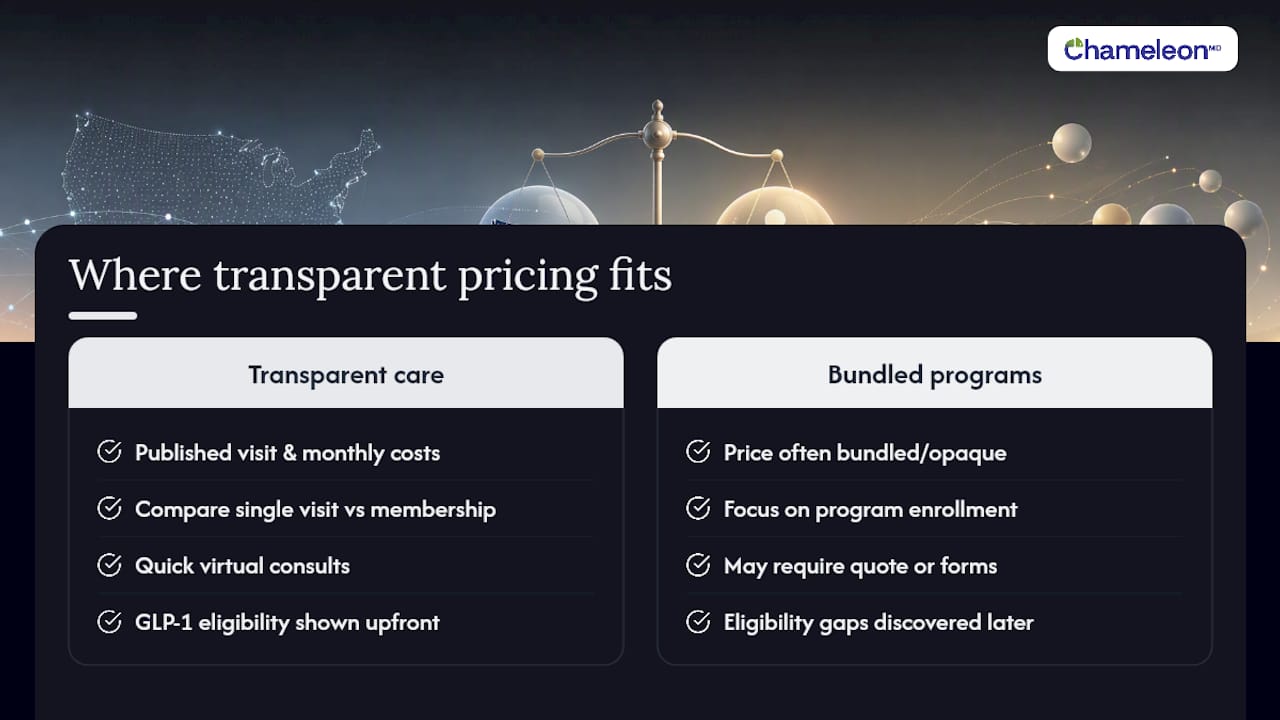
Cost-conscious patients need to know two numbers before they enroll anywhere: what a visit costs today, and what ongoing care costs next month. Some telehealth models are built around upfront clarity, whether you’re comparing a single-visit fee or a membership plan against a weight-loss-specific program.
Virtual access often allows quicker consultations to determine your actual medication quote. And because pricing is published rather than buried behind a “request a quote” form, you can compare Chameleonhc’s membership and single-visit pricing structure against any bundled weight-loss program using the same maintenance-cost math covered above. Understanding GLP-1 eligibility requirements upfront also helps you avoid enrolling in a program only to discover documentation gaps later.
The Real Value Play in Telehealth Weight Loss
Most people overthink the medication brand and underthink the billing structure. The drug matters clinically, but the thing that actually determines whether you can afford this for twelve months straight is whether your program bundles clinician oversight into one predictable price or nickel-and-dimes you with separate charges for labs, shipping, and dose changes.
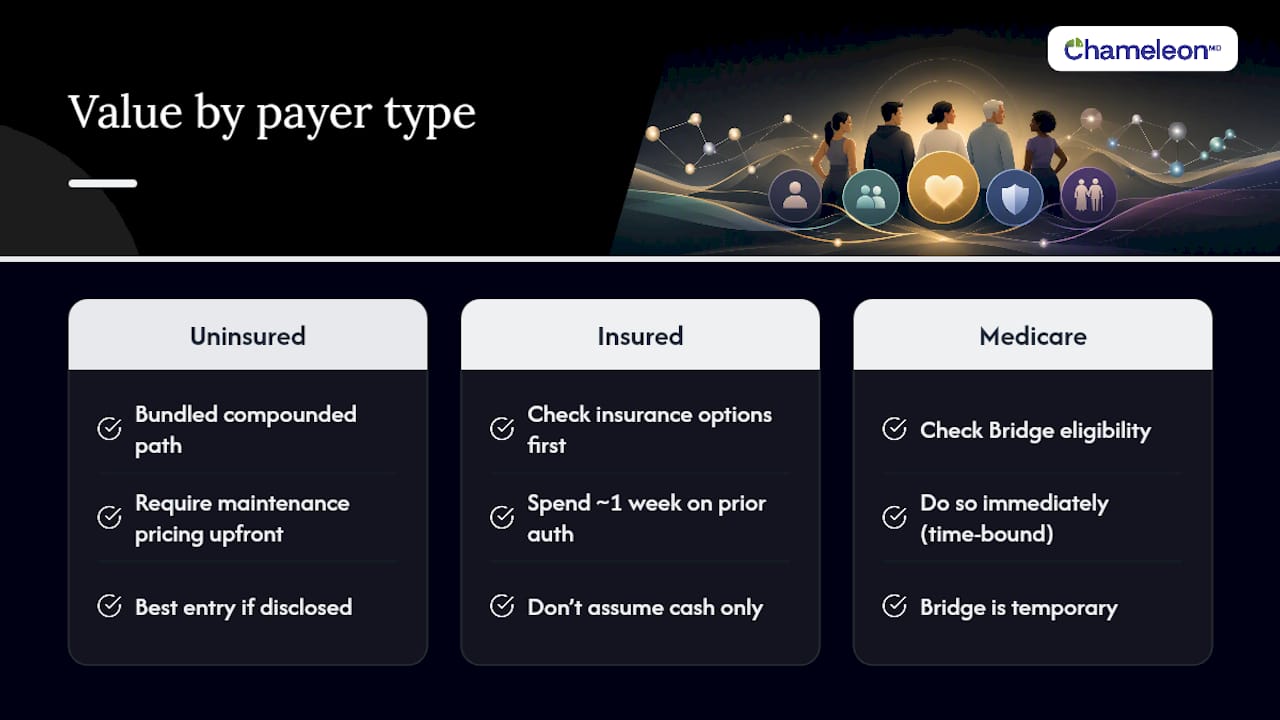
If you’re uninsured, a telehealth bundled compounded path is usually your best value entry point, provided the platform discloses maintenance pricing upfront. If you have insurance, spend a week on prior authorization before assuming cash price is your only option. If you’re on Medicare, check Bridge eligibility immediately since it’s temporary and time-bound. Whatever your situation, get a real consultation and a medication-specific quote before comparing anything on price alone.
— Vector
Get a Clear Telehealth Cost Estimate Before You Commit
Some telehealth services provide published prices you can see before booking. Depending on the provider, there may be options for single virtual visits or ongoing membership-based care, upfront pricing, prompt virtual appointments, and no requirement for insurance to access timely consultations.

If you’re weighing a weight-loss telehealth program against your broader healthcare needs, comparing telehealth cost against traditional clinic visits is a useful next step, especially if you’re also managing routine conditions alongside a weight-management plan. Ready to see where you stand? Check current visit pricing on the asthma care page as an example of Chameleonhc’s transparent per-visit model, or book an initial consultation to get a personalized cost estimate for your situation.
This article is general information, not a substitute for advice from a qualified doctor. Consult a qualified healthcare professional about your own circumstances before acting on anything here.
Sources
- Coming Soon: CMS to Provide $50 Monthly Access to GLP-1 Medications for Medicare Beneficiaries
- Weight loss drugs | Medicare
- GLP-1 Telehealth Price Report 2026: $149 to $448/mo