

TL;DR:
- Small businesses can use telehealth as a cost-effective, integral part of their healthcare strategy to reduce costs and improve access. It offers faster care, addresses common conditions, and supports mental health, making employees healthier and more engaged. Integrated, predictable plans promote higher utilization, transforming telehealth from a perk into essential infrastructure.
Most small business owners think of telehealth as a nice perk, something to tack onto a benefits package once the company grows. That assumption is costing you money. The role of telehealth in small business is far more fundamental than a convenience feature. It’s a practical way to give your team real access to medical care while keeping healthcare costs from swallowing your operating budget. This article breaks down exactly how it works, what it costs, and how to make it work for your team.
Table of Contents
- Key takeaways
- Healthcare costs and access for small businesses
- How telehealth addresses key pain points
- Choosing a telehealth solution for your team
- Measuring telehealth ROI over time
- My take on telehealth as business infrastructure
- Get your team covered with Chameleonhc
- FAQ
Key takeaways
| Point | Details |
|---|---|
| Telehealth reduces hard costs | Virtual visits save an average of $186 and nearly 3 hours per appointment compared to in-person care. |
| Traditional insurance is increasingly unaffordable | Average group coverage now costs around $17,000 per employee, pushing small businesses toward alternative care models. |
| Subscription plans are budget-friendly | Telehealth plans typically run $10 to $40 per employee monthly with no per-visit fees. |
| Integration drives utilization | Platforms that connect with existing HR systems reduce administrative burden and get more employees actually using the benefit. |
| Telehealth is care infrastructure, not a perk | It closes the gap between having health benefits and employees actually receiving care when they need it. |
Healthcare costs and access for small businesses
If you run a small business, you already know that offering health coverage is expensive. What you might not realize is how much worse it has gotten. Average group insurance costs have climbed to roughly $17,000 per employee annually for small businesses. That number alone stops many owners from offering coverage at all.
When employees don’t have health benefits, the downstream effects show up quickly. People skip routine care, delay addressing infections or injuries, and end up missing more work days. Absenteeism rises. Morale dips. And the productivity loss adds up faster than you might expect.
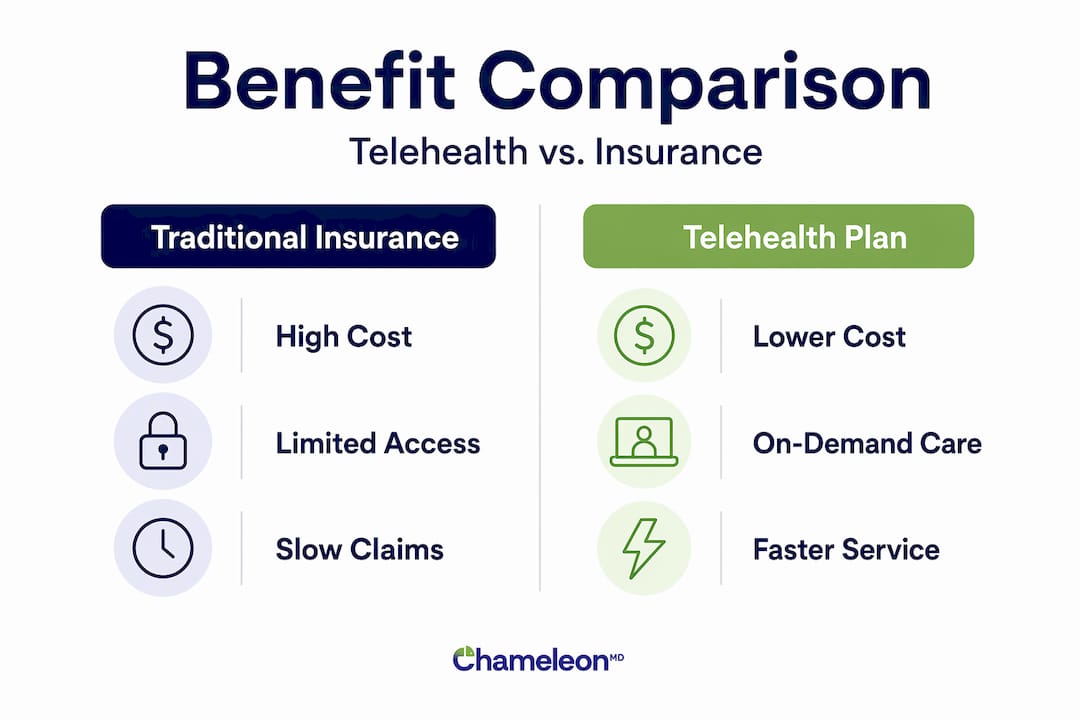
The table below shows how traditional insurance stacks up against telehealth-based care models on a few critical dimensions:
| Factor | Traditional group insurance | Telehealth subscription plan |
|---|---|---|
| Monthly cost per employee | $1,200 to $1,500+ | $10 to $40 |
| Employee wait time for care | Days to weeks | Same day |
| Absenteeism impact | High (travel + wait time) | Low (virtual access) |
| Mental health access | Often limited | Frequently included |
| Administrative complexity | High | Low to moderate |
Small businesses increasingly prefer telehealth as a baseline employee benefit precisely because the math works. You don’t have to choose between going broke and leaving your team without care. Telemedicine in small enterprises fills the gap that traditional insurance leaves wide open.
How telehealth addresses key pain points
The practical telehealth benefits for small businesses come down to three things: cost, time, and access. When an employee needs care, every hour spent traveling to a clinic, sitting in a waiting room, and returning to work represents lost productivity. Virtual visits save an average of $186 and nearly 3 hours per appointment compared to in-person visits. Multiply that across a team of 20 people over a year, and the savings become significant.

Access matters just as much as cost. If your workforce includes employees in rural areas or anyone without reliable transportation, telehealth removes the biggest barrier to care. Telehealth eases access disparities across geographically diverse teams, making care available regardless of location or schedule.
Here are the most common care needs your employees can address through telehealth:
- Urgent care issues like sore throats, sinus infections, ear infections, rashes, and urinary tract infections
- Mental health support including therapy sessions and medication management for anxiety and depression
- Chronic condition check-ins for conditions like asthma or hypertension where regular monitoring matters
- Minor injuries such as sprains, strains, and skin concerns that don’t require an ER visit
- Prescription refills and follow-up consultations without requiring a separate appointment
Mental health access deserves special attention here. Virtual mental health offerings increase utilization specifically because employees can access care privately, flexibly, and without taking a half day off work. For small businesses where every person counts, having your team supported mentally and emotionally is not a luxury.
Pro Tip: When evaluating telehealth services for startups or small teams, look for plans that include mental health therapy as part of the base subscription rather than an add-on. Employees use benefits they don’t have to navigate extra steps to access.
Telehealth also acts as care infrastructure that closes the gap between having health benefits and employees actually using them. Coverage without access is just paperwork.
Choosing a telehealth solution for your team
Selecting the right platform matters more than most people realize. The wrong choice creates more administrative headaches and leads to employees ignoring the benefit entirely. Here’s a straightforward process for making the right call:
- Audit your current setup. Understand what benefits you already offer and where the gaps are. If employees are skipping care because of cost or inconvenience, telehealth addresses both.
- Prioritize integrated platforms. Standalone telehealth vendors increase administrative complexity and reduce employee adoption when they’re not connected to existing HR or benefits systems. Look for platforms that fit inside the tools your HR team already uses.
- Compare subscription models. Telehealth subscription plans typically cost $10 to $40 per employee monthly with unlimited virtual urgent care and mental health therapy included. No per-visit fees means predictable budgeting.
- Match features to workforce needs. A team of remote workers spread across multiple states needs different coverage than a team of hourly workers in a single location. Consider factors like mental health access, prescription services, and bilingual support.
- Evaluate the onboarding experience. The best telehealth platforms make adoption easier for HR teams by minimizing the administrative work required to enroll employees and manage the account.
The difference between synchronous video visits and asynchronous care (where an employee submits their symptoms and receives a response later) matters depending on your team’s workflow. Some employees prefer the flexibility of async care. Others want to speak with a provider in real time. A good platform offers both.
Pro Tip: Before signing any telehealth contract, ask the vendor for utilization data from comparable small businesses. A plan with low actual usage among similar teams is a warning sign that adoption will be a struggle, regardless of how good the features look on paper.
If you’re exploring how small businesses can implement telehealth practically, the biggest mistake is choosing a platform based on features alone without testing the employee experience.
Measuring telehealth ROI over time
The clearest way to measure the return on a telehealth investment is to look at what it replaces. Telehealth usage reduces avoidable urgent care and ER visits, both of which carry costs that ripple far beyond the bill itself. An ER visit for a sinus infection can run $500 to $2,000 and pulls an employee out for half a day or more. A virtual visit handles the same issue in under 30 minutes.
Beyond direct cost savings, there’s the employee retention angle. Teams that have easy access to care feel more supported. Telehealth improves workforce stability through faster access and better benefit utilization, and that translates directly into lower turnover costs for small businesses.
A few areas where ROI shows up over time:
- Fewer unplanned absences as employees address health issues quickly rather than waiting them out
- Reduced pressure on any traditional insurance plan you carry, since telehealth handles a high volume of routine issues
- Improved engagement among employees who see healthcare access as a genuine part of their compensation
Some small businesses pair telehealth with an Individual Coverage Health Reimbursement Arrangement (ICHRA) rather than traditional group insurance. This lets employees choose their own coverage while the business controls costs. Telehealth sits alongside that as a low-cost, high-use layer that handles most day-to-day care needs.
The one pitfall to avoid: treating telehealth as an add-on rather than a core part of your care strategy. When employees view it as optional or secondary, utilization stays low and the ROI never materializes. Positioning it clearly as your team’s first stop for everyday health concerns makes all the difference. You can find more context on virtual care approaches that small companies have used successfully.
My take on telehealth as business infrastructure
I’ve worked with a lot of small business owners who view telehealth as something they’ll “add later,” once the team is bigger or the budget loosens up. In my experience, that thinking has it backwards.
The businesses that get the most value from telehealth are the ones that treat it like they treat payroll software or accounting tools. It’s not a perk. It’s part of how you run a functioning operation. Healthcare concerns have a way of showing up at the worst times, and having a system that gives employees a clear, easy path to care is what separates businesses with stable, productive teams from those constantly dealing with absences and turnover.
What I’ve also seen is that integrated platforms consistently outperform standalone apps in real-world usage. When employees have to log into a separate system they’ve never used before, they don’t. When care is one click away from where they already are, they use it. The impact of telehealth on business outcomes comes down almost entirely to whether employees actually engage with the benefit. That means employers have to do more than just purchase a plan. They need to communicate it, reinforce it, and make it feel like a normal part of working there.
I also think the mental health component is systematically undervalued by employers right now. It’s the benefit that employees want most and use least, usually because the access model is too complicated. Telehealth fixes that.
— Vector
Get your team covered with Chameleonhc
If you’re ready to give your employees real healthcare access without the cost and complexity of traditional insurance, Chameleonhc makes it straightforward.
Chameleonhc offers telehealth subscription plans built for small businesses, with same-day access to licensed providers, virtual urgent care, and mental health support included. Employees can connect from their phone or computer to get care for everyday conditions like sore throats, tooth infections, sinus issues, and minor injuries without waiting rooms or insurance requirements. Pricing is transparent and predictable, so you always know what you’re budgeting. If you want a virtual care plan that your team will actually use, Chameleonhc is built for exactly that.
FAQ
What is the role of telehealth in small business?
Telehealth gives small businesses a cost-effective way to provide employees with real access to medical care, reducing absences, lowering healthcare spending, and improving overall workforce stability compared to relying solely on traditional insurance.
How much do telehealth plans cost for small businesses?
Subscription-based plans typically cost between $10 and $40 per employee per month, with no additional per-visit fees, making them far more predictable than traditional group insurance premiums.
Can telehealth replace traditional health insurance for small businesses?
Telehealth works best alongside other coverage options rather than as a complete replacement, though many small businesses use it as a primary care layer paired with catastrophic coverage or ICHRA arrangements to control costs.
Why does integration matter when choosing a telehealth platform?
Platforms that connect with your existing HR systems reduce administrative work and make it easier for employees to access care. Fragmented or standalone apps consistently show lower employee adoption, which reduces the benefit’s value entirely.
What conditions can employees treat through telehealth?
Employees can address a wide range of common conditions through telehealth, including sinus infections, skin rashes, urinary tract infections, sprains and strains, anxiety, and many other everyday health concerns without visiting a clinic.