

TL;DR:
- Not all online healthcare providers are equally qualified, and licensing ensures legal authority to diagnose, treat, and prescribe.
- Patient location determines licensing jurisdiction, making it essential to verify provider licensure in your state to ensure safety and compliance.
Not every online healthcare provider is the same, and that difference can genuinely affect your health. The role of licensed online providers goes far beyond having a logo and a booking page. Licensing determines whether a provider is legally qualified to diagnose, treat, and prescribe, and whether you have real recourse if something goes wrong. If you are exploring affordable virtual care without insurance, understanding what licensing actually means is the single most important step you can take before scheduling your first visit.
Table of Contents
- Key takeaways
- The role of licensed online providers explained
- How online provider regulations actually work
- What licensing actually does for you as a patient
- Challenges you should know about in online care
- How to choose a trusted licensed online provider
- My take on why licensing cannot be optional
- Get affordable, licensed virtual care with Chameleonhc
- FAQ
Key takeaways
| Point | Details |
|---|---|
| Licensing is legally required | A license is a government-issued requirement, not a voluntary credential or marketing badge. |
| Your location determines jurisdiction | Providers must be licensed in the state where you are physically located during your session. |
| Licensing boards protect you | Licensed providers can face formal complaints, discipline, and license revocation if they cause harm. |
| Not all platforms are equal | Platform branding does not replace clinical accountability. Always verify provider licensure directly. |
| Affordable care does not mean unregulated care | Licensed telehealth services offer transparent, quality care without requiring traditional insurance coverage. |
The role of licensed online providers explained
When people talk about licensing in healthcare, the terminology can feel confusing. Licensing, credentialing, and certification are often used interchangeably, but they mean very different things, and only one of them is legally required.
A license is issued by a government authority, typically a state licensing board, and it is the legal baseline that allows a provider to practice medicine, therapy, or nursing. Without it, practicing is illegal. Credentialing, on the other hand, is a process healthcare organizations use to verify a provider’s background, education, and history before granting them privileges at a facility. Certification is a voluntary designation awarded by professional organizations to recognize specialty knowledge.
Licensed providers complete graduate-level education, thousands of supervised clinical hours, national licensing exams, and ongoing continuing education overseen by state boards. That process is not a formality. It is how the system verifies that the person you are trusting with your health actually knows what they are doing.
| Type | Who Grants It | Legally Required? | Ongoing Oversight? |
|---|---|---|---|
| License | State government board | Yes | Yes, with renewal requirements |
| Credentialing | Healthcare facility or payer | No | Varies by organization |
| Certification | Professional association | No | Yes, renewal often required |
Pro Tip: When you search for a virtual care provider, look specifically for language about state licensure, not just “certified” or “credentialed.” Those terms sound official but do not carry the same legal weight as a state-issued license.
How online provider regulations actually work
One of the most misunderstood aspects of telehealth is where a provider’s license applies. The rule is straightforward but catches many people off guard. Patient location determines the legal jurisdiction for telehealth. That means your provider needs to be licensed in the state where you are sitting during the session, not just the state where their practice is based.
This creates real complexity for providers who want to serve patients across multiple states. Most must obtain individual licenses in each state where they treat patients. Some specialties have found a workaround through interstate compacts. For example, PSYPACT allows qualified mental health providers to practice in member states without holding a separate full license in each one, as of December 2025. Similar compacts exist for nurses and physicians, though coverage varies by state.
Federal law also shapes what licensed providers can do online. The Ryan Haight Act governs controlled substance prescribing via telehealth. As of April 2026, controlled substance prescriptions generally require an in-person evaluation, with stricter limits expected to resume for new patients seeking telehealth prescriptions for stimulants. This is especially relevant if you are seeking mental health care or treatment for ADHD through online services.
| Licensing Pathway | Who It Applies To | Key Requirement |
|---|---|---|
| Single state license | Most telehealth providers | Must be licensed in patient’s state |
| PSYPACT | Licensed mental health providers | Membership in compact state required |
| Temporary telehealth registration | Some states during emergencies | Limited scope and time-bound |
| Nurse Licensure Compact | Registered and licensed practical nurses | Multistate privileges through compact |
Pro Tip: If you travel frequently, check whether your online provider is licensed in the states you commonly visit. You may need to pause care or transition to a provider with multi-state coverage to stay within the law.
What licensing actually does for you as a patient
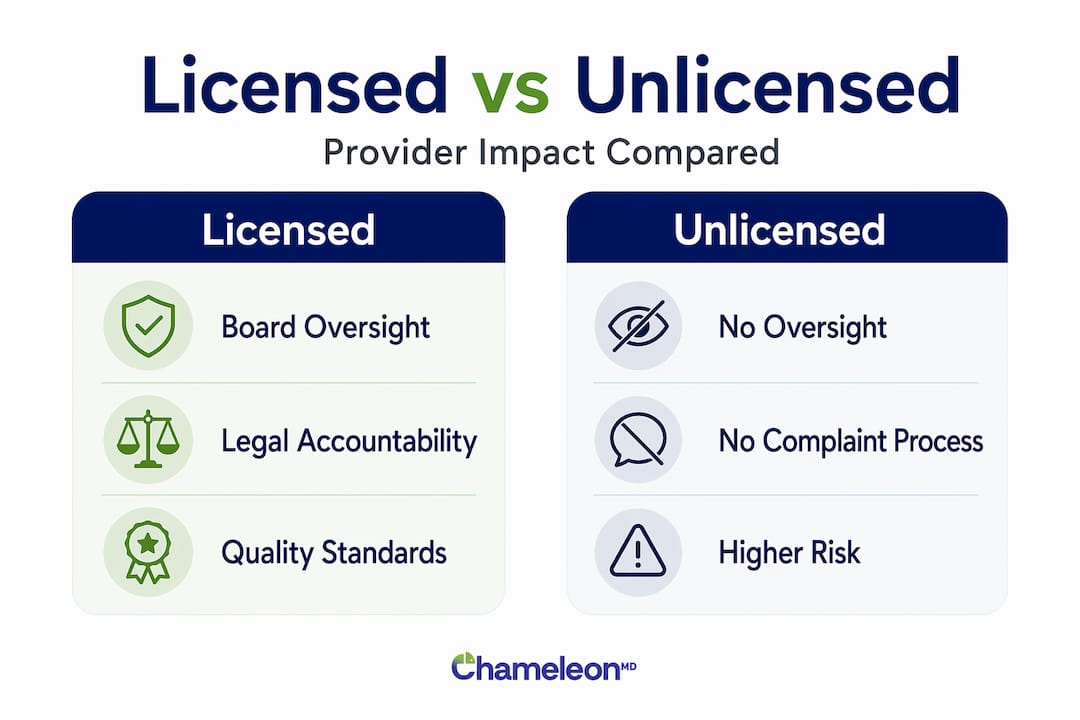
Understanding licensing regulations matters, but what really counts is how those rules protect you in practice. Licensed providers are not just qualified on paper. They are professionally accountable in ways that unlicensed practitioners simply are not.
Here is what you actually gain by choosing a licensed online provider:
- Ethical enforcement: Licensed providers must follow a code of ethics set by their licensing board. Violations can trigger formal investigations, not just negative reviews.
- Confidentiality protections: Research shows that confidentiality is a primary ethical concern in online care, and licensed providers are required to use secure platforms and follow HIPAA standards.
- Scope of practice limits: Licensed providers must work within their areas of expertise and refer you to a specialist when your needs exceed their qualifications. This is a feature, not a limitation.
- Complaint and recourse systems: Licensing boards provide enforceable complaint processes and can revoke or suspend a provider’s license if they cause harm or act unethically.
- Ongoing competency: Continuing education requirements mean your provider is not practicing on outdated knowledge from a decade ago.
- Two-way clinical dialogue: Safe online services involve a real conversation with a licensed prescriber, not just a questionnaire and an auto-generated treatment plan.
One thing consumers often overlook is the danger of confusing platform credibility with clinical accountability. A polished website or a recognizable app does not mean the providers on that platform are licensed and monitored. Oversight varies widely between telehealth platforms, and it is your responsibility as a patient to verify the credentials of the individual treating you, not just the brand behind the service.
Challenges you should know about in online care
Even with a fully licensed provider, telehealth has real limitations that are worth understanding before you start. Knowing them up front helps you make smarter choices and get better care.

The most cited issue is communication quality. Providers benefit from specific training in digital communication and ethics, because reading body language, facial expressions, and tone is harder through a screen. Not every licensed provider has that training. When evaluating a telehealth service, it is worth asking whether their providers have experience in virtual care specifically, not just traditional in-person practice.
Technical interruptions are another real consideration. A dropped call mid-consultation is frustrating at best and a genuine care gap at worst. Licensed providers are trained to document sessions carefully and maintain continuity even when technology gets in the way. Well-designed telehealth platforms also build in protocols for handling dropped connections or incomplete consultations.
Location-based licensing also creates complications if you are traveling. Providers must verify your location at each session and maintain documentation to comply with jurisdictional laws. This is one reason why platforms with multi-state licensed providers give you more flexibility and fewer interruptions in your care.
Pro Tip: Before starting care with any online provider, visit your state’s medical licensing board website and search the provider’s name directly. Most states offer free, public license verification tools. This one step can save you from a situation that feels safe but is not.
How to choose a trusted licensed online provider
You now have the background knowledge. Here is how to put it into practice when evaluating your options for affordable virtual care without insurance.
- Verify the license directly. Do not rely on the platform’s claims. Visit your state medical board’s website and search the provider by name. Confirm the license is active and in good standing.
- Ask about multi-state coverage. If you travel between states, ask whether the provider holds licenses in other states or participates in any interstate compacts.
- Confirm scope of practice. Ask the provider directly what conditions they treat and what they will refer out. A good provider will answer this clearly and without hesitation.
- Look beyond the marketing. Check whether the platform discloses individual provider credentials, not just general brand claims. Transparency here is a strong signal of quality.
- Understand the pricing upfront. Licensed telehealth services for care without insurance barriers should offer clear, predictable pricing before your visit begins.
- Protect your privacy. Confirm the platform is HIPAA-compliant and uses encrypted communication for sessions and messages.
- Consider membership options. Telehealth membership plans often give you faster access and lower per-visit costs, making ongoing licensed care genuinely affordable.
Whether you need help managing a sinus infection, a skin rash, or a recurring condition, these steps apply every time you choose a new provider or platform.
My take on why licensing cannot be optional
I’ve spent years watching people make healthcare decisions based on convenience alone, and I understand why. When you are dealing with an unexpected illness or managing a condition without insurance, speed and cost naturally come first. But what I’ve learned is that convenience and safety are not in conflict when you know what to look for.
The most common mistake I see is trusting a platform’s reputation instead of verifying a provider’s individual license. A well-branded app can still host unlicensed practitioners, and without a licensing board in the picture, your options for recourse are limited to a customer service email. That is not a safety net.
I’ve also seen how quickly regulations evolve in telehealth. The rules around controlled substance prescribing, interstate practice, and platform compliance have changed significantly in just the last few years. Consumers who stay informed about state licensing laws and how they affect their care are always in a stronger position than those who assume everything is being handled behind the scenes.
My honest opinion: licensing is the non-negotiable baseline for any online care you receive. Everything else, price, convenience, speed, is a benefit you can evaluate after you have confirmed that your provider is legally qualified and accountable. Never reverse that order.
— Vector
Get affordable, licensed virtual care with Chameleonhc
If you want the peace of mind that comes with licensed, regulated care and the convenience of not needing insurance, Chameleonhc was built exactly for that.
Chameleonhc connects you with licensed providers online for same-day care, with transparent pricing and no waiting rooms. Whether you are managing a tooth infection, dealing with an unexpected rash, or looking for ongoing support through a virtual care plan, Chameleonhc’s providers are licensed, compliant, and ready to help. The platform is designed around real life. You should not have to choose between quality care and what you can actually afford. With Chameleonhc, you do not have to.
FAQ
What does it mean for an online provider to be licensed?
A licensed online provider has met government-mandated education, examination, and training requirements set by a state licensing board, giving them the legal authority to diagnose and treat patients in that state.
How can I verify a telehealth provider’s license?
Visit your state medical or professional licensing board’s website and search the provider’s full name. Most states offer free public lookup tools that show active license status.
Does my provider need to be licensed in my state specifically?
Yes. Patient location determines jurisdiction in telehealth, so your provider must hold a valid license in the state where you are physically located during your session.
What happens if I use an unlicensed online provider?
Unlicensed providers have no licensing board oversight, meaning there is no formal complaint process or enforcement mechanism if care is negligent or harmful. You lose the primary consumer protection that licensing provides.
Are licensed telehealth services really affordable without insurance?
Yes. Many licensed telehealth platforms, including membership-based models, offer clear flat-rate pricing for common conditions that is significantly lower than traditional office visits, with no insurance required.