

TL;DR:
- Telehealth enables busy professionals to access medical and mental health services remotely, saving over 59% of their time compared to in-person visits. It offers benefits like lower costs, flexible scheduling, and reduced exposure to illness, making routine care more convenient and efficient. Proper platform selection, privacy precautions, and preparation maximize virtual care’s effectiveness and safety.
Telehealth is defined as the delivery of healthcare services through digital technology, allowing patients to consult licensed providers remotely without visiting a clinic. For busy professionals, this model of virtual care addresses one of the most persistent barriers to getting medical attention: time. Research confirms that telemedicine patients report over 59% time savings compared to in-person visits, a figure that translates directly into fewer disrupted workdays and less calendar juggling. The role of telehealth for busy professionals goes well beyond convenience. It covers mental health support, chronic condition monitoring, and even Medicare-covered services, all accessible from your phone or laptop.
What are the primary benefits of telehealth for busy professionals?
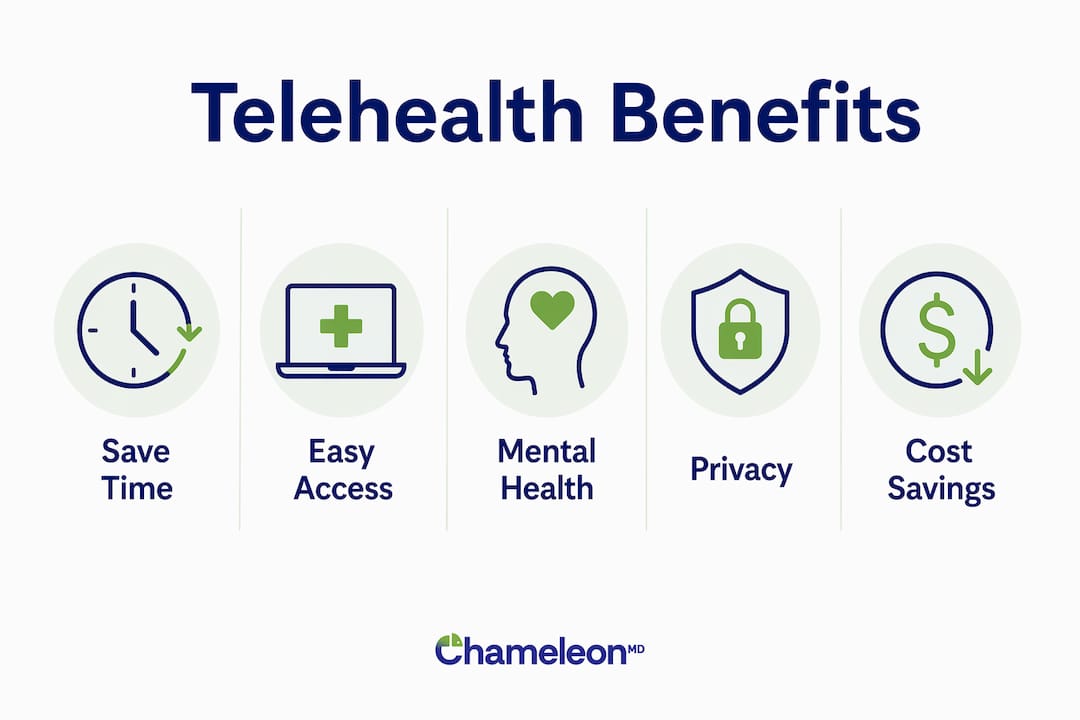
Telehealth’s most immediate benefit is time recovery. Studies show that telemedicine patients avoid overcrowding in over 70% of cases, meaning you skip the waiting room entirely and get care on your schedule. For a professional with back-to-back meetings, that difference is the gap between addressing a health concern the same day or postponing it for weeks.

Cost is the second major advantage. Research comparing telehealth to in-person primary care found that telehealth costs significantly less per consultation, with patient satisfaction scores of 4.2 out of 5 for virtual visits versus 3.3 out of 5 for in-person care. Lower cost and higher satisfaction together make a compelling case for virtual care as a default for routine and follow-up appointments.
Here is what busy professionals consistently gain from telehealth over traditional in-person visits:
- No commute or waiting room time. You connect from your office, home, or anywhere with a stable internet connection.
- Same-day access for common conditions. Sore throats, sinus infections, rashes, and urinary tract infections are diagnosable and treatable without a physical exam in most cases.
- Reduced exposure to illness. Sitting in a clinic waiting room carries real infection risk, especially during flu season. Virtual visits eliminate that entirely.
- Flexible scheduling. Many telemedicine platforms for busy professionals offer early morning, evening, and weekend appointments that traditional clinics do not.
- Lower out-of-pocket costs. Virtual consultations typically cost less than in-person visits, and many are covered by insurance or Medicare.
Pro Tip: Use telehealth for prescription refills, lab result reviews, and follow-up appointments first. These visit types are ideal for virtual care and free up in-person slots for situations that genuinely require a physical exam.
The top benefits of telemedicine extend to working parents as well. Telehealth tips for busy parents often center on the same core advantages: no need to arrange childcare for a clinic visit, faster access to pediatric advice, and the ability to handle a child’s minor illness from home during a lunch break.
How does telehealth support mental health care for professionals?
Mental health care is one of the most underused benefits available to busy professionals, largely because scheduling and stigma create friction. Telehealth removes both barriers. A retrospective cohort study of 2,984 patients at Two Chairs found that 99% of therapy sessions were delivered virtually, with sessions consistently lasting 45 to 55 minutes and using standardized symptom tracking tools.
Those tools, specifically the PHQ-9 for depression and the GAD-7 for anxiety, allow clinicians to monitor your progress between sessions without requiring additional appointments. This approach is called measurement-based care, and it is the standard in high-quality teletherapy programs. For a professional managing stress, burnout, or anxiety, having a structured, data-informed care plan that fits into a predictable weekly slot is far more sustainable than sporadic in-person therapy.
Technology also reduces the administrative burden on clinicians, which means more of your session time is spent on actual care. Clinical decision support tools integrated into teletherapy platforms improve treatment retention and outcomes in routine practice settings. That matters for busy adults who need care that works efficiently, not just care that is convenient.
If you are considering starting mental health treatment online, platforms that specialize in conditions like anxiety and depression offer structured intake processes and licensed providers experienced in virtual delivery. A practical guide to starting online mental health care can help you understand what to expect from your first session and how to prepare.
Pro Tip: Before your first teletherapy session, write down three specific situations from the past two weeks that affected your mood or focus. Concrete examples help your provider calibrate the right assessment tools from the start.
What privacy and security considerations matter for telehealth users?
Privacy is a legitimate concern, and understanding the basics protects you without requiring a law degree. HIPAA, the Health Insurance Portability and Accountability Act, governs how your health information is handled by providers and the platforms they use. Complete HIPAA compliance for telehealth requires documented policies, technical safeguards like encryption and multi-factor authentication, and formal agreements with any vendor that handles your protected health information (PHI).
As a patient, your role is simpler but still important. Follow these steps to protect your privacy during virtual visits:
- Use a private, quiet space. Avoid shared offices, coffee shops, or any location where others can hear your conversation.
- Verify the platform is HIPAA-compliant. Consumer video tools like FaceTime or standard Zoom are not approved for telehealth without specific configurations.
- Confirm your provider’s identity. Reputable platforms verify provider credentials. You should also confirm you are speaking with the correct licensed professional before sharing health details.
- Review consent forms carefully. Understand what data is collected, how it is stored, and who can access it.
- Ask about Business Associate Agreements. Any third-party vendor handling your PHI must have a signed BAA with your provider. Minimizing PHI disclosures and executing these agreements are foundational to a compliant telehealth workflow.
Pro Tip: Before your first appointment on any new platform, search the platform name plus “HIPAA compliance” to confirm it meets federal standards. Reputable services publish this information publicly.
How does Medicare coverage affect telehealth access in 2026?
Medicare coverage of telehealth changed significantly in 2026. The Centers for Medicare and Medicaid Services (CMS) simplified how telehealth services are added to the covered list by removing the distinction between provisional and permanent telehealth services. This change also expanded which providers can deliver telehealth services, now including Federally Qualified Health Centers (FQHCs) and Rural Health Clinics (RHCs) as eligible distant sites.
Coverage still depends on where you are located and what type of service you need. The table below summarizes the key variables:
| Coverage Factor | What It Means for You |
|---|---|
| Patient location | Rural and certain urban areas have broader coverage; verify your originating site eligibility |
| Service type | Most evaluation and management visits are covered; some specialty services require prior authorization |
| Provider type | FQHCs and RHCs are now eligible distant sites under 2026 CMS rules |
| Audio-only services | Covered under specific waivers for patients without video capability |
| Out-of-pocket costs | Vary by plan and service; always verify before your appointment |
Medicare telehealth eligibility varies based on originating site and provider type, so checking your specific plan before assuming coverage is the only reliable approach. Unexpected out-of-pocket costs are avoidable with a quick eligibility check before scheduling. For professionals without insurance or those navigating coverage gaps, understanding telehealth care without insurance is equally worth reviewing.
What practical tips help you get the most from virtual care?
Getting real value from telehealth comes down to preparation and choosing the right visit type. Not every health concern is suited for a virtual appointment, and knowing the difference saves you time and prevents misdiagnosis.
Use telehealth for:
- Follow-up appointments after an in-person diagnosis or procedure
- Prescription refills for stable, ongoing conditions
- Non-urgent symptoms like mild rashes, cold symptoms, or minor infections
- Mental health check-ins and therapy sessions
- Lab result reviews where no physical exam is needed
Reserve in-person care for new symptoms that are severe, rapidly worsening, or involve chest pain, difficulty breathing, or significant injury. Privacy concerns and misdiagnosis risk remain the top barriers physicians cite, and both are reduced when patients prepare thoroughly and select visit types carefully.
Before your appointment, write down your symptom timeline, any medications you are currently taking, and any relevant changes in your health over the past few weeks. This preparation directly improves diagnostic accuracy. Also confirm your internet connection is stable and have a phone number ready as a backup if video fails.
Research shows that patient comfort and perceived quality are the strongest predictors of telehealth acceptance, with comfort showing odds ratios between 4.15 and 20.3. This means the experience itself matters as much as the outcome. Choosing a platform that is easy to use and feels reliable keeps you engaged in your care over time.
Pro Tip: Test your camera, microphone, and internet connection five minutes before any telehealth appointment. A technical issue at the start of a session wastes your provider’s time and yours.
Key takeaways
Telehealth works best for busy professionals when it is used strategically: for the right visit types, on HIPAA-compliant platforms, with preparation that gives providers the information they need to deliver accurate care.
| Point | Details |
|---|---|
| Time and cost savings | Telehealth patients report over 59% time savings and lower per-visit costs than in-person care. |
| Mental health continuity | Measurement-based care tools like PHQ-9 and GAD-7 enable structured, trackable teletherapy for busy schedules. |
| Privacy protection | Use HIPAA-compliant platforms, private spaces, and verify Business Associate Agreements before sharing health data. |
| Medicare coverage in 2026 | CMS expanded eligible providers and removed provisional distinctions; always verify your specific plan eligibility. |
| Preparation drives outcomes | Clear symptom timelines and correct visit type selection reduce misdiagnosis risk and improve care quality. |
Why telehealth works best when you treat it like a tool, not a shortcut
I have spent years watching professionals approach telehealth the same way they approach a quick Google search: fast, low-effort, and with the expectation of an instant answer. That mindset produces mediocre results. The professionals who get genuine value from virtual care treat each appointment with the same preparation they would bring to an important meeting.
The research on measurement-based care in teletherapy is the clearest example of this. When patients and providers use structured tools like the PHQ-9 consistently, outcomes improve and care attrition drops. That does not happen by accident. It happens because both sides show up prepared and engaged.
My honest view is that telehealth is not a replacement for in-person care. It is a complement that, when used correctly, makes in-person care more targeted and less frequent. The professionals who blend both wisely, using virtual visits for routine management and reserving clinic time for complex or new presentations, end up with better health outcomes and fewer disrupted workdays. The pros and cons of virtual healthcare are real on both sides, and understanding them is what separates smart users from frustrated ones.
Verify your coverage, choose your platform carefully, and prepare before every session. Telehealth rewards the same habits that make you effective at work.
— Vector
How Chameleonhc makes virtual care simple for busy professionals
If you are ready to put telehealth to work in your schedule, Chameleonhc is built for exactly that. The platform connects you with licensed providers online for same-day care, with clear pricing and no insurance required.
Chameleonhc covers a wide range of conditions, from sore throats and sinus infections to asthma management and sprains and strains, all without a waiting room. Whether you are a time-strapped executive or a working parent fitting care into a packed day, the platform is designed to remove friction from the process. Explore telehealth subscription plans that give you on-demand access to care at a price that makes sense, with no surprise bills.
FAQ
What is the role of telehealth for busy professionals?
Telehealth gives busy professionals on-demand access to licensed medical providers without commuting or waiting, covering everything from prescription refills to mental health care. Research shows patients report over 59% time savings compared to in-person visits.
Is telehealth covered by Medicare in 2026?
Yes, Medicare covers a broad range of telehealth services in 2026 following CMS rule changes that removed the provisional versus permanent service distinction and expanded eligible providers to include FQHCs and RHCs. Coverage still depends on your location and service type, so verifying eligibility before your appointment is necessary.
How do I use telehealth safely and privately?
Use a HIPAA-compliant platform, conduct sessions in a private space, verify your provider’s identity, and confirm that any third-party vendor handling your health data has a signed Business Associate Agreement with your provider.
Can telehealth replace in-person care entirely?
Telehealth is most effective as a complement to in-person care, not a full replacement. Follow-ups, prescription management, and mental health sessions work well virtually, while new or severe symptoms typically require a physical exam for accurate diagnosis.
How does telehealth support mental health for working adults?
Teletherapy platforms using measurement-based care tools like PHQ-9 and GAD-7 allow clinicians to track symptoms between sessions, improving outcomes and reducing care dropout. A Two Chairs cohort study found that 99% of therapy sessions were delivered virtually with strong clinical results.