

TL;DR:
- Online healthcare offers comparable outcomes to in-person visits for most conditions, with lower costs and greater convenience. However, in-person care remains essential for physical exams, severe mental health issues, and acute interventions. Choosing the appropriate format depends on clinical needs, personal preferences, and access considerations, often best addressed through hybrid care models.
Providers online vs in person refers to the two main healthcare delivery methods: care given through digital platforms like telehealth apps and video visits, or care delivered face-to-face at a clinic or office. For most common conditions, including sinus infections, rashes, and mental health concerns, research shows these two formats produce comparable clinical outcomes. The real differences show up in cost, convenience, and which conditions each format handles best. Knowing those differences helps you choose the right fit for your situation.
How do providers online vs in person compare clinically?
Online providers and in-person providers produce similar results for a wide range of conditions. A 2024 meta-analysis published in the Canadian Medical Association Journal found no significant difference in symptom reduction or treatment completion rates between therapist-guided remote cognitive behavioral therapy (CBT) and in-person CBT. That finding matters because it removes one of the biggest concerns patients have: that virtual care is somehow a lesser version of real care.

Virtual psychiatric care also holds up well for complex conditions. Industry data through 2026 shows non-inferior outcomes for conditions like treatment-resistant depression and ADHD, with patients reporting higher satisfaction around scheduling and convenience. The quality of care depends far more on provider skill and patient engagement than on whether the visit happens on a screen or in a room.
That said, in-person care remains the standard for certain situations. Clinical evidence confirms that severe trauma cases and conditions requiring detailed physical assessment are better served face-to-face. A 2026 JMIR Human Factors study also found that interpersonal connection and clinical safety are stronger in physical settings for high-acuity mental health clients.
| Condition Type | Online Provider | In-Person Provider |
|---|---|---|
| Common infections, rashes, sore throat | Highly effective | Effective |
| Anxiety, depression, primary care | Clinically equivalent | Clinically equivalent |
| Complex mental health (ADHD, depression) | Non-inferior outcomes | Standard option |
| Severe trauma, acute psychosis | Not recommended | Strongly preferred |
| Physical exams, acute interventions | Not suitable | Required |
How do cost and convenience differ between virtual and in-person care?
Cost is one of the clearest advantages of online service providers. Economic analyses show that online sessions cost 10–30% less than in-person visits, largely because providers save on office overhead and patients avoid travel expenses. Those savings often get passed directly to you through lower session fees or subscription-based pricing models.
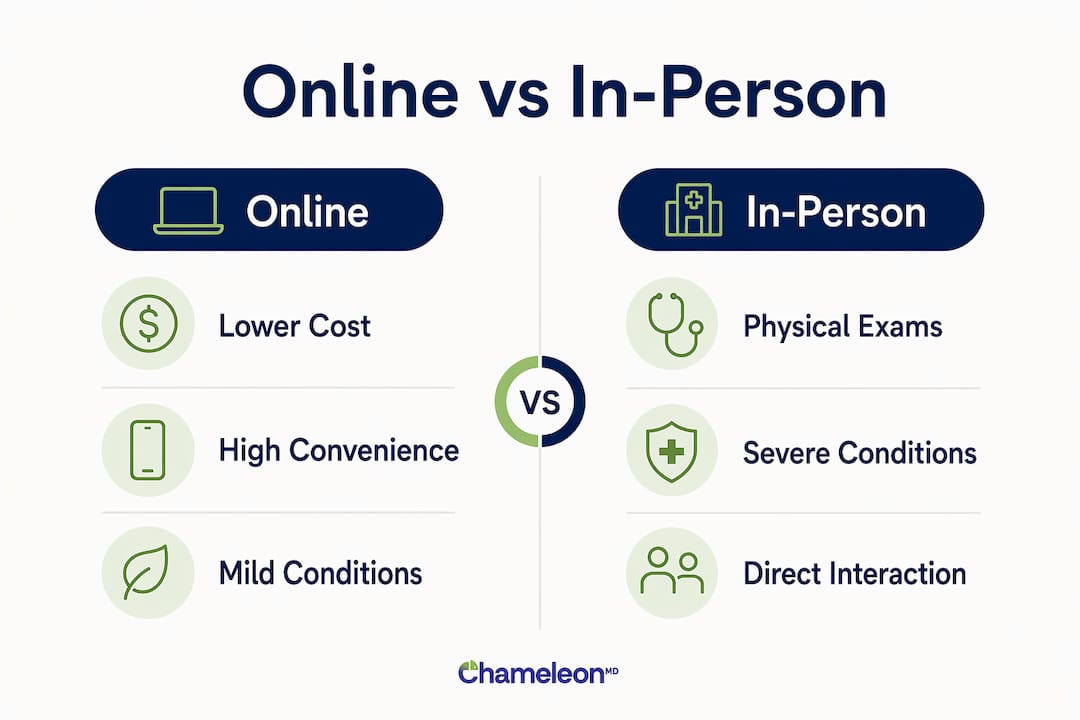
Scheduling flexibility is another real benefit. Surveys show patients report higher satisfaction with virtual visits specifically around evening and weekend availability. When you can book a visit at 8 p.m. from your couch instead of rearranging your workday, you are more likely to actually follow through. That consistency matters more than most people realize.
Here is a quick breakdown of what each format typically looks like in practice:
- Online providers: No commute, no waiting room, visits from home or work, flexible scheduling, often lower cost, requires a stable internet connection and a private space
- In-person providers: Travel and parking required, office hours only in many cases, higher overhead costs, physical exam capability, stronger nonverbal communication
- Technology requirements for virtual care: A smartphone or computer with a camera, a reliable internet connection, and a quiet, private location for the visit
Pro Tip: If you are comparing costs between a telehealth platform and a local clinic, ask about the total visit cost upfront, including any facility fees. Many in-person offices charge separate fees for the room, the provider, and any tests, while online providers like Chameleonhc use transparent flat-rate pricing.
What are the limitations of online providers compared to in-person services?
Virtual care is not the right fit for every situation. Understanding where it falls short helps you make a smarter decision rather than a convenient one.
- Physical exams are not possible online. Conditions that require hands-on assessment, such as a suspected fracture, an abdominal exam, or a skin biopsy, require an in-person visit. No video platform replaces what a provider can learn by touching, listening, or observing you directly.
- Nonverbal cues are harder to read virtually. Subtle signals critical for acute cases, including microexpressions and body language, are harder to detect on a screen. For high-acuity mental health clients, this gap can affect clinical decision-making.
- Some conditions require in-person or residential care. Clinical guidelines confirm that active psychosis and medical detox are not appropriate for virtual care. These situations need immediate, hands-on intervention.
- Technology access is not universal. Patients without reliable internet, a private space, or comfort using video platforms face real barriers to virtual care. This is a genuine equity concern that online providers are still working to address.
- Some patients prefer the in-person experience. Research confirms that relational depth often favors in-person settings, even when symptom outcomes are equal. If you feel more connected and engaged face-to-face, that preference is clinically relevant.
Hybrid care models address many of these limitations. Expert practitioners increasingly recommend fluid modality selection, where you start with virtual visits for routine care and shift to in-person when your condition or comfort level calls for it.
Pro Tip: If you are unsure whether your condition is suitable for a virtual visit, call the telehealth provider before booking. Most platforms, including Chameleonhc, will tell you upfront whether your symptoms need an in-person evaluation.
How should you choose between online and in-person providers?
The right choice depends on your condition, your schedule, and your personal comfort with technology. Use this framework to think it through clearly.
| Factor | Choose Online | Choose In-Person |
|---|---|---|
| Condition severity | Mild to moderate symptoms | Severe, acute, or complex |
| Physical exam needed | No | Yes |
| Scheduling flexibility | Limited availability or busy schedule | Flexible schedule, prefer office setting |
| Technology comfort | Comfortable with video visits | Prefer face-to-face interaction |
| Cost sensitivity | Seeking lower-cost options | Cost is less of a concern |
| Location and commute | Remote area or long travel time | Clinic nearby and accessible |
One factor most people overlook is treatment adherence. Consistent attendance predicts health outcomes more reliably than the format of your visit. If a long commute or rigid office hours make you skip appointments, virtual care is the better clinical choice, even if in-person care feels more traditional.
Many patients also underestimate how closely virtual care parallels traditional clinical processes. A telehealth visit with a licensed provider follows the same intake, assessment, and treatment steps as an office visit. The screen is different. The care is not.
For most people, the answer is not choosing one format permanently. Hybrid models that combine virtual check-ins with occasional in-person assessments reduce anxiety about committing to one approach and tend to produce better long-term outcomes. Think of it as using the right tool for the right moment, rather than picking a side.
You can also explore virtual care treatments for common conditions to get a clearer sense of what telehealth handles well before making your decision.
Key takeaways
Online and in-person providers deliver comparable outcomes for most common conditions, and the best choice depends on condition severity, scheduling needs, and personal comfort rather than a blanket preference for one format.
| Point | Details |
|---|---|
| Clinical outcomes are largely equal | Research shows no significant difference in results for most primary care and mental health conditions. |
| Online care costs 10–30% less | Reduced overhead and no travel expenses make virtual visits more affordable for most patients. |
| In-person care is required for some conditions | Physical exams, acute interventions, and high-acuity mental health cases need face-to-face care. |
| Treatment adherence matters most | Consistent attendance predicts outcomes more than modality; choose the format you will actually use. |
| Hybrid models work best for many patients | Combining virtual and in-person visits gives you flexibility without sacrificing clinical quality. |
The format debate misses the real question
Here is what I have come to believe after looking at this research closely: the online vs in-person debate is mostly the wrong conversation. Most patients are not choosing between two equally accessible options. They are choosing between getting care and not getting care.
When a parent with two kids and a full-time job skips a follow-up appointment because the clinic closes at 5 p.m., that is not a modality problem. That is an access problem. Virtual care solves it. When someone with active suicidal ideation needs immediate, hands-on support, virtual care is not the answer. In-person care is. The format should follow the clinical need, not the other way around.
What I find most interesting is the data on home environment comfort. Many patients are more honest and open during virtual sessions because they feel safe in their own space. That openness improves the quality of care in ways that are hard to measure but genuinely matter. A provider who gets accurate information makes better decisions.
The myth worth retiring is that online care is a compromise. For the right conditions and the right patients, it is the better option. The goal is always the same: consistent, quality care that fits your life.
— Vector
How Chameleonhc makes the choice easier
If you are weighing your options and want care that fits your schedule without the wait, Chameleonhc is built for exactly that. The platform connects you with licensed providers online for same-day visits covering common conditions like sore throats, sinus infections, pink eye, low back pain, and more. No insurance required. No waiting room.
Chameleonhc combines urgent care, primary care, and membership-based plans into one clear, affordable model. You get transparent pricing, flexible scheduling, and real medical care from your phone or computer. When your condition calls for in-person follow-up, your provider will tell you directly. Explore telehealth subscription plans to find the option that fits your health needs and your budget.
FAQ
Is online care as effective as in-person care?
For most common conditions, yes. A 2024 meta-analysis in the Canadian Medical Association Journal found no significant difference in outcomes between remote and in-person care for primary care and mental health conditions.
When should i choose in-person over virtual care?
Choose in-person care when you need a physical exam, have a high-acuity condition like active psychosis, or require an acute intervention that cannot be performed remotely.
Are online providers cheaper than in-person providers?
Online visits typically cost 10–30% less than in-person visits due to lower overhead and no travel costs, making them a practical option for patients without insurance or with high deductibles.
What is a hybrid care model?
A hybrid model combines virtual check-ins with occasional in-person visits, giving you scheduling flexibility for routine care while preserving access to hands-on assessment when your condition requires it.
Can i use telehealth without insurance?
Yes. Platforms like Chameleonhc offer no-insurance telehealth access with flat-rate pricing, so you know the cost before your visit and do not need a plan to get care.