

TL;DR:
- Streamlined primary care access involves timely appointments, digital tools, and workforce expansion to reduce delays. Implementing advanced same-day scheduling, digital-first communication, and expanding nurse practitioner roles significantly improve patient experiences and reduce emergency visits. Proper workflow redesign and continuous metric tracking are essential for sustainable improvements in primary care access.
Streamlined primary care access is defined as the ability to obtain timely, convenient, and coordinated medical appointments without unnecessary delays or administrative friction. The U.S. healthcare system currently invests only 5–7 cents of every healthcare dollar into primary care, which directly fuels the appointment wait time crises millions of patients face. Knowing how to streamline primary care access means understanding three core levers: modern scheduling models, digital tools, and workforce design. Each one removes a specific type of barrier between you and the care you need.
How to streamline primary care access with advanced scheduling

Advanced access scheduling, also called same-day scheduling, is a model where practices reserve appointment slots specifically for patients who call that day. Traditional scheduling fills future slots weeks in advance, leaving little room for urgent but non-emergency needs. The result is predictable: patients wait too long, then turn to emergency departments for conditions a primary care provider could handle.
A 2026 systematic review published in Annals of Family Medicine found that advanced access improves appointment timeliness, patient satisfaction, and reduces emergency department crowding. That means fewer costly ER visits and a care experience that actually fits your schedule.
| Feature | Advanced access scheduling | Traditional scheduling |
|---|---|---|
| Appointment availability | Same day or next day | Days to weeks out |
| Patient satisfaction | Higher | Lower |
| ED utilization | Reduced | Higher |
| Scheduling flexibility | Built in | Rigid |
| Care continuity | Maintained | Often disrupted |
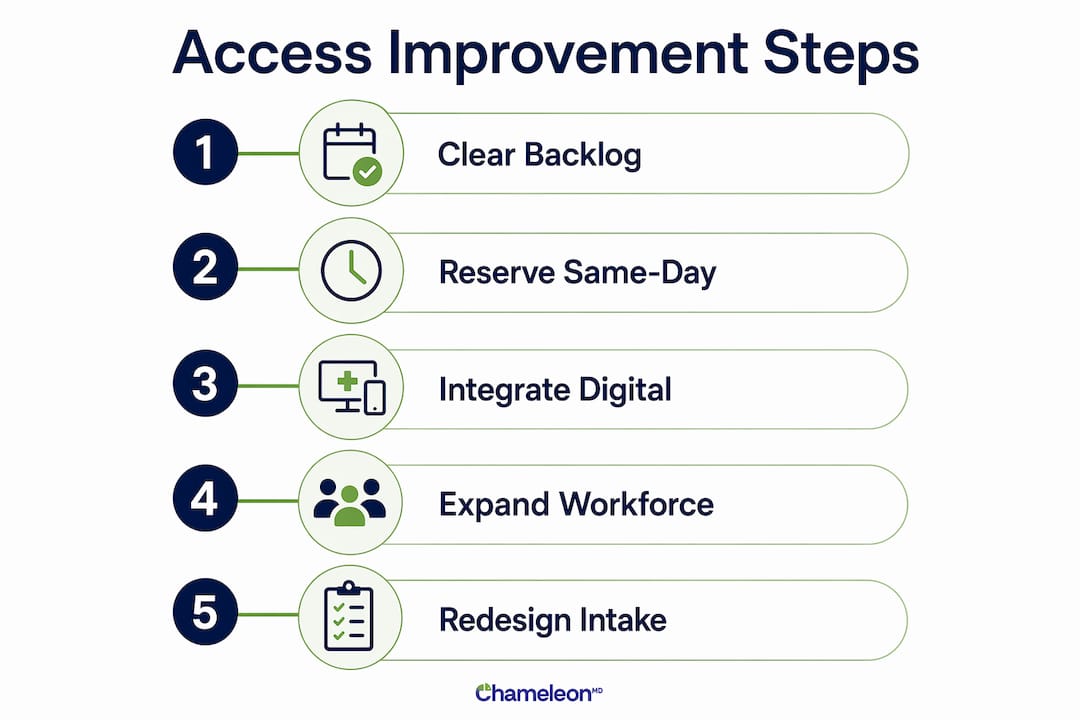
Implementing advanced access requires practices to first clear their backlog of pre-booked appointments. Once the backlog is resolved, the practice matches daily supply of appointment slots to daily patient demand. The transition period is the hardest part, but practices that complete it report lasting improvements in both access and provider satisfaction.
Pro Tip: If your provider offers same-day slots, call early in the morning. Most practices release same-day appointments at opening time, and they fill within the first hour.
How do digital-first tools and virtual care improve patient access?
Digital-first care refers to using telehealth visits, patient portals, online self-scheduling, and secure messaging as the primary channels for routine care. These tools remove the most common access barriers: phone hold times, geographic distance, and rigid office hours. Same-day digital access is no longer a convenience feature. It is now a core expectation patients bring to every healthcare interaction.
The practical benefits of digital tools include:
- Telehealth visits let you see a licensed provider from your phone or computer, eliminating travel time and waiting room delays entirely.
- Online self-scheduling gives you 24/7 booking access without waiting on hold, which is especially useful for working adults and parents managing full schedules.
- Secure patient messaging allows you to ask follow-up questions or request prescription refills without scheduling a full appointment.
- Digital pre-registration collects your intake information before your visit, so you are not filling out the same forms repeatedly at the front desk.
One critical design challenge exists with self-scheduling systems. Patients think in symptoms and visit reasons, not administrative codes. Self-scheduling systems require a mapping layer that converts patient-friendly inputs like “sore throat” or “rash” into the correct clinical visit type. Without that layer, scheduling errors and patient confusion are common.
Workflow integration is equally important. A telehealth platform that sits outside your provider’s electronic health record (EHR) creates duplicate documentation and slows care down. The benefits of telemedicine are fully realized only when the digital tools connect directly to the clinical workflow.
Pro Tip: Before your first virtual visit, complete all pre-registration steps in the patient portal. Providers can review your history before the appointment starts, which means more time discussing your health and less time on paperwork.
What workforce strategies expand primary care access efficiently?
The primary care workforce shortage is one of the most direct causes of long wait times. Expanding the roles of nurse practitioners (NPs) is the most evidence-backed solution currently in use. In the most disadvantaged communities, 66.8% of primary care practices employ NPs, compared to 33.4% in the least disadvantaged areas. NPs are filling gaps where physician supply is lowest and patient need is highest.
Several workforce strategies directly improve how quickly and consistently you can access care:
- Full practice authority for NPs: States that grant NPs independent practice authority remove the requirement for physician oversight agreements, allowing NPs to see patients, prescribe medications, and manage chronic conditions without administrative delays.
- Signature recognition reforms: Expanding NP practice authority to include signature recognition on routine forms, such as disability paperwork and home health orders, reduces unnecessary physician bottlenecks.
- Team-based care models: Practices that assign medical assistants, care coordinators, and NPs to handle specific parts of the care process free physicians to focus on complex cases. This increases the total number of patients a practice can serve each day.
- Proper NP reimbursement policies: When NPs are reimbursed at the same rate as physicians for equivalent services, practices have a financial reason to hire and retain them. Reimbursement gaps discourage investment in NP capacity.
Team-based care also improves care continuity. When you see the same care team consistently, your providers know your history and can act faster. That familiarity reduces duplicate testing and unnecessary referrals.
How can redesigning intake workflows reduce delays?
Intake redundancy is the biggest hidden cause of delays in patient throughput. You have likely experienced it: filling out the same health history form on paper at the front desk, even though you completed the same information online the week before. Digital pre-registration linked to EHR systems before arrival eliminates this bottleneck entirely.
The operational steps for redesigning intake workflows follow a clear sequence:
- Audit your current intake process. Identify every point where patients provide the same information more than once.
- Integrate digital pre-registration with your EHR. Patient-submitted data should populate directly into the clinical record, not sit in a separate system.
- Centralize scheduling management. A 2025 Delphi panel of U.S. health system leaders found that centralized contact centers handle complex scheduling more efficiently than front desk staff managing it case by case.
- Train staff on the redesigned workflow. Technology changes fail when staff revert to old habits because they were not trained on the new process.
- Test with a pilot group before full rollout. A small-scale test reveals gaps before they affect your entire patient population.
One risk deserves direct attention. Adding automated tools without fixing the underlying scheduling process first makes the problem worse, not better. Automation accelerates whatever process it touches. If that process is disorganized, automation accelerates the chaos.
Fix the workflow first. Then automate it.
Healthcare practices that follow this sequence report faster patient throughput, fewer scheduling errors, and higher patient satisfaction scores. The technology is not the solution. The redesigned process is.
What common pitfalls should you avoid when improving care access?
Improving primary care access fails most often not because the strategy is wrong, but because implementation skips critical steps. Recognizing these pitfalls before you encounter them saves significant time and frustration.
- Mismatched scheduling templates: If your scheduling template does not align with your clinical triage rules, patients end up booked into the wrong appointment type. This creates delays on the day of the visit and erodes trust in the scheduling system.
- Clinical language in patient-facing systems: Listing appointment types as “Level 3 Office Visit” or “99213” means nothing to a patient. Every patient-facing scheduling option must use plain language that describes the visit purpose clearly.
- Skipping staff training: A new digital intake system fails quickly if front desk staff continue to hand patients paper forms out of habit. Training is not optional.
- Ignoring access metrics: You cannot improve what you do not measure. Track metrics like third-next-available appointment, no-show rates, and patient-reported wait times on a monthly basis.
Pro Tip: Ask your provider’s office for their “third-next-available” appointment metric. This is the standard measure of scheduling access. If the answer is more than three days, the practice has a backlog worth asking about.
Practices that optimize their online presence alongside internal workflow changes see faster patient adoption of digital tools. Clear website navigation, visible online booking buttons, and accurate wait time information all reduce the friction patients feel before they even contact the practice.
Key takeaways
Improving primary care access requires fixing scheduling models, integrating digital tools, expanding workforce capacity, and redesigning intake workflows before adding any automation.
| Point | Details |
|---|---|
| Advanced access scheduling | Reserve same-day slots to reduce wait times and lower emergency department use. |
| Digital tools require mapping | Self-scheduling systems must convert patient symptoms into correct clinical visit types to avoid errors. |
| NPs fill critical gaps | In disadvantaged communities, 66.8% of practices employ NPs to expand access where it is needed most. |
| Fix workflows before automating | Automation applied to a broken process accelerates delays rather than resolving them. |
| Measure access continuously | Track third-next-available appointments and patient feedback monthly to catch bottlenecks early. |
My honest take on what actually moves the needle
I have spent a lot of time looking at how primary care access breaks down, and the pattern is almost always the same. Practices invest in a new scheduling platform or a telehealth tool, and then wonder why wait times barely improve. The technology gets the blame, but the real issue is that the underlying process was never fixed first.
The intake redundancy problem is a perfect example. Patients filling out the same forms repeatedly is not a technology failure. It is a workflow design failure that technology was layered on top of. Until someone maps the actual patient journey from first contact to the exam room and removes every repeated step, no software will solve it.
Workforce policy matters just as much as any digital tool. States that have granted NPs full practice authority have measurably better access outcomes, particularly in rural and underserved areas. That is a policy win that costs practices very little to take advantage of, yet many still operate under outdated supervision requirements that slow everything down.
The most underrated strategy is patient education. When patients understand how to use a portal, how to book online, and what same-day slots are available, they use those channels. That reduces phone volume, frees staff time, and speeds up access for everyone. Simpler care starts with clearer communication, and that is something any practice can do right now.
— Vector
See faster, simpler care with Chameleonhc
If long wait times and complicated scheduling are getting in the way of your health, Chameleonhc offers a straightforward alternative. You can connect with a licensed provider online the same day, without insurance, without a waiting room, and without the back-and-forth of traditional booking.
Chameleonhc covers a wide range of everyday conditions, from heartburn and reflux to low back pain, all through a clear, affordable model built around your schedule. Whether you need a quick check-in or ongoing care, the telehealth subscription plans at Chameleonhc give you flexible, same-day access to care that fits real life. No paperwork piles. No hold music. Just care when you need it.
FAQ
What is advanced access scheduling in primary care?
Advanced access scheduling reserves appointment slots for same-day booking rather than filling them weeks in advance. A 2026 systematic review found this model improves timeliness, patient satisfaction, and reduces emergency department crowding.
How do telehealth tools reduce wait times?
Telehealth eliminates travel time and waiting room delays by connecting you with a licensed provider through your phone or computer. Digital-first communication channels are now considered essential to meeting same-day access demand in modern primary care.
Why does intake redundancy slow down primary care visits?
Intake redundancy occurs when patients provide the same health information multiple times across paper and digital systems. Linking digital pre-registration directly to the EHR before arrival removes this bottleneck and speeds up the entire visit.
What role do nurse practitioners play in expanding access?
Nurse practitioners expand primary care capacity, particularly in underserved areas where 66.8% of practices employ them. States that grant NPs full practice authority see the greatest access improvements because NPs can see patients and prescribe independently.
How do I know if my primary care practice has a scheduling problem?
Ask for the “third-next-available” appointment date. If it is more than three days out, the practice has a scheduling backlog. Practices using medical practice differentiation strategies in 2026 prioritize this metric as a core measure of patient access quality.