
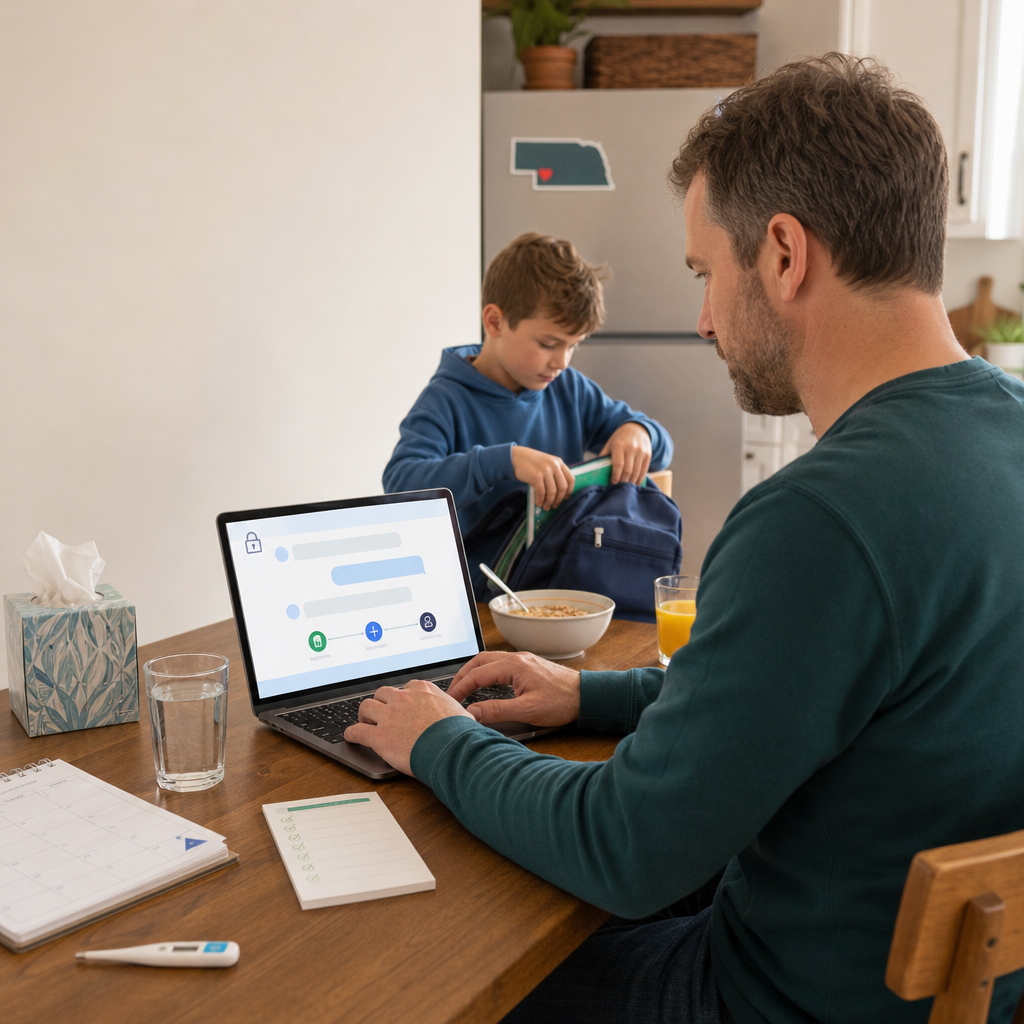
Message a Doctor Online Nebraska: A Guide to Virtual Care
Yes, you can message a doctor online Nebraska residents are eligible to consult when the clinician is licensed to practice in the state and the concern is appropriate for virtual care. Through a secure telehealth platform, you can describe symptoms, answer clinical questions, upload photos when useful, and receive medical guidance without visiting a waiting room.
This guide explains how an online doctor consultation works, which non-emergency conditions may be evaluated, what virtual urgent care may cost, and how patient privacy is protected. You will also learn how to select a Nebraska-licensed healthcare provider and when to arrange an in-person examination or seek emergency help instead.
Key Takeaways
| Point | Details |
|---|---|
| How it works | You submit symptoms and health information through a secure platform, then a Nebraska-licensed provider reviews your case and responds. |
| Good uses | Messaging may help with minor illnesses, rashes, allergies, urinary symptoms, pink eye, medication questions, and other non-emergency concerns. |
| Timing | Many services offer same-day access, although response times and overnight availability vary. |
| Cost | Charges may be per visit, subscription-based, employer-sponsored, or billed through insurance. |
| Safety | Use a reputable service with licensed providers, clear privacy practices, transparent pricing, and a plan for escalating care. |
| Emergencies | Call 911 for severe or life-threatening symptoms rather than waiting for an online response. |
Table of Contents
How to Message a Doctor Online Nebraska Residents Can Consult
An online doctor consultation in Nebraska commonly starts with account registration and an identity check. You select your concern, complete a health questionnaire, list medications and allergies, and explain what is happening. Depending on the service and your symptoms, the telemedicine visit may continue through secure text messaging, uploaded photos, a phone call, or a video appointment.
A licensed provider reviews the information, asks follow-up questions, and recommends next steps. Those steps may include self-care, a prescription when medically appropriate, an in-person examination, diagnostic testing, or urgent evaluation. For a broader overview of remote healthcare, read how telehealth in Nebraska works and when to use it.

Practical care standard: A trustworthy virtual provider should explain not only what you can do next, but also which symptoms mean you should stop messaging and seek in-person or emergency care.
Text-first care can be especially useful for busy parents, shift workers, rural residents, and people who face transportation or scheduling barriers. It can also help patients explain a concern on their own schedule rather than coordinating an immediate video call. ChameleonMD offers convenient access to local licensed providers, with same-day care available when applicable and clear escalation when a concern cannot be handled safely online.
Online messaging is not simply a customer-service chat. It is a clinical encounter that requires accurate health information and medical judgment. The provider may need additional details before making a recommendation, and a delayed answer to follow-up questions can delay the assessment. Keep platform notifications enabled and respond promptly when possible.
Get same-day Nebraska care from ChameleonMD
What Online Messaging Can—and Cannot—Address
When you chat with a doctor online in Nebraska, the provider can often evaluate straightforward, non-emergency symptoms using your health history and visible findings. A photo may be useful for certain skin or eye concerns, but image quality and clinical context matter. Some conditions still require vital signs, laboratory testing, imaging, or a hands-on physical examination.
Common concerns that may be appropriate for online urgent care include:
- Cold, cough, flu-like symptoms, and mild respiratory concerns
- Seasonal allergies and sinus symptoms
- Minor rashes, insect bites, and uncomplicated skin irritation
- Pink eye symptoms
- Urinary symptoms without severe pain, pregnancy complications, or systemic illness
- Mild nausea, diarrhea, or heartburn
- Minor medication questions or short-term refill requests, when clinically appropriate
The symptoms and conditions page provides examples of concerns commonly considered for virtual evaluation. Eligibility depends on the details of your case, however, and appearing on a list does not guarantee that a diagnosis or treatment can be completed remotely.
| Type of concern | Messaging may be appropriate when | Choose in-person or urgent evaluation when |
|---|---|---|
| Cold or cough | Symptoms are mild and breathing is comfortable | There is breathing difficulty, blue or gray coloring, confusion, or severe weakness |
| Rash | The rash is limited and you can provide clear photos | It spreads rapidly, affects the eyes or mouth, or occurs with trouble breathing |
| Urinary symptoms | There is burning or frequency without severe systemic symptoms | There is severe back pain, vomiting, pregnancy-related concern, or significant fever |
| Minor injury | You need guidance about basic home care | There may be a fracture, deep wound, uncontrolled bleeding, or loss of function |
| Abdominal symptoms | Symptoms are mild and short-lived | Pain is severe, worsening, localized, or accompanied by fainting or blood |
A virtual doctor appointment in Nebraska is not the right setting for every condition. If the provider cannot make a safe assessment remotely, being directed to a clinic is not a failure of telemedicine—it is responsible medical care. Recommendations can also change if symptoms worsen, new symptoms develop, or a treatment does not work as expected.
Online care may be less suitable for an infant, a complex pregnancy-related concern, severe pain, a significant injury, or an illness in someone who is medically fragile. Tell the clinician about relevant chronic conditions, immune suppression, recent surgery, or a history of serious complications because those factors can affect the safest level of care.
How to Choose a Reputable Nebraska Telemedicine Service
Start by confirming that the clinician is licensed to practice in Nebraska. The Nebraska License Information System provides a public way to check many professional licenses, while the Nebraska Department of Health and Human Services offers additional healthcare licensing information.
Next, review the service’s response times, fees, prescribing policies, follow-up process, and privacy notice. Reliable Nebraska telemedicine services identify who will provide care, explain whether messages are monitored overnight, and make it easy to understand when you will be referred elsewhere. They should also distinguish routine virtual care from emergency services.
Service Selection Checklist
- The provider is appropriately licensed in Nebraska.
- The platform uses secure, access-controlled communication.
- Costs are disclosed before you submit the visit.
- Clinical limitations and emergency instructions are easy to find.
- Prescriptions are based on medical evaluation, not guaranteed on request.
- You can receive follow-up instructions or a visit summary.
- The service provides a clear contact path for technical or billing questions.

Be cautious with any platform that promises a specific prescription, minimizes health screening, or does not identify its clinicians. Legitimate providers may decline a requested medication, suggest a different treatment, or require an examination or testing. These decisions should be based on your health history, symptoms, clinical standards, and applicable prescribing rules.
Review the service’s privacy policy before sharing sensitive information. The policy should explain how personal and medical data are collected, used, stored, and disclosed, as well as how you can contact the organization with a privacy question.
Pro Tip: “24/7 online doctor Nebraska” may describe the ability to submit a request at any time, not necessarily an immediate clinician response at 3 a.m. Check the stated clinical response hours and emergency guidance before relying on a service after hours.
How to Prepare and Communicate Clearly
Before opening the message, gather your medication list, allergies, major health conditions, pregnancy status when relevant, and any recent temperature, blood pressure, heart rate, or oxygen reading you can obtain accurately. Note when symptoms began, whether they are improving or worsening, and what you have already tried.
Use a simple structure so the provider can understand your concern quickly:
- Main concern: State the symptom or question in one sentence.
- Timeline: Explain when it started and how it has changed.
- Severity: Describe how it affects sleep, eating, work, or normal activity.
- Related symptoms: Mention fever, pain, rash, breathing changes, vomiting, or other relevant signs.
- Medical context: Include medications, allergies, recent treatments, pregnancy, and important diagnoses.
- Your goal: Ask whether home care is reasonable, whether testing is needed, or whether you should be seen in person.
For example: “I have had burning with urination and increased frequency since yesterday. I do not have severe back pain, vomiting, or known fever. I am allergic to penicillin and would like to know whether I need testing or treatment.” This is more clinically useful than sending only, “I think I have a UTI.” Information about virtual assessment for bladder infection and UTI symptoms can help you understand what details may matter.
If you upload a photo, use bright natural light, keep the image in focus, and include both a close view and a wider view for location and scale. Do not apply filters or edit the color. If size matters, place a ruler or another familiar object nearby without covering the affected area.
Ask how soon to expect a response, what changes should prompt urgent care, and whether follow-up is needed. Repeat back any important instructions in your own words if they are unclear. Before ending the consultation, confirm the medication dose and duration, possible side effects, pharmacy information, and what to do if symptoms fail to improve.
If you have access to home readings, share how and when they were taken. A single value from an unreliable device may not be enough for clinical decisions, so mention whether the reading was repeated. Never delay urgent care to obtain measurements or photographs.
Costs, Privacy, and When to Seek Urgent Help
Online care costs vary by platform and may involve a flat per-visit charge, membership, employer benefit, or insurance copay. Before starting, ask whether the price includes follow-up messages, prescriptions, work notes, or referrals. Medication, testing, imaging, and outside facility fees are usually separate.
If using insurance, verify whether the platform and provider participate in your plan and whether a deductible applies. Patients paying directly should look for the total visit price, cancellation policy, refund terms, and any additional charge for extended follow-up. The least expensive service is not always the best option if licensing, privacy, or clinical support is unclear.
For privacy, use your own device when possible, create a strong unique password, and avoid public Wi-Fi for sensitive conversations. Read the platform’s notice of privacy practices and learn more about health-information protections from the U.S. Department of Health and Human Services; the Telehealth.HHS.gov privacy guide also offers practical patient tips.

Choose a private location where you can discuss symptoms honestly. Sign out of shared devices, avoid saving passwords on public computers, and verify that messages come from the platform before opening links or sharing information. A legitimate clinician or telehealth service should not ask you to send passwords or payment card details through an unsecured message.
Do not wait for an online message if symptoms may be life-threatening. Call 911 for severe trouble breathing, signs of stroke, severe chest pain, uncontrolled bleeding, loss of consciousness, a severe allergic reaction, or an immediate risk of self-harm; the CDC’s stroke guidance explains warning signs that require fast action.
- Seek in-person care for symptoms requiring a hands-on examination, imaging, stitches, laboratory testing, or immediate treatment.
- Consider urgent evaluation for persistent high fever, significant dehydration, worsening abdominal pain, or rapidly changing symptoms.
- For a mental health or substance-use crisis, call or text 988 through the 988 Suicide & Crisis Lifeline.
- For possible poisoning, contact Poison Control at 1-800-222-1222.
Virtual messaging works best when convenience is paired with sound clinical judgment. A Nebraska-rooted service such as ChameleonMD can offer a fast, straightforward next step for eligible non-emergency concerns while directing you to in-person care when that is the safer choice.
Get same-day Nebraska care from ChameleonMD
Frequently Asked Questions
Can I message a doctor online in Nebraska?
Yes. Nebraska residents can use a secure telehealth service to message a provider who is licensed to practice in the state. Availability, response time, and eligible conditions vary by platform.
How quickly will an online doctor respond in Nebraska?
Many platforms offer same-day responses, but timing depends on provider availability and the service’s operating hours. Check whether “24/7” means continuous clinician coverage or only that requests can be submitted at any time.
Can an online doctor prescribe medication in Nebraska?
A Nebraska-licensed provider may prescribe medication when it is medically appropriate and permitted by applicable law and clinical standards. A prescription is never guaranteed, and some medicines or conditions require an in-person evaluation.
What health problems can be treated through online messaging?
Messaging may be suitable for minor respiratory symptoms, allergies, uncomplicated rashes, pink eye, urinary symptoms, and other non-emergency concerns. The provider may recommend testing or an in-person examination if a remote assessment is not sufficient.
How much does an online doctor consultation in Nebraska cost?
Costs vary among flat-fee visits, subscriptions, employer benefits, and insurance-based services. Confirm the visit fee and whether prescriptions, tests, follow-up, or outside services involve separate charges.
Is it private to chat with a doctor online in Nebraska?
Reputable healthcare platforms use safeguards designed to protect health information and explain their privacy practices. Patients should use secure networks, strong passwords, and a private setting whenever possible.
Do I need a video call for a virtual doctor appointment in Nebraska?
Not always. Some concerns can be reviewed through secure text and photos, while others require video, phone, testing, or an in-person examination based on the provider’s judgment.
When should I go to urgent care instead of messaging a doctor?
Choose in-person urgent care when you may need imaging, stitches, laboratory testing, or a physical examination that cannot wait. Call 911 for severe chest pain, stroke signs, major breathing difficulty, uncontrolled bleeding, unconsciousness, or another possible life-threatening emergency.
Recommended Reading
- How to See an Online Doctor in Nebraska Without Leaving Home
- Telehealth in Nebraska: What It Is, How It Works, and When to Use It
- 7 Reasons Nebraska Families Choose Telehealth for Everyday Health Needs
Get same-day Nebraska care from ChameleonMD