

TL;DR:
- Eighty-nine percent of large employers now offer employer-sponsored telehealth benefits, making virtual healthcare widely accessible.
- These programs provide convenient access to licensed providers via video, phone, or messaging, covering general, urgent, and mental health care.
- Understanding program structures, benefits, limitations, and future trends helps employees and employers maximize telehealth’s potential benefits.
Most people still think telehealth is a perk for people with premium insurance plans or tech-savvy patients who know where to look. The reality? 90% of large employers now offer some form of telehealth benefit to their workers. That changes everything about how you think about accessing care. Whether you’re an employee trying to avoid a three-hour urgent care wait or a small business owner searching for benefits that actually attract good people, employer-sponsored telehealth is worth understanding deeply. This article walks you through what it is, how it works, who benefits most, what to watch out for, and where it’s all heading.
Table of Contents
- What is employer-sponsored telehealth?
- How employer-sponsored telehealth works: Embedded vs. standalone options
- Why employers offer telehealth—and who benefits most
- Limitations, legal considerations, and potential downsides
- The future of employer-sponsored telehealth: Trends to watch
- Our take: Why telehealth only works when it solves real problems
- Connect with affordable, comprehensive telehealth
- Frequently asked questions
Key Takeaways
| Point | Details |
|---|---|
| Widespread access | Employer-sponsored telehealth is now offered by 70–90% of employers, making virtual care more available than ever. |
| Flexible program types | Programs may be embedded in health plans or provided standalone, impacting costs and coverage. |
| Best for routine care | Telehealth excels for routine, mental health, and chronic condition management, often with lower copays. |
| Know the limits | Some conditions and legal issues—like licensure and HIPAA—mean telehealth is not a full replacement for all care. |
| Trends point up | Employer use of telehealth is rising fast, with future plans aiming for full-spectrum virtual care coordination. |
What is employer-sponsored telehealth?
Now that you know how widespread telehealth benefits are, let’s break down exactly what employer-sponsored telehealth means and how it works for you.
Employer-sponsored telehealth is a benefit provided by employers, typically as part of a group health plan or standalone supplemental benefit, giving employees access to licensed healthcare providers via video, phone, or asynchronous messaging (secure text-based communication). It’s not a workaround or a last resort. It’s a structured, legitimate channel for getting medical care without stepping foot in a clinic.
You can learn more about employer telehealth basics to understand how these programs compare to other telehealth options available today.
Here’s what a typical employer-sponsored telehealth setup includes:
- Access methods: Video appointments, phone calls, and secure messaging with licensed providers
- Coverage scope: General medical concerns, urgent care, mental health, and sometimes chronic disease management
- Who qualifies: Usually all benefits-eligible employees, and often their dependents too
- Provider types: Primary care physicians, nurse practitioners, behavioral health counselors, and in some plans, specialists
- Cost structure: Low or zero copays, with costs typically covered or heavily subsidized by the employer
“Employer-sponsored telehealth is a benefit offered by employers, typically as part of a group health plan or standalone supplemental benefit, providing employees access to licensed healthcare providers via video, phone, or asynchronous messaging.” — National Telehealth Authority
This kind of setup removes some of the biggest friction points in traditional care: scheduling delays, transportation, time off work, and unpredictable costs. For hourly employees or remote workers especially, those barriers can mean skipping care altogether. Employer-sponsored telehealth closes that gap in a practical and affordable way.
How employer-sponsored telehealth works: Embedded vs. standalone options
Understanding these basics, it’s crucial to know how the structure of telehealth programs can affect your costs and experience.
There are two main program types: embedded telehealth built directly into a health plan, and standalone telehealth offered as a separate carve-out benefit. Each one works differently, and the structure matters a lot when it comes to what you pay and how you access care.
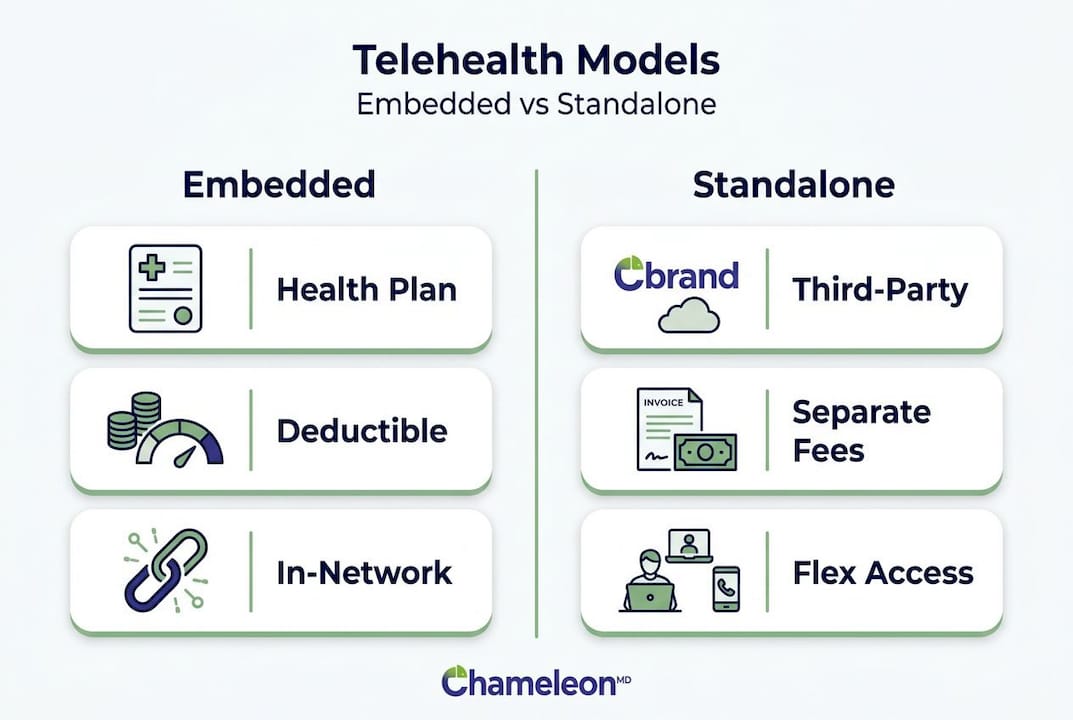
| Feature | Embedded telehealth | Standalone telehealth |
|---|---|---|
| Part of health plan | Yes | No |
| Counts toward deductible | Yes | No |
| Typical copay | Standard plan copay | Often $0 or very low flat fee |
| Vendor examples | Included in plan network | Teladoc, MDLive, Chameleon |
| HSA interaction | May be affected | Usually separate |
| Flexibility | Tied to your health plan | Can be offered independently |
With an embedded model, you use telehealth the same way you’d use any in-network doctor. Your visits count toward your deductible and out-of-pocket maximum. That can be a good thing if you’re working toward meeting your deductible, but it also means costs vary based on where you are in your coverage year.
Standalone models work differently. They operate outside your main health plan, often through third-party vendors. These tend to have flat, predictable fees or even zero copays, which makes them especially attractive for routine care like sinus infections, rashes, or sore throats. If you want to understand the broader landscape of how telemedicine explained can complement these employer programs, it’s worth exploring your options.
Pro Tip: Before your next visit, check whether your telehealth benefit is embedded or standalone. Knowing this upfront prevents surprise bills and helps you get the most out of what your employer is already paying for.
Why employers offer telehealth—and who benefits most
Knowing how these plans are structured, let’s look at why employers are investing in telehealth and which employees gain the most from these benefits.
Employers don’t add telehealth benefits out of generosity alone. There’s a clear business case. Telehealth reduces absenteeism because employees get faster care without taking half a day off. It lowers overall healthcare spend by steering people toward lower-cost virtual visits instead of emergency rooms. And in a competitive hiring market, a robust benefits package with telehealth is a real differentiator.
The 2025 Employer Health Benefits Survey shows that among firms with 50 or more workers offering health benefits, 45% of those with 1,000 or more employees have contracts for virtual primary care services, compared to 29% for smaller firms with 50 to 999 workers. That gap matters if you work for or run a smaller business, because it means you may have fewer options, but you’re also competing for talent against larger companies that do offer these benefits.
Here’s a breakdown of who sees the biggest impact from employer-sponsored telehealth:
- Routine care users: People dealing with common illnesses like colds, UTIs, pink eye, or minor injuries benefit most because those issues are easy to diagnose and treat remotely
- Mental health patients: Employees seeking therapy, counseling, or medication management for anxiety or depression gain huge value from convenient virtual access
- Chronic condition patients: Workers managing diabetes, hypertension, or asthma benefit from regular virtual check-ins without frequent office visits
- Remote and hybrid workers: Employees who don’t live near major medical centers or who travel frequently often have limited in-person options, making virtual access essential
- Parents and caregivers: When your child or an aging parent needs a quick assessment, a same-day virtual visit is far easier to manage than an in-person appointment
The telemedicine benefits go beyond just convenience. They touch real cost savings too. Lower copays, reduced time off work, and faster treatment all add up over the course of a year. For employees exploring exactly what these programs include, reviewing telehealth membership details provides a clear picture of coverage.

For telehealth without insurance, the employer-sponsored model is even more compelling. It provides a level of access that many workers wouldn’t otherwise have.
Key stat: Adoption among large firms sits at 45% for virtual primary care, compared to just 29% for smaller employers. If you run a small business, closing that gap can be a meaningful competitive edge.
Limitations, legal considerations, and potential downsides
While the upsides are clear, every benefit has its fine print. Here’s what employees and employers should watch for when using or selecting a telehealth program.
Telehealth is genuinely useful for a wide range of concerns, but it has real boundaries. Not every health situation is appropriate for a virtual visit, and some legal and financial details can catch people off guard if they’re not prepared.
Here are the key limitations and risks to understand:
- Clinical complexity: Physical exams or imaging are beyond what any telehealth visit can provide. If you need a physical exam, lab work, or diagnostic imaging, you’ll need to go in person.
- Licensure restrictions: Providers must be licensed in the state where you’re located at the time of the visit. This creates real headaches for remote workers or frequent travelers who may find themselves in a state where their usual provider isn’t licensed.
- HSA eligibility impact: If you have a high-deductible health plan (HDHP) paired with a health savings account (HSA), pre-deductible telehealth coverage may affect your ability to contribute to your HSA. Check with your benefits provider before assuming your plan is compliant.
- ERISA and state law variation: Self-funded ERISA plans, which cover about 65% of insured workers, are exempt from state telehealth parity laws. That means coverage requirements can vary significantly depending on how your employer structures its plan.
- Overutilization risk: Overuse of telehealth can drive up total healthcare spending rather than reducing it, especially if employees use virtual visits for issues that don’t actually need medical attention or duplicate care they’re already receiving.
“Potential downsides include overutilization leading to higher costs, and telehealth is not a full substitute for in-person primary care due to the lack of physical cues.” — PPI Benefits
For a balanced view of virtual care pros and cons, it’s helpful to review how virtual care fits alongside traditional options rather than replacing them entirely. You can also explore what’s known about at-home health testing limitations, which often intersects with employer-sponsored virtual care programs.
Pro Tip: If you’re unsure whether your condition is right for telehealth, err on the side of calling ahead. Most telehealth platforms have intake screens or triage nurses who can tell you quickly whether a virtual visit is appropriate or whether you need in-person care.
The future of employer-sponsored telehealth: Trends to watch
Despite some caveats, employer-sponsored telehealth is rapidly evolving. Let’s explore where it’s headed next and how to get ahead of the curve.
The numbers tell a clear story. 70% of employers now offer telemedicine as a standard healthcare access option. That’s not a niche perk anymore. It’s quickly becoming a baseline expectation. And the next phase is even more ambitious.
44% of employers plan to add more virtual primary care in the coming year, shifting from one-off episodic visits toward fully coordinated virtual-first care. That means ongoing relationships with a care team, not just isolated urgent care consultations.
Here’s what that shift looks like in practice:
- Integrated care teams: Virtual providers who can see your health history, coordinate referrals, and follow up over time
- Mental health expansion: More employers adding dedicated behavioral health telehealth programs as a standalone or integrated benefit
- Chronic disease programs: Structured virtual programs for managing conditions like diabetes, heart disease, and asthma with regular check-ins and data tracking
- Wellness integration: Telehealth platforms connecting with fitness trackers, nutrition apps, and wellness coaching for a more complete health picture
- On-demand pediatric and specialty care: Growing access to specialists like dermatologists, cardiologists, and pediatricians through virtual channels
For employees and employers alike, the best move right now is to get familiar with your current telehealth options, use them regularly for appropriate conditions, and start thinking about telehealth as a relationship rather than a one-time transaction. Explore what’s available through virtual care treatments to understand the full range of what modern telehealth can address today.
Key stat: With 44% of employers expanding virtual primary care, now is the right time to understand your benefits so you’re ready to take full advantage as programs grow.
Our take: Why telehealth only works when it solves real problems
Here’s a perspective you don’t hear often enough: offering telehealth doesn’t automatically make employees healthier or happier. An employer can check every box, sign up with a reputable vendor, and still see almost zero utilization if their team doesn’t understand what the benefit does or how to use it.
We see this pattern regularly. Companies invest in quality telehealth programs and then communicate about them once during open enrollment. One email, one slide in a presentation. That’s not enough. Real utilization comes from repeated, practical reminders. It comes from managers normalizing telehealth as a legitimate care option, not something people use only when they can’t get a regular appointment.
For small businesses especially, this matters even more. You may not have the budget for elaborate benefits packages, but a well-chosen telehealth plan that your team actually knows how to use delivers more value than premium coverage no one touches. Focus on what your employees will genuinely reach for. A 30-year-old with two kids needs different access than a 55-year-old managing a chronic condition. Tailoring your communication to those real-life scenarios makes the benefit feel personal, not generic.
The virtual visit advantages are real and well-documented. But advantages only matter if people actually show up for the visit. Technology doesn’t fix healthcare access. Simple, clear, trust-building communication does.
Connect with affordable, comprehensive telehealth
Ready to experience the benefits of accessible telehealth for yourself or your team?
At Chameleon Healthcare, we built our platform around the idea that good care should be simple and affordable, without requiring insurance or a lengthy wait. Whether your employees are dealing with sore throats, sinus infections, skin rashes, asthma flares, or a dozen other common conditions, our licensed providers are available for same-day virtual visits with clear, upfront pricing.

Employers and individuals can explore virtual care plans that fit real budgets and real schedules. From urgent care to ongoing membership options, Chameleon Healthcare is designed to be the telehealth partner your team will actually use. You can also learn more about specific condition-focused care, including asthma telehealth solutions, to see how targeted virtual care can make a meaningful difference in day-to-day health management. No waiting rooms, no paperwork headaches. Just care when you need it.
Frequently asked questions
What is the difference between employer-sponsored telehealth and regular telemedicine?
Employer-sponsored telehealth is provided as a job benefit, often with significantly lower costs and structured access compared to standalone or direct-to-consumer telemedicine options. Employer-sponsored plans are typically integrated into your group health benefits or offered as a carve-out with subsidized pricing.
Does telehealth cover specialist visits or only primary care?
Most employer-sponsored telehealth plans focus on primary and urgent care, though some vendors offer specialist access depending on the plan structure. Embedded and standalone plans differ significantly in the scope of specialty services available.
Will using telehealth affect my HSA eligibility?
Pre-deductible telehealth coverage paired with an HSA-qualified high-deductible health plan may impact your eligibility rules, so it’s important to verify with your benefits provider. HSA eligibility depends on how your plan is structured and when telehealth is accessible relative to your deductible.
Can employer telehealth replace all in-person doctor visits?
No. Telehealth is effective for routine issues and many urgent concerns, but it cannot replace exams, imaging, or complex diagnostics that require physical presence. Think of it as a strong complement to in-person care, not a full substitute.
How common is employer-sponsored telehealth?
By 2023, about 90% of large employers offered some form of telehealth benefit, and 70% of all employers now offer telemedicine as a standard option, making it one of the fastest-growing workplace benefits today.