

TL;DR:
- By 2026, remote healthcare integrates telehealth, RPM, and digital care as standard system components supported by major policy reforms.
- New billing codes and extensive federal funding, especially for rural access, are transforming virtual care into a structural healthcare solution.
Remote healthcare in 2026 is defined as the integrated delivery of telehealth, remote patient monitoring (RPM), and digital-first care models as standard components of the healthcare system, not supplemental options. The industry term is “virtual care,” and it now encompasses everything from Medicare-reimbursed video visits to wearable-driven chronic disease management. Policy changes from CMS, new RPM billing codes, and a $50 billion federal infrastructure investment have collectively made the role of remote healthcare in 2026 one of the most consequential shifts in modern care delivery. For healthcare professionals and policymakers, understanding what has changed, and what is still uncertain, is no longer optional.
What recent policy changes have shaped remote healthcare in 2026?
Federal policy is the backbone of virtual care adoption, and 2026 brings the most significant regulatory clarity the field has seen since the COVID-19 public health emergency. The CMS CY 2026 Physician Fee Schedule establishes permanent virtual direct supervision, meaning physicians can now supervise certain clinical staff remotely without a time-limited waiver. This removes a major operational uncertainty that had slowed telehealth program expansion in hospital systems and group practices.
The Consolidated Appropriations Act, 2026 extends telehealth flexibilities through December 31, 2027. That two-year window gives providers enough runway to build telehealth into their standard workflows rather than treating it as a temporary accommodation. The practical implication is clear: organizations that have delayed telehealth infrastructure investment now face a defined deadline before potential policy reversions in 2028 affect non-behavioral telehealth services.
Rural access receives the most dramatic funding commitment in this cycle. Key provisions include:
- $50 billion allocated through the Rural Health Transformation Program from 2026 to 2030, averaging $10 billion annually
- Funds targeted to states based on documented rural need, covering telehealth infrastructure, care coordination, and technology adoption
- Workforce development components designed to address provider shortages in underserved areas
- Measurable outcome expectations tied to funding disbursement
The Rural Health Transformation Program signals that Congress views telehealth not as a convenience feature but as a structural solution to geographic care inequity. For policymakers designing state-level programs, this funding creates both an opportunity and an accountability framework. Organizations that align their telehealth programs with measurable outcomes now will be better positioned to access and retain these resources.
How do new RPM CPT codes change billing and clinical practice?
Two new CPT codes, effective January 1, 2026, fundamentally change how remote patient monitoring is billed and documented. CPT 99445 covers device data collection over 2 to 15 days in a 30-day period, while CPT 99470 covers the first 10 to 19 minutes of RPM treatment management with a required interactive communication component. Both codes reflect clinical realities that the previous billing structure did not accommodate.

The comparison below illustrates how the new codes differ from legacy RPM billing thresholds:
| Billing element | Previous RPM structure | 2026 codes (99445 / 99470) |
|---|---|---|
| Minimum monitoring days | 16 days per 30-day period | 2 to 15 days per 30-day period |
| Treatment time threshold | 20+ minutes | 10 to 19 minutes (99470) |
| Interactive communication | Required at 20-minute threshold | Required within 99470 cycle |
| Clinical use case fit | Chronic, continuous monitoring | Post-surgical, intermittent, short-cycle |
The clinical value here is significant. Under the old structure, a post-surgical patient monitored for 10 days generated no billable RPM event, even if the monitoring produced clinically meaningful data. CPT 99445 closes that gap. Similarly, a provider who spends 12 minutes reviewing device data and communicating with a patient about medication adjustment can now bill that encounter under 99470 rather than absorbing the time as unbillable overhead.
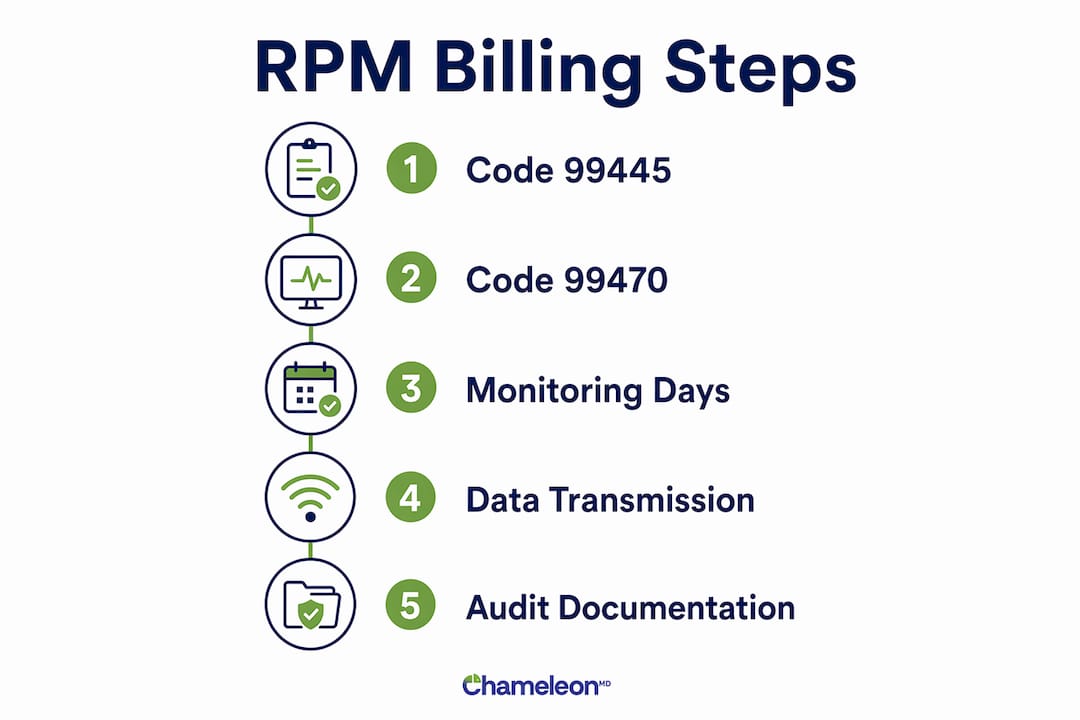
Pro Tip: Track device data transmission dates explicitly within each 2 to 15 day window for CPT 99445. The audit documentation requirement means your EHR notes must confirm that valid device data was received during the billing cycle, not just that a device was assigned to the patient.
For billing teams, the shift is conceptual as much as procedural. RPM documentation moves from operational telemetry to billing evidence. Every data transmission window becomes an auditable record. Organizations that treat these codes as simple add-ons without updating their documentation workflows will face recoupment risk. Those that build structured tracking into their RPM platforms from the start will find the new codes expand their reimbursable scope considerably. You can also review Medicare home care billing updates for related context on how home-based monitoring intersects with 2026 coverage rules.
What does evidence say about clinical outcomes and economic impact?
The evidence base for virtual care is growing, but it demands careful reading. A 2026 structured review found that 63.6% of telemedicine studies reviewed showed positive clinical outcomes. That is an encouraging majority, but it also means roughly one in three studies showed neutral or mixed results. The heterogeneity of study designs makes blanket conclusions unreliable, and economic outcome data is frequently absent or contradictory.
“Positive clinical outcomes are present in many telemedicine studies, but heterogeneous study designs and missing economic data demand cautious interpretation and local outcome tracking.” — Frontiers in Medicine, 2026
The economic picture is similarly nuanced. Of the studies that included economic data, three showed positive results and four showed negative results. This is not an argument against telehealth. It is an argument for segmenting use cases and measuring downstream costs separately rather than assuming that virtual care automatically reduces spending.
RAND’s analysis of telemedicine adoption from 2019 to 2023 offers the most nationally representative data available. The RAND difference-in-differences analysis found no statistically significant increase in total ambulatory visits or medical spending in high-adoption areas compared to low-adoption areas. This directly counters the concern that telehealth drives unnecessary utilization. The finding reframes telehealth as a capacity optimization tool rather than a cost inflator, which has direct implications for how policymakers should approach coverage expansion decisions.
For healthcare organizations, the practical takeaway is to build outcome tracking into every telehealth program from day one. Segment by clinical domain, measure downstream utilization, and document both clinical and economic results. Programs that generate their own evidence base will be far better positioned when reimbursement negotiations or policy reviews occur.
How are digital-first care models operationalized effectively?
Operationalizing virtual care requires more than a video platform and a scheduling link. NHS England evaluations of digital-first primary care found that benefits depend on using digital options as genuine alternatives with smooth in-person escalation pathways, not as rigid replacements for face-to-face care. That distinction matters enormously for clinical safety and patient trust.
Effective implementation follows a structured sequence:
- Triage design. Define which conditions are appropriate for remote assessment and which require in-person evaluation from the outset. Sore throats, sinus infections, rashes, and urinary symptoms are well-suited to virtual visits. Chest pain, acute neurological symptoms, and complex wound assessments are not.
- Escalation protocols. Build clear, documented pathways from remote to in-person care. Safe escalation is a clinical workflow involving triage thresholds and continuity safeguards, not a checkbox. Patients need to know exactly what happens if their remote provider determines they need to be seen in person.
- Digital inclusion assessment. Identify patients who lack reliable internet access, device literacy, or language support before defaulting them to digital-first care. Offering telehealth without addressing these barriers creates a two-tier system that disadvantages the patients who most need accessible care.
- Workflow integration. Embed telehealth into existing scheduling, documentation, and billing systems rather than running it as a parallel process. Parallel systems create documentation gaps and increase administrative burden on clinical staff.
Pro Tip: Assign a dedicated telehealth coordinator role within your practice to manage scheduling, patient onboarding, and escalation tracking. Organizations that treat telehealth as a workflow design decision rather than a technology deployment consistently report better adoption rates and fewer care gaps.
The benefits of digital-first care are real, but they are conditional. Convenience and access improve when the model is designed thoughtfully. They erode when digital-first becomes digital-only without the infrastructure to support patients who need more. Policymakers designing telehealth mandates should require escalation pathway documentation as a condition of program approval, not an afterthought.
Key takeaways
Remote healthcare in 2026 is a policy-backed, billing-supported, and evidence-informed component of standard care delivery that requires deliberate workflow design and outcome tracking to deliver its full value.
| Point | Details |
|---|---|
| Policy stability through 2027 | Telehealth flexibilities are extended, giving providers a defined window to build permanent programs. |
| New RPM codes expand billing scope | CPT 99445 and 99470 cover shorter monitoring cycles, opening reimbursement for post-surgical and intermittent monitoring. |
| Clinical evidence is positive but mixed | 63.6% of studies show positive outcomes; economic data is often absent, requiring local evaluation. |
| Telehealth does not inflate utilization | RAND analysis confirms no significant increase in visits or spending from telemedicine adoption. |
| Digital inclusion is a clinical obligation | Escalation pathways and access equity measures are required for safe and effective virtual care delivery. |
Why remote healthcare’s future depends on what we build right now
The policy window from 2026 to 2027 is the most favorable environment for telehealth integration that healthcare organizations have ever had. Permanent virtual supervision, extended flexibilities, and $50 billion in rural infrastructure funding do not come along often. What concerns me is that many organizations are still treating telehealth as a reactive tool rather than a proactive care design decision.
The evidence from RAND and the Frontiers review tells a consistent story: telehealth works when it is matched to the right clinical use case, supported by clear escalation pathways, and measured with discipline. It does not automatically save money, and it does not automatically improve outcomes. The organizations that will thrive in this environment are the ones that build outcome tracking into their programs from the start, address digital exclusion proactively, and treat the new RPM codes as an invitation to redesign their monitoring workflows rather than just a billing update.
Policymakers have a parallel responsibility. The 2028 potential reversion on non-behavioral telehealth is a real risk. Sustainable reimbursement frameworks and continued infrastructure investment are not just good policy. They are the conditions under which the clinical evidence base will grow strong enough to justify permanent expansion. The window is open. What gets built inside it will define virtual care for the next decade.
— Vector
See remote care in action with Chameleonhc

Chameleonhc delivers the kind of remote healthcare this article describes: fast, licensed provider access for common conditions without the friction of insurance or waiting rooms. Whether you are managing a sore throat, a sinus infection, a rash, or another everyday health concern, Chameleonhc connects you with a provider from your phone or computer, often the same day. Explore the full range of conditions treated online to see how virtual care works in practice. For healthcare professionals looking to understand what a well-designed telehealth model looks like from the patient side, Chameleonhc offers a clear example of digital-first care built around access, transparency, and real clinical support.
FAQ
What is the role of remote healthcare in 2026?
Remote healthcare in 2026 serves as a core component of care delivery, encompassing telehealth visits, remote patient monitoring, and digital-first primary care models supported by permanent CMS policy updates and $50 billion in federal rural infrastructure funding.
What are CPT codes 99445 and 99470?
CPT 99445 covers RPM device data collected over 2 to 15 days in a 30-day period, and CPT 99470 covers the first 10 to 19 minutes of RPM treatment management. Both codes became effective January 1, 2026, and expand billing access for shorter monitoring cycles.
Does telehealth increase healthcare spending?
RAND’s analysis of telemedicine adoption from 2019 to 2023 found no statistically significant increase in total ambulatory visits or medical spending in high-adoption areas, indicating that telehealth expands access without inflating aggregate costs.
How will telehealth evolve after 2027?
Telehealth flexibilities are currently extended through December 31, 2027. Non-behavioral telehealth services face potential policy reversion in 2028, making it critical for providers and policymakers to document outcomes and advocate for sustainable reimbursement frameworks before that deadline.
What conditions are well-suited to virtual care?
Conditions including sore throat, sinus infections, urinary symptoms, and skin rashes are consistently identified as appropriate for remote assessment. Complex or acute presentations require in-person evaluation, and clear escalation protocols should be built into every virtual care program.