

TL;DR:
- Clinicians in telehealth manage technology, compliance, triage, and care beyond direct patient assessment. Their responsibilities vary by specialty, with psychiatry leading telehealth use due to its suitability for virtual delivery. Effective organization, protocols, and training are crucial to improving care quality and clinician satisfaction.
Telehealth is not simply video calls with a stethoscope nearby. The role of clinicians in telehealth spans technology management, regulatory compliance, remote triage, crisis intervention, and clinical governance. These responsibilities are layered on top of direct patient care, and many healthcare professionals find the scope far broader than they anticipated when they first logged into a virtual platform. This guide breaks down exactly what clinicians are expected to do, where the complexity lives, and how the best providers are managing it well.
Table of Contents
- Key takeaways
- Role of clinicians in telehealth workflows
- Legal and compliance responsibilities
- How specialty shapes the clinician’s telehealth role
- Clinical governance and leadership beyond direct care
- Telehealth best practices for providers
- My take on what clinicians actually face in telehealth
- Accessible virtual care designed around real workflows
- FAQ
Key takeaways
| Point | Details |
|---|---|
| Workflows are fundamentally different | Telehealth shifts pre-visit tasks, documentation, and post-visit follow-up into new formats clinicians must learn. |
| Licensing follows the patient | Clinicians must hold an active license in the state where the patient is physically located during the encounter. |
| Specialty adoption varies widely | Psychiatry leads telehealth Medicare spending at over 31%, far ahead of other specialties. |
| Governance goes beyond patient care | Medical directors and clinical leaders carry responsibility for protocol oversight, audit readiness, and compliance. |
| Adaptation improves satisfaction | Telemedicine adoption correlates with higher physician job satisfaction, partly through stronger patient relationships. |
Role of clinicians in telehealth workflows
Telehealth changes the rhythm of clinical work before you even join a video call. The pre-encounter work in telehealth includes technology verification, connectivity troubleshooting, and asynchronous review of patient-submitted intake data. These tasks traditionally belonged to medical assistants or front-desk staff. In telehealth, they migrate into the clinician’s preparation window, or get distributed across a coordinated care team.
During the encounter itself, the clinician’s responsibilities shift in meaningful ways. You cannot auscultate lungs or palpate an abdomen through a screen. That limitation requires a different kind of clinical reasoning, one that leans heavily on patient-reported symptoms, visual assessment, and informed triage judgment. When a virtual assessment is not sufficient, escalation to in-person care is required, and that decision must be documented with clear rationale.
Post-visit workflows are just as distinct. Instructions go through patient portals, not printed discharge papers handed at the door. Billing requires telehealth-specific CPT and HCPCS codes, and clinicians bear responsibility for selecting them accurately.
Here is what a complete telehealth clinical workflow typically covers:
- Pre-visit: Technology and connectivity check, patient intake review, asynchronous data triage from remote monitoring or questionnaires
- During the visit: Remote assessment, clinical decision-making with modality awareness, informed consent review
- Post-visit: Portal-based follow-up instructions, telehealth-specific billing code selection, escalation documentation if applicable
- Connectivity failure protocol: Defined backup steps, such as switching to phone audio or rescheduling, with a documented rationale for how care was affected
Pro Tip: Keep a short pre-visit checklist that includes camera angle, lighting, audio quality, and patient location confirmation. Five minutes of preparation prevents the most common disruptions that erode visit quality and patient trust.
Legal and compliance responsibilities
Clinician responsibilities in telehealth carry real legal weight. The foundational rule is that licensing follows patient location. If your patient is physically located in another state when they connect with you, you must hold an active license in that state. Many clinicians underestimate how often this situation arises, especially in border regions or when patients are traveling.
Beyond licensing, compliance in telehealth requires attention to several distinct areas. Here is how clinicians should think through their legal obligations:
- Obtain informed consent before the encounter. Telehealth consent must go beyond clinical services. It needs to cover technology risks and limitations, patient rights, privacy considerations, and alternatives to virtual care. Patients who prefer in-person care cannot be denied services based on their choice.
- Use the correct billing codes. Telehealth encounters have designated CPT and HCPCS codes under Medicare. Using the wrong codes creates compliance exposure and risks claim denials or audits.
- Document to defend. Courts and regulators increasingly scrutinize whether clinicians justified virtual assessment sufficiency and triggered appropriate escalation. Your documentation is your primary protection.
- Prepare for cross-state emergencies. Behavioral health telehealth in particular raises complex jurisdictional demands. When a patient presents with a crisis, you must confirm their physical location immediately, engage local emergency services if needed, and document every step of your response.
- Stay current on evolving state laws. Telehealth regulations shift frequently. Clinicians practicing across state lines need a reliable system for tracking changes to consent requirements, prescribing rules, and modality restrictions.
Pro Tip: Confirm patient physical location verbally at the start of every urgent or behavioral health visit, and note it in the chart. This single habit satisfies both licensure compliance and emergency preparedness requirements at once.
How specialty shapes the clinician’s telehealth role
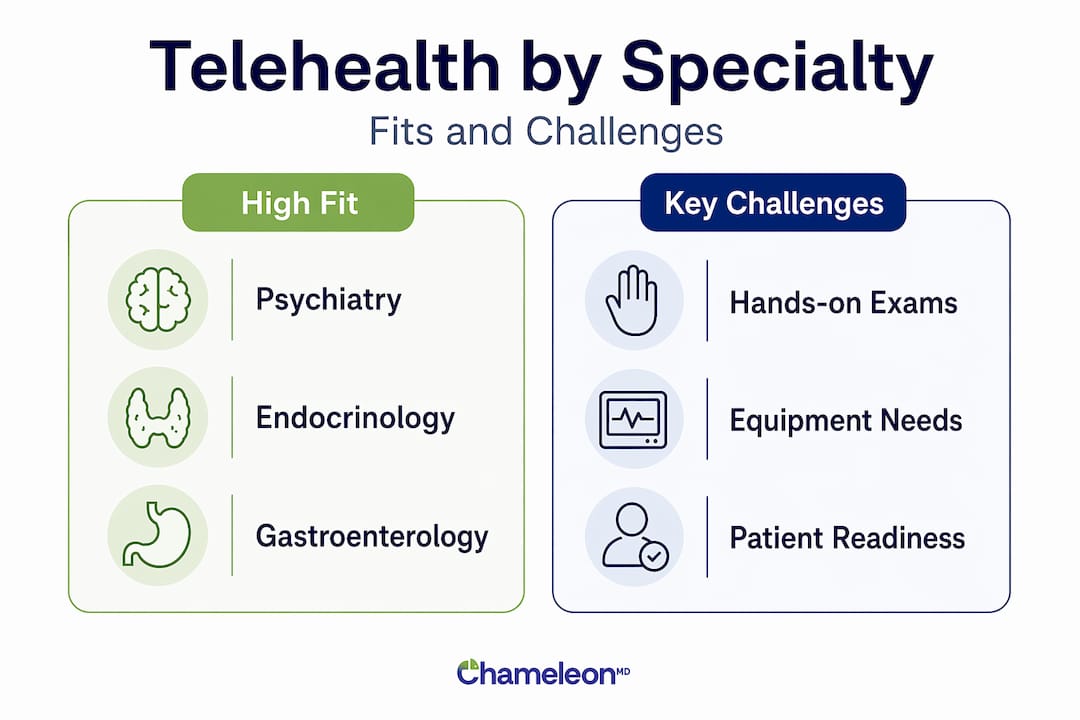
Not every specialty integrates telehealth the same way, and that difference matters for how clinicians actually experience their work. Psychiatry accounts for over 31% of all telehealth-related Medicare spending, which reflects both patient demand and clinical suitability. Mental health care does not require physical examination in most encounters, making it highly compatible with virtual delivery.
Other specialties tell a very different story. Endocrinology, neurology, and gastroenterology have adopted telehealth for specific use cases, such as medication management and follow-up visits, but physical exam requirements limit the range of conditions they can manage virtually.
| Specialty | Telehealth fit | Primary use case | Key challenge |
|---|---|---|---|
| Psychiatry | Very high | Therapy, medication management | Crisis management, licensing across states |
| Endocrinology | Moderate | Diabetes follow-up, lab review | Remote monitoring integration |
| Neurology | Moderate | Headache management, post-stroke check-ins | Neurological exam limitations |
| Primary care | High | Acute illness, chronic care management | Triage escalation decisions |
| Gastroenterology | Low to moderate | Post-procedure follow-up, IBD monitoring | Physical exam dependency |
For clinicians, specialty-specific telehealth adoption directly affects workload and job satisfaction. Telemedicine adoption correlates with improved physician-patient relationships, and roughly 30% of satisfaction gains trace back to that connection quality. Specialties where virtual care fits naturally tend to see the strongest benefits. Where the fit is poor, clinicians report frustration from incomplete assessments and repeated escalations. Understanding where your specialty sits on this spectrum helps you set realistic expectations and advocate for the right tools and protocols.
You can also explore how telehealth varies by specialty and what that means for patient access at the broader system level.
Clinical governance and leadership beyond direct care

The roles of healthcare professionals in telehealth extend well beyond seeing patients. In any well-run telehealth organization, clinicians carry governance responsibilities that shape the quality and safety of the entire program.
Telehealth medical directors, in particular, carry significant accountability:
- Protocol development and approval: Medical directors establish and sign off on clinical protocols, standing orders, and scope-of-practice guidelines that all providers must follow.
- Multi-state compliance oversight: Medical directors carry accountability for confirming that providers are licensed appropriately across every state where patients are seen.
- Documentation review and audit readiness: Programs need regular chart reviews to verify that documentation meets regulatory standards. Clinician leaders drive that process.
- Scope-of-practice supervision: When nurse practitioners or physician assistants practice in telehealth programs, supervising physicians are responsible for confirming that care stays within appropriate boundaries.
- Organizational integrity: Governance through medical directors reduces legal risk and influences how frontline clinicians experience their day-to-day practice.
For clinicians who are not in formal leadership roles, understanding this governance structure matters. It clarifies who sets the protocols you follow, who reviews your documentation, and who carries ultimate accountability when things get complicated.
Telehealth best practices for providers
Adapting to telehealth delivery is a skill set that goes beyond clinical competence. The clinicians who do it well have learned specific habits that keep their care quality high and their patients engaged. Here are the practices that make the biggest difference:
- Master your environment first. Lighting, camera angle, and background all affect how patients perceive you. A well-framed, well-lit setup communicates professionalism and helps patients feel they are receiving serious attention.
- Adapt your communication style. Without physical presence, non-verbal cues carry less weight. Speak clearly, pause for responses, and confirm understanding more deliberately than you would in person.
- Document thoroughly and specifically. Because physical exam limitations create documentation risk, your notes need to explain what you assessed, what you could not assess remotely, and why your clinical decision was reasonable given those constraints.
- Collaborate with your remote team. Telehealth shifts clinician roles and workflow adaptations require coordination with medical assistants, care coordinators, and support staff who may be handling intake, prior authorizations, or portal messaging on your behalf.
- Stay ahead of regulatory changes. Telehealth policy evolves faster than most areas of healthcare. Build a habit of reviewing regulatory updates quarterly, especially if you practice across state lines.
Pro Tip: After every telehealth visit, take sixty seconds to confirm your documentation explicitly addresses the triage decision. Did you explain why virtual assessment was sufficient, or why you escalated? That brief habit prevents the most common compliance gaps.
A 2026 study of over 1.2 million Medicare patients found that higher telehealth use in primary care decreased in-person visits without increasing hospitalizations or overall spending. That evidence supports telehealth as a safe delivery model when clinicians manage their workflows and escalation decisions well.
My take on what clinicians actually face in telehealth
I’ve spent time reviewing how clinicians describe their telehealth experience, and the gap between theory and practice is wider than most programs acknowledge. The workflow frameworks look clean on paper. In real visits, dropped connections, patients using phones in cars, and intake forms that arrive incomplete are routine. The technical burden alone can erode the care quality that everyone works to protect.
What I’ve found is that the clinicians who handle telehealth well are not necessarily the most tech-savvy. They are the ones who have clear, rehearsed responses for when things go wrong. They know what to say when a connection fails. They have a protocol for when a patient’s location is unclear. That preparation is not built into most telehealth training programs, and it should be.
The regulatory burden also deserves more honesty. Managing mental health crises across jurisdictions remotely is genuinely hard. It requires fast thinking, careful documentation, and coordination with emergency services in a location you cannot see. Clinicians who carry that responsibility need organizational support, not just a policy document.
My overall read is that telehealth done right improves both care and clinician satisfaction. Telehealth done carelessly adds burden without benefit. The difference is almost entirely in how well the organization structures its governance, protocols, and training. Individual clinicians can only adapt so far without institutional support.
— Vector
Accessible virtual care designed around real workflows
Chameleonhc was built with the understanding that modern healthcare needs to fit around real life. That means giving clinicians the tools and clear protocols to manage common conditions confidently, and giving patients same-day access without waiting rooms or insurance hurdles.
Whether you are managing a sinus infection, a skin rash, or a recurring condition that needs consistent follow-up, Chameleonhc connects you with licensed providers who are set up specifically for virtual care delivery. The platform handles conditions from urgent dental concerns to respiratory management like asthma through a model that keeps both provider and patient experience clear and manageable.
Explore telehealth subscription plans that make ongoing care simple, affordable, and structured so clinicians can focus on what they do best. No insurance required. No unnecessary complexity.
FAQ
What is the core role of clinicians in telehealth?
Clinicians in telehealth are responsible for remote patient assessment, clinical decision-making, triage escalation, regulatory compliance, and documentation. Their role extends beyond direct care to include technology management and legal accountability tied to patient location and licensure.
What licensing rules apply to telehealth providers?
Clinicians must hold an active license in the state where the patient is physically located during the telehealth visit. This rule applies regardless of where the clinician’s primary practice is based.
How do clinicians handle emergencies during telehealth visits?
Clinicians should confirm the patient’s physical location at the start of every urgent visit, maintain engagement during a crisis, coordinate with local emergency services, and document all risk assessments and interventions thoroughly.
Which specialty uses telehealth the most?
Psychiatry leads telehealth utilization, accounting for over 31% of telehealth-related Medicare spending according to 2024 AMA data. Its low dependency on physical examination makes it the most naturally compatible specialty for virtual care.
How does telehealth affect clinician job satisfaction?
Research shows that telemedicine adoption correlates with higher physician job satisfaction, with improved physician-patient relationships accounting for roughly 30% of that satisfaction improvement.