

TL;DR:
- Care continuity online involves receiving consistent care from the same provider over time through digital health services. It improves patient outcomes by reducing errors, hospitalizations, and improving medication adherence, especially in managing chronic conditions. Patients can protect their care quality by requesting summaries, choosing named clinicians, and actively engaging in follow-up and health records.
Care continuity online is defined as the consistent, coordinated medical care a patient receives from the same provider or care team over time through digital health services. When this continuity breaks down, patients face higher risks of medical errors, missed diagnoses, and poor medication adherence. 2026 professional guidelines identify continuity as a primary driver of safer outcomes in telehealth. Platforms like DevotedDOc and SiggyMD have built their entire models around this principle, recognizing that the role of care continuity online goes far beyond a single convenient appointment.
How does care continuity improve patient outcomes in online healthcare?
Continuous online care produces measurable, documented improvements in health. A 2023 cohort study found that higher continuity in psychiatric services significantly reduced symptom severity and improved social functioning, with medium effect sizes across both measures. That means patients who saw the same provider consistently got better, not just marginally better, but in ways researchers could measure and replicate.
The benefits extend well beyond mental health. Continuous nursing care online through Internet+ platforms significantly improves inflammatory response, treatment adherence, and quality of life for patients managing chronic conditions like ulcerative colitis. This matters because chronic illness management depends on a provider who knows your history, not one who reads your chart for the first time at every visit.
Here is what the evidence shows continuity delivers across online care settings:
- Fewer medical errors. A provider with your full history catches drug interactions and contradictions that a one-off telehealth visit misses entirely.
- Lower hospitalization rates. Patients with consistent digital care teams are less likely to end up in emergency rooms for conditions that could have been caught earlier.
- Better medication adherence. When a provider follows up on whether a treatment is working, patients stay on track with prescriptions and lifestyle changes.
- Improved chronic illness management. Conditions like asthma, diabetes, and hypertension require ongoing monitoring. A single visit cannot replace a care relationship.
- Stronger mental health outcomes. The American Psychiatric Association supports telepsychiatry as equivalent to in-person care when the clinical structure supports continuity.
Pro Tip: When choosing a telehealth provider, ask directly whether your visits are logged in a longitudinal record and whether the same clinician will be available for follow-ups. This one question separates genuine care continuity from a convenient prescription service.
What are the challenges and risks of fragmented care in digital health environments?
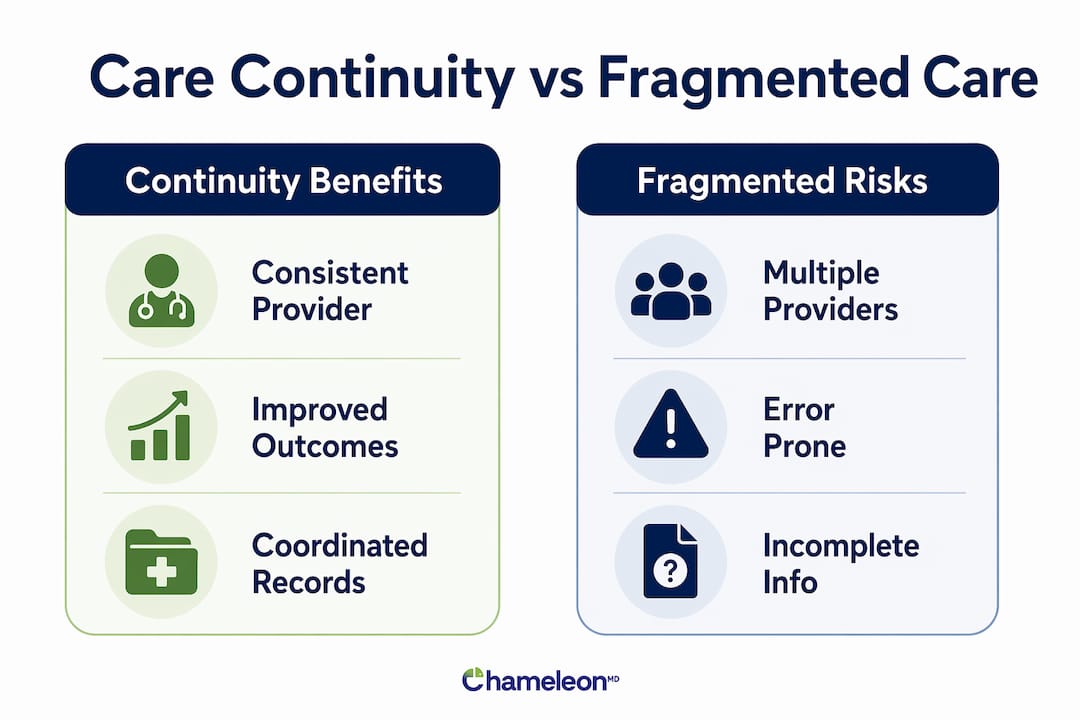
Fragmented telehealth care is one of the most underappreciated risks in online medicine. When patients rotate through different providers on different platforms with no shared records, clinical decision-making suffers. Experts warn that transactional telehealth without longitudinal records fails to provide safe, coordinated care. The convenience of a quick online visit becomes a liability when no one has the full picture.
The risks compound quickly in specific scenarios. Consider a patient managing anxiety who uses three separate apps: one for therapy, one for medication refills, and one for urgent care visits. None of these providers communicate with each other. A medication prescribed on one platform may interact dangerously with something prescribed on another. No single clinician holds the complete story.
The most common fragmentation risks in digital care include:
- Siloed records. Each platform holds a piece of your health history, but no provider sees the whole.
- Anonymous triage visits. One-off consultations with rotating clinicians reduce care to a transaction, not a relationship.
- No post-visit follow-up. Without a scheduled next step, patients fall through the gaps between appointments.
- Missed escalation signals. A provider who has never seen you before cannot recognize that your symptoms have changed or worsened over time.
- Weakened patient trust. Patients who feel unrecognized by their providers are less likely to share complete information, which further compromises care quality.
Pro Tip: After every telehealth visit, request a written post-visit summary. This gives you a personal record you can share with any new provider, reducing the risk that critical information gets lost between platforms.
How is care continuity maintained and enhanced in telehealth platforms?
The most effective telehealth models build continuity into their structure from the start. One-team online psychiatric care with shared longitudinal records consistently outperforms siloed systems where care restarts at every visit. The difference is not just clinical. Patients who work with a consistent team report higher satisfaction and greater willingness to engage with their care plans.

Digital-first primary care works best when combined with hybrid models that preserve modality choice and safe escalation pathways. This means patients can move between video visits, messaging, and in-person care without losing their clinical history. An NHS England review confirmed that patient-centered digital care depends on this kind of careful design.
The table below shows the key differences between continuity-focused telehealth and transactional telehealth models:
| Feature | Continuity-focused telehealth | Transactional telehealth |
|---|---|---|
| Provider consistency | Same clinician or named care team | Rotating, anonymous providers |
| Patient records | Shared longitudinal record | Visit-by-visit, siloed notes |
| Follow-up structure | Scheduled follow-ups built into care plan | No follow-up unless patient initiates |
| Escalation pathway | Clear referral and escalation protocols | Patient manages escalation independently |
| Medication management | Active monitoring and adjustment | Refill-focused, minimal oversight |
Platforms that prioritize continuity also integrate pharmacy coordination, lab result tracking, and mental health support within a single care environment. This integration removes the burden from patients to coordinate their own care across disconnected systems. The benefits of telemedicine are fully realized only when this coordination exists.
What can you do to ensure continuity in your online care?
You have more control over your care continuity than most people realize. The choices you make when selecting a telehealth provider and how you engage with that provider directly affect the quality and safety of your care over time.
Start with these practical steps:
- Choose platforms with named clinicians. Avoid services that assign a random provider to each visit. Look for platforms where you can request or be assigned a consistent clinician.
- Request visit summaries every time. Post-visit summaries and same-clinician appointments are recognized quality measures in virtual consultations. Ask for them as a standard part of every visit.
- Maintain your own health record. Keep a simple document with your current medications, diagnoses, allergies, and recent visit notes. Share this at the start of any new provider relationship.
- Schedule follow-ups before you leave. Do not wait until symptoms return to book your next appointment. Consistent scheduling keeps your care on track.
- Share your full medical history upfront. Providers can only make good decisions with complete information. Withholding details, even unintentionally, creates gaps that lead to errors.
- Use platforms that integrate mental health and chronic care. Fragmented care is most dangerous when mental health, medication, and physical health are managed separately. Look for services that connect these areas.
The central value of digital-first services is access to a known clinician rather than anonymous triage. That relationship is worth protecting. For parents managing care for the whole family, same-day online visits work best when they are part of an ongoing care relationship, not a one-time fix.
True continuity also requires active clinical monitoring and treatment adjustment, not just prescription refills. If your telehealth provider only contacts you when you initiate, that is a signal to look for a more engaged care model.
Key takeaways
Care continuity online is the single most important factor separating effective telehealth from convenient but risky transactional care. It requires consistent providers, shared records, scheduled follow-ups, and active clinical monitoring to deliver real health improvements.
| Point | Details |
|---|---|
| Continuity improves outcomes | Consistent online care reduces symptom severity, hospitalizations, and medication errors. |
| Fragmentation creates risk | Siloed records and rotating providers increase clinical errors and weaken patient safety. |
| One-team models outperform | Platforms with shared longitudinal records deliver better results than visit-by-visit systems. |
| Patients can protect continuity | Requesting visit summaries and choosing named clinicians reduces fragmentation risk. |
| Active monitoring matters | Real continuity means ongoing treatment adjustment, not just refill access. |
Why I think most patients underestimate this problem
Most people I speak with think of telehealth as a convenience tool. They use it to get a prescription faster or avoid a waiting room. That framing is understandable, but it misses something important.
The patients who get the most out of digital care are the ones who treat their online provider the same way they would treat a long-term family doctor. They share their history. They show up for follow-ups. They ask questions when something changes. The technology is just the delivery mechanism. The relationship is what does the work.
What concerns me most is the rise of platforms that optimize for speed at the expense of connection. A five-minute visit with a provider who has never seen your chart is not care. It is triage. And triage repeated indefinitely is not a healthcare strategy.
The good news is that patients have real leverage here. You can ask for continuity. You can request the same clinician. You can choose platforms that build follow-up into their model rather than leaving it to chance. The research is clear that this choice matters. A 2023 study showed measurable improvements in both symptoms and social functioning when psychiatric patients maintained consistent provider relationships online. That finding applies across conditions, not just mental health.
My honest advice: treat your telehealth provider like a partner, not a vending machine. The outcomes are better when you do.
— Vector
Chameleonhc makes ongoing online care simple and clear
Chameleonhc is built around the idea that good care does not stop after one visit. The platform connects you with licensed providers for same-day appointments, clear care plans, and easy follow-ups, all without insurance or waiting rooms.
Whether you are managing a chronic condition like asthma or dealing with something that keeps coming back, Chameleonhc keeps your care connected and your provider informed. Transparent pricing and a membership model mean you can schedule follow-ups without worrying about surprise costs. Explore telehealth subscription plans designed to keep your care consistent, coordinated, and always within reach.
FAQ
What is care continuity in online healthcare?
Care continuity in online healthcare means receiving consistent, coordinated care from the same provider or team over time through digital platforms. It ensures your medical history, treatment plans, and follow-ups are connected rather than starting fresh at every visit.
Why does care continuity matter in telehealth?
2026 professional guidelines identify continuity as a key driver of reduced medical errors, lower hospitalization rates, and better medication adherence. Without it, telehealth becomes transactional and clinically risky.
How can I tell if a telehealth platform supports care continuity?
Look for platforms that assign named clinicians, maintain longitudinal patient records, and schedule follow-up appointments as part of the standard care process. Platforms that rotate anonymous providers with no shared records do not support true continuity.
Does care continuity apply to mental health telehealth too?
Yes. A 2023 cohort study found that consistent provider relationships in online psychiatric care significantly reduced symptom severity and improved social functioning. The American Psychiatric Association confirms telepsychiatry matches in-person outcomes when clinical continuity is maintained.
What should I do if my telehealth visits feel disconnected?
Request a written post-visit summary after every appointment and ask to be assigned the same clinician for future visits. Maintaining your own medication and diagnosis record also helps any new provider get up to speed quickly.