

Expect to pay roughly $150 to $650 a month for legitimate online semaglutide access, depending on which lane you use. Manufacturer self-pay and discount programs land at the low end for uninsured buyers, insurance with a savings card is usually cheapest if your plan covers it, and compounded cash options sit somewhere in between but carry real safety trade-offs. The number that actually applies to you depends on your coverage, your dose, and whether you’re looking at intro pricing or the maintenance price you’ll pay for the long haul.
TL;DR:
- Most consumers will pay between $150 and $650 a month for legitimate online semaglutide, depending on coverage, dose, and payment method.
- Manufacturer self-pay programs often offer introductory prices around $199 monthly for uninsured buyers, but prices can increase significantly after initial discounts.
- Insurance coverage, especially through favorable formulary tiers and prior authorization, can reduce out-of-pocket costs to double digits or less.
- Compounded semaglutide is typically cheaper on paper but carries safety risks, lacks FDA approval, and is usually not covered by insurance, making it less reliable.
- Buying from a licensed provider who includes monitoring and follows regulatory standards protects safety and can ultimately save money through transparent pricing.
Table of Contents
- Semaglutide Online Cost at a Glance: Lanes and Typical Monthly Ranges
- How Prices Vary by Purchase Pathway
- How Insurance, Copay Cards, and the Medicare GLP-1 Bridge Change Your Cost
- Estimating Your Real Out-of-Pocket Cost, Month by Month
- Why Regulatory Status Affects Both Safety and Price
- How to Buy Semaglutide Online Safely and Affordably
- Chameleon Healthcare: Clear Pricing for GLP-1 Management, No Insurance Required
- When Paying More for Semaglutide Actually Makes Sense
- Sources
Semaglutide Online Cost at a Glance: Lanes and Typical Monthly Ranges
Not all “semaglutide online” purchases are the same product, sold the same way, at the same price. Before you compare numbers, it helps to know which lane you’re actually shopping in.
- Brand retail list price. This is the sticker price before any discount or coverage. Wegovy lists at $1,349.02 a month and Ozempic at roughly $1,027.51, and almost nobody pays this figure out of pocket for long.
- Manufacturer self-pay programs. NovoCare’s direct-to-patient pricing brings Wegovy and Ozempic down dramatically for cash payers, often starting around $199 a month for an introductory period before settling higher.
- Discount and telehealth-bundled platforms. Services built around GoodRx-style pricing typically start with a promotional rate for the first fill or two, then step up once the introductory window closes.
- Compounded semaglutide (cash-only). Prices here vary widely by pharmacy and dose, and availability has tightened as regulators narrow which versions can legally be compounded.
- Oral semaglutide (Rybelsus). The pill form has its own pricing structure separate from the weekly injectable, and it isn’t a straight substitute for Wegovy in dosing or approved use.
If you have insurance that covers a GLP-1 for weight management or diabetes, and your plan tier is favorable, your monthly copay can undercut every cash option on this list, sometimes down to double digits. If you’re uninsured, the manufacturer self-pay lane and discount platforms are usually your best bet, at least during the promotional period. Medicare beneficiaries have a distinct path worth understanding on its own, which we’ll get to.
The honest takeaway: the “list price” you see quoted in headlines is rarely what anyone actually pays. It’s the starting point insurers negotiate down from and the number manufacturers use as a baseline before self-pay discounts kick in.
How Prices Vary by Purchase Pathway
Semaglutide’s price swings so widely because the drug moves through at least five distinct pricing systems, each with its own logic. Understanding the mechanics behind each one tells you which lane actually fits your situation.
Brand list price versus what patients pay
The Wall Street Journal-style headline number, Wegovy at $1,349.02 monthly, is the Wholesale Acquisition Cost, the price a wholesaler pays before rebates, discounts, or insurance negotiations. It’s a real number, but it’s almost never the number that lands on a patient’s bill. Insurers negotiate it down through pharmacy benefit managers, and manufacturers offer separate self-pay pricing entirely disconnected from that list price. Think of the list price as the drug’s version of a car’s MSRP: informative for comparison, but nobody expects to write that check.
Manufacturer self-pay programs: the fastest relief for uninsured buyers
NovoCare’s self-pay option for Wegovy and Ozempic has run introductory pricing around $199 a month for new patients, a steep drop from list price. LillyDirect runs a comparable self-pay structure for its own GLP-1 products. Two things matter here that a lot of buyers miss:
- The discounted rate typically applies for a limited number of fills, often the first one to three months, before reverting to a higher maintenance price.
- Government beneficiaries, including Medicare and Medicaid enrollees, are usually excluded from these manufacturer self-pay programs by design, since federal rules restrict how drug makers can offer cash discounts to patients whose care is federally funded.
Pro Tip: Call NovoCare or LillyDirect directly and ask for the exact maintenance price that kicks in after your introductory months end, not just the promo rate. Write that second number down. It’s the one your budget actually needs.
Discount platforms and telehealth-bundled pricing
Discount aggregators and telehealth companies that bundle a prescription with a coupon often mirror the manufacturer’s own promotional structure. Reporting on these platforms shows a common pattern: an introductory rate near $199 for the first couple of fills, then a jump to a moderate higher price ongoing (https://www.middlewaynutrition.com/glp-1/glp-1-price-comparison). The catch is that this “online prescription no insurance” price frequently bundles a telehealth visit fee into the total, so the number you see advertised isn’t always the number you’ll be charged once a clinician evaluation and any lab work get added.
Compounded semaglutide: cheaper on paper, riskier in practice
Compounded versions have historically undercut brand pricing because they’re made by compounding pharmacies rather than the original manufacturer. But two things have changed the math recently. First, compounded semaglutide is not FDA-approved, and the FDA has issued public guidance on compounding concerns that directly affects which products pharmacies can legally offer. Second, reporting indicates compounded semaglutide moved off allowed bulk-compounding lists in 2026, which has constrained supply and pushed some vendors to raise prices or exit the market entirely. Compounded products are also almost never covered by insurance, so whatever price you see is the full price.
Oral versus injectable: not a simple swap
Rybelsus, the oral tablet form of semaglutide, follows its own dosing schedule and its own pricing track, separate from Wegovy’s weekly injection. It’s not simply “the cheaper version” of the same drug. Dosing requirements differ, and labeling data confirms the distinct titration schedules each formulation requires. If a provider or platform is comparing an oral price against an injectable price as if they’re interchangeable, that’s worth a second look before you commit.
How Insurance, Copay Cards, and the Medicare GLP-1 Bridge Change Your Cost
If you have commercial insurance, your out-of-pocket cost depends far more on your plan’s formulary than on the drug’s sticker price. Three mechanics decide what you’ll actually owe:
- Formulary tier. GLP-1s for weight management often sit on a higher tier than the same drug prescribed for diabetes, which can mean a bigger copay or coinsurance percentage even for chemically identical medication.
- Prior authorization. Most plans require your prescriber to document medical necessity before they’ll cover Wegovy or Ozempic for weight loss. Without an approved PA, you’re billed the full cash price at the pharmacy counter, which can be a nasty surprise if nobody warned you it might happen.
- Step therapy. Some insurers require you to try and fail a cheaper option first, whether that’s lifestyle intervention documentation or another medication class, before they’ll approve a GLP-1.
Manufacturer copay cards can stack on top of insurance coverage to shrink your payment further. Novo Nordisk and Eli Lilly both run savings card programs that cap eligible commercially insured patients’ monthly copay, sometimes to a flat, low amount, though the exact cap depends on your specific plan and whether your insurer already covers the drug at some level. These cards typically exclude anyone on Medicare, Medicaid, or another government health program, same as the self-pay discounts.
Medicare beneficiaries have their own path. The Medicare GLP-1 Bridge program offers eligible Part D enrollees access to Wegovy and similar drugs for $50 a month during the Bridge period running from July 1, 2026, through December 31, 2027. It’s not automatic. You still need prior authorization through your Part D plan, and eligibility rules apply, so this is a program to ask your prescriber and plan about directly rather than assume you qualify for by default.
Before you accept any quoted price, run through this checklist with your insurer or prescriber’s office:
- Is semaglutide or the specific brand covered under my plan, and at what tier?
- Does my plan require prior authorization, and has my prescriber submitted it?
- What’s my estimated copay or coinsurance once PA is approved?
- Am I eligible for a manufacturer copay card, and does my insurance status disqualify me?
- If I’m on Medicare, does the GLP-1 Bridge program apply to my plan and dose?
Estimating Your Real Out-of-Pocket Cost, Month by Month
Sticker prices are a starting point, not an answer. Building your own estimate takes five steps.
- Pick your product and starting dose. Semaglutide starts low and escalates. Dosing schedules from product labeling show gradual increases over weeks or months to reach a maintenance dose, and pharmacies sometimes price different dose strengths differently.
- Find your real price for that dose. Call your insurer for your formulary copay, or check the manufacturer or discount platform’s actual price for that specific strength, not just their advertised “starting at” number.
- Add telehealth or provider fees. If you’re getting your prescription through an online provider, add their visit fee and any required follow-up visit cost to the drug price itself.
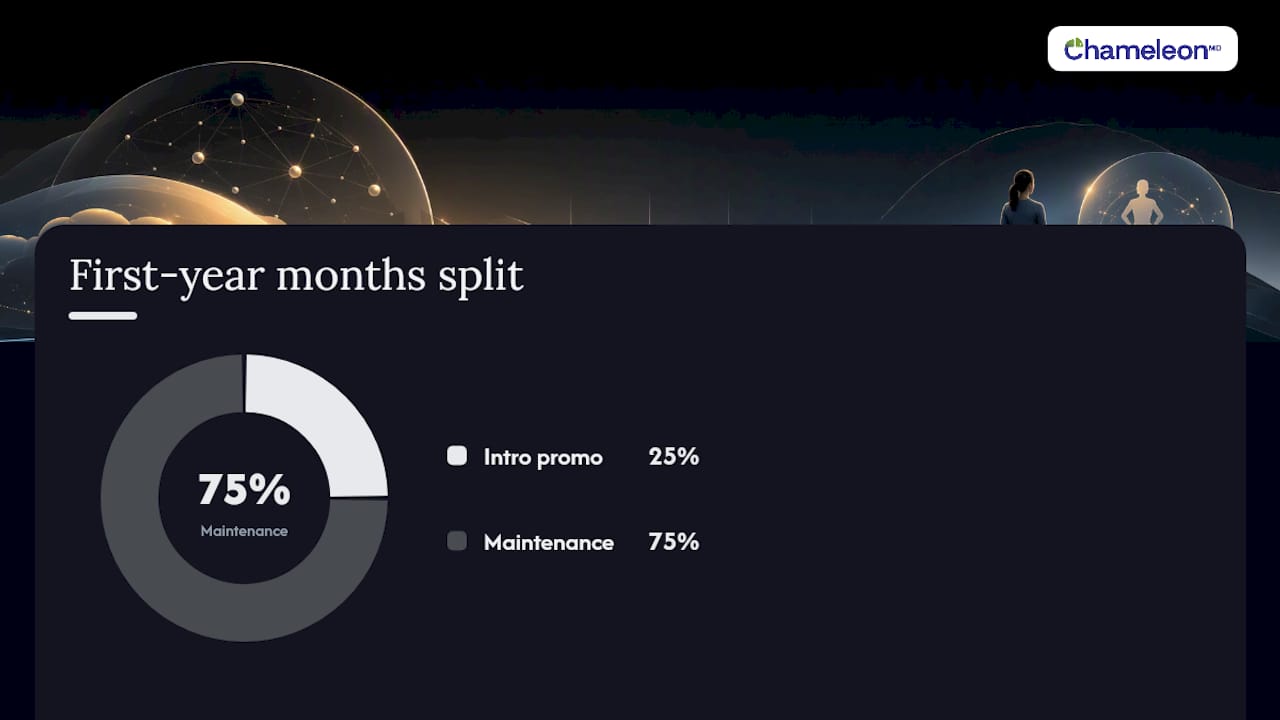
- Map the intro-to-maintenance timeline. Note exactly when a promotional rate ends and what the price becomes afterward, then multiply that maintenance price by the number of months you’ll realistically stay on treatment.
- Add the hidden costs. Shipping fees, periodic lab monitoring, a higher copay if a prior authorization gets denied, and wasted doses from a missed or expired refill all add up.
Statistic Callout: Manufacturer self-pay intro pricing near $199 a month is a real, documented starting offer, but clinicians who track patient budgeting say the most common financial surprise isn’t the intro price at all. It’s forgetting that the maintenance price replaces it after just a few months.
Here’s what that looks like across a real timeline. Say you start on manufacturer self-pay at the $199 introductory rate for months one through three while your dose escalates. In month four, once you’ve reached maintenance dosing, your price jumps to the standard self-pay rate, which can run several times higher depending on the current program terms. Add a modest monthly telehealth follow-up fee if your prescription comes through an online-only provider, plus occasional lab work your prescriber orders to monitor kidney function or blood sugar. A patient who budgeted only for that first $199 month is often caught off guard by month four’s total, which is why projecting a full year of costs, using the maintenance price rather than the promo price, is the single most useful thing you can do before starting treatment.
Why Regulatory Status Affects Both Safety and Price
Compounded semaglutide sits in a different legal category than the brand-name drug, and that distinction shapes both what you’ll pay and what protections you have if something goes wrong.
Compounding pharmacies operate under two designations. A 503A pharmacy compounds patient-specific prescriptions in smaller batches, typically for a single patient based on an individual prescription. A 503B outsourcing facility compounds in bulk under different oversight requirements. USP’s compounding standards explain how these categories differ in quality control and testing obligations, and neither category means the FDA has approved the specific compounded product the way it approves Wegovy or Ozempic.
That regulatory gap has direct financial consequences. Because compounded semaglutide isn’t FDA-approved, insurance plans almost never cover it, which is why every compounded price you see quoted online is a full cash price with no copay ceiling and no manufacturer savings card to soften it. The FDA’s own guidance on compounding also means availability can shift quickly if a compounding ingredient loses its eligibility, which is part of why compounded pricing has been more volatile than brand pricing recently.
Before paying anyone for online semaglutide, run through a short verification checklist:
- Confirm the pharmacy is licensed in your state through your state board of pharmacy’s public license lookup.
- Check whether the pharmacy carries NABP verification or VIPPS accreditation, both signals of a legitimately operating U.S. pharmacy.
- Confirm a licensed clinician actually evaluates you, reviews your history, and writes the prescription, rather than a form you fill out that auto-generates an order.
- Be wary of any seller offering semaglutide with no medical evaluation at all, or dispensing from outside the U.S. without a domestic license.
Pro Tip: A legitimate telehealth provider will always require some form of clinical intake, whether that’s a video visit or a detailed health questionnaire reviewed by a licensed provider, before writing any prescription. If a site skips that step entirely, treat it as a red flag, not a convenience.
If you’re weighing other injectable treatments and want a broader look at how U.S. regulation shapes safety and pricing for injection-based care, this overview of injection safety standards walks through similar verification principles that apply well beyond GLP-1s.
How to Buy Semaglutide Online Safely and Affordably
Once you’ve decided to move forward, following a set sequence keeps you from overpaying or, worse, ordering from a source that skips medical oversight entirely.
- Check your insurance coverage first. Call your insurer or check your plan portal to see if GLP-1s are covered for your diagnosis, and what tier they sit on.
- Compare self-pay lanes side by side. Get the actual current self-pay price from NovoCare or LillyDirect, then compare it against any discount platform’s post-promo maintenance price, not just their advertised intro rate.
- Choose a telehealth visit that includes follow-up. A one-time prescription with no monitoring plan is a poor value even at a low price, since dose escalation and side-effect management both require ongoing clinician contact.
- Confirm pharmacy licensure before you pay anything. Look up the dispensing pharmacy’s license through your state board of pharmacy.
- Schedule your monitoring visits up front. Ask when your next check-in happens and what it costs, so it’s part of your budget from day one, not a surprise fee later.
Before committing to any provider, ask them directly:
- Will I get lab monitoring, and how often, and is that cost included or billed separately?
- What’s your refill cadence, and what happens if a refill is delayed?
- Are shipping and handling fees included in the quoted monthly price?
- What’s the total price after any introductory period ends?
Choosing between lanes comes down to trade-offs, not a single best answer. Manufacturer self-pay tends to fit uninsured buyers who want the most direct pricing from the drug’s actual maker. Telehealth-managed care fits people who value built-in follow-up and don’t want to coordinate labs and prescriptions across separate providers. Cash-pay compounded options might look cheaper upfront, but given the regulatory tightening around compounded GLP-1s and the total absence of insurance backing, they carry more uncertainty than either of the other two paths.
Walk away immediately from any seller that skips a real clinician evaluation, ships from overseas without U.S. licensure, or promises “no monitoring required.” Those aren’t convenience features. They’re the exact gaps where things go wrong.
Chameleon Healthcare: Clear Pricing for GLP-1 Management, No Insurance Required
If you’ve made it this far, you already know the hardest part of buying semaglutide online isn’t finding a low price. It’s finding a low price attached to a provider who actually checks in with you as your dose changes. A GLP-1 management subscription can close that gap by offering licensed providers, transparent pricing, and timely access, usually without requiring insurance to begin.
You connect with a licensed provider online, get evaluated for eligibility, and if appropriate, start a treatment plan with clear pricing you can see before you commit. That transparency matters more with GLP-1s than with most prescriptions, since intro pricing, dose escalation, and maintenance costs can shift your monthly bill if nobody’s walking you through it. This model pairs pricing clarity with clinician follow-up, so monitoring isn’t an afterthought you have to arrange separately.
Eligibility and coverage still depend on clinical judgment and your specific health history, and if you have insurance, it’s worth checking your own plan’s GLP-1 coverage before choosing a self-pay path. If you want to see current plans and pricing, you can explore Chameleonhc’s telehealth plans and get a same-day sense of what GLP-1 management would actually cost you.
When Paying More for Semaglutide Actually Makes Sense
The cheapest legitimate path makes sense when you’re a healthy, uninsured adult with no complicating conditions, willing to track your own dose escalation and stick to a strict maintenance budget from month one. It gets risky the moment you have kidney issues, a complex medication list, or a habit of skipping follow-up visits, because that’s exactly when unmonitored cash options fail people.
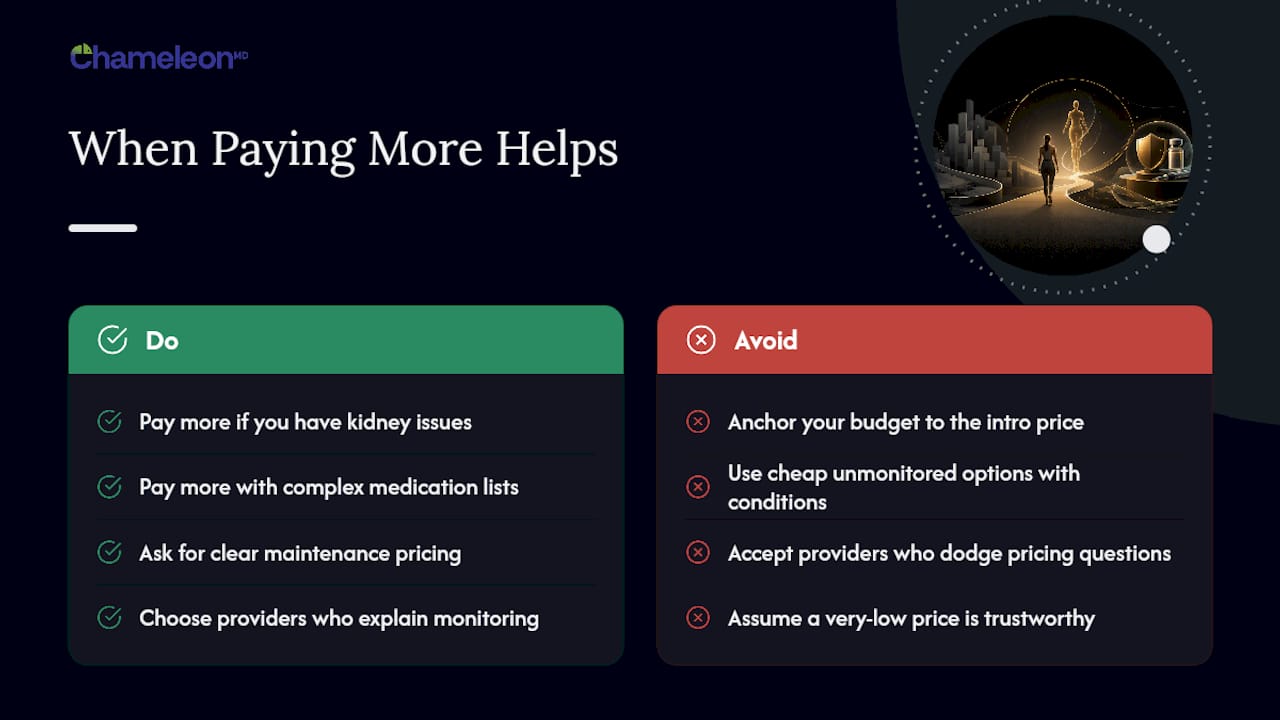
The single biggest budgeting mistake isn’t picking the wrong lane. It’s anchoring your entire mental budget to an introductory price that was never meant to last. Whatever number gets you excited in month one, ask what you’ll be paying in month six, then decide if that’s still a price you can live with.
If a price feels too good given everything else in this article, it usually is. A pharmacist or provider who won’t clearly explain their maintenance pricing, or who dodges questions about monitoring, is telling you something even if they never say it directly. The providers worth paying more for are the ones who answer those questions before you ask twice.
— Vector
This article is general information, not a substitute for advice from a qualified doctor. Consult a qualified healthcare professional about your own circumstances before acting on anything here.
Sources
- Semaglutide Costs, Insurance & Savings Tips – Forbes Health
- Compounding and FDA: Questions and Answers | FDA
- Medicare Part D benefits manual — Chapter 6 (CMS)
- USP: Compounding
- DailyMed: Semaglutide drug info