
TL;DR:
- Same-day doctor visits provide prompt, non-emergency care for conditions like infections and minor injuries, either in person or virtually. They offer faster, more affordable access than emergency rooms, especially when coordinated through your primary care provider or telehealth platforms. Choosing the right option depends on symptom severity, your medical history, and cost considerations, with telehealth serving as a convenient alternative for many common issues.
Same-day doctor visits are medical appointments designed to address non-life-threatening health issues on the very day you request care. They cover everything from a sore throat that won’t quit to a sprained ankle you picked up at the gym. Clinically, these visits fall under two main categories: same-day primary care appointments and urgent care visits. Both give you access to a licensed provider without waiting days for an opening. If you’ve ever wondered what qualifies, what to expect, or how to choose the right option, this guide covers all of it.
What conditions are treated during same-day doctor visits?
Same-day doctor visits handle a wide range of non-emergency conditions. Urgent care provides prompt treatment for issues like throat infections, sprains, and minor cuts that are not life-threatening. These visits sit firmly between a routine checkup and a trip to the emergency room.
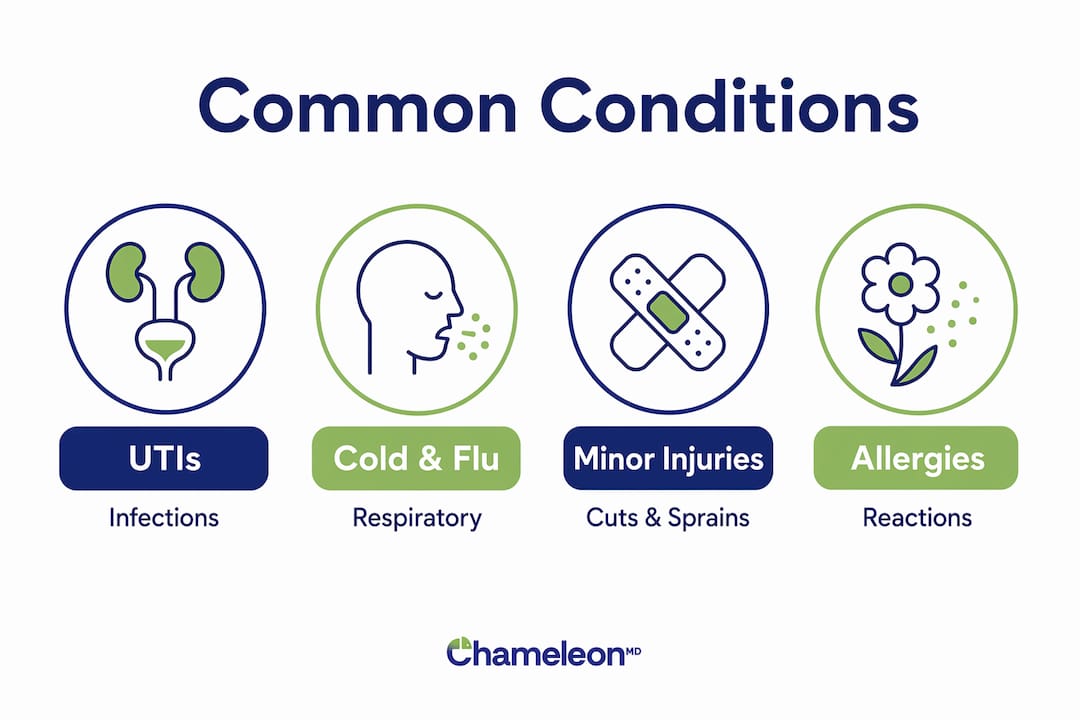
Common conditions treated at same-day visits include:
- Cold and flu symptoms, including fever, body aches, and congestion
- Sinus infections and ear infections
- Urinary tract infections (UTIs)
- Allergic reactions that are uncomfortable but not severe
- Skin rashes, minor burns, and insect bites
- Sprains, strains, and minor fractures
- Minor lacerations that need cleaning or closure
- Pink eye and other mild eye irritations
- Nausea, vomiting, and mild dehydration
Typical services available during these visits:
- Basic lab tests such as strep throat swabs and urinalysis
- X-rays for suspected fractures or joint injuries
- Prescriptions for antibiotics, antivirals, or other medications
- Referrals to specialists when needed
- EKGs and oxygen level checks at many immediate care centers
Same-day visits are not appropriate for every situation. Chest pain, difficulty breathing, signs of stroke, severe bleeding, or any condition that feels life-threatening belongs in an emergency department. The distinction matters because urgent care centers, while capable, are not equipped with ED-level diagnostics or specialist staffing. Knowing this boundary protects you from delays in genuinely critical moments.
Same-day primary care vs. urgent care: what’s the difference?
Understanding the difference between these two options helps you choose the one that actually fits your situation. They are not interchangeable, even though both offer same-day access.
| Feature | Same-day primary care | Urgent care |
|---|---|---|
| Medical history access | Full access to your records | Limited or no prior history |
| Continuity of care | Coordinated with your care team | Typically a one-time visit |
| Chronic condition management | Yes, can address ongoing issues | Generally not |
| Wait times | Varies; appointment-based | Often shorter, walk-ins welcome |
| Cost | Usually lower with insurance | Lower than ER, varies without insurance |
| Hours | Standard office hours | Evenings, weekends, holidays |
Same-day PCP visits often result in lower overall costs and more coordinated treatment because your provider already knows your medications, allergies, and health history. That context reduces duplicate testing and the risk of prescribing something that conflicts with an existing treatment. For someone managing diabetes, high blood pressure, or asthma, this continuity is not a small detail. It’s the difference between care that fits your full picture and care that only addresses today’s symptom.
Urgent care, on the other hand, is built for speed and access. Urgent care centers are often open when primary care offices are closed, including evenings and weekends. If you wake up on a Saturday with a painful ear infection and your doctor’s office is closed, urgent care is the practical answer. The tradeoff is that the provider treating you has no prior relationship with you, which means you may need to repeat information or follow up with your PCP afterward.
Pro Tip: If you have an established primary care provider, check their patient portal first before heading to urgent care. Many primary care clinics release same-day appointment slots the night before or early in the morning, and booking through the portal takes less than two minutes.
How to decide which same-day option fits your situation
Not every health concern needs the same response. Working through a few quick questions helps you land on the right choice without second-guessing yourself.
-
Is this a life-threatening emergency? Chest pain, stroke symptoms, severe allergic reactions, or uncontrolled bleeding require a 911 call or emergency department visit. No same-day clinic is the right answer here.
-
Do you have an established primary care provider? If yes, check their portal or call the office first. Same-day primary care reduces safety risks by using your full medical history for coordinated treatment.
-
Is it after hours or on a weekend? Urgent care is your most practical option. Most centers operate on evenings and weekends specifically for this gap.
-
Are you uninsured or managing costs carefully? Urgent care visits generally result in lower out-of-pocket costs than emergency department visits. That gap can be significant, sometimes hundreds of dollars for the same condition. For uninsured patients, telehealth is often even more affordable than a walk-in clinic. You can find a breakdown of low-cost care options to compare what fits your budget.
-
Can this be handled virtually? Telehealth platforms now handle a wide range of same-day health consultations, including UTIs, sinus infections, rashes, and prescription refills. If you don’t need a physical exam or imaging, a video visit saves you time and often money.
-
Do you need follow-up or specialist coordination? If your condition is ongoing or complex, a same-day PCP visit sets you up for better continuity than a one-time urgent care encounter.
Pro Tip: If you’re uninsured or cost-sensitive, urgent care is often the financially safer option for non-emergencies compared to the emergency room. Telehealth takes that savings even further by removing facility fees entirely.
What to expect during a same-day visit
Knowing what the process looks like takes the uncertainty out of it. Whether you’re walking into a clinic or opening a video call, the general workflow follows a predictable pattern.
Walk-in urgent care visits typically look like this:
- Arrive at the clinic and complete a brief check-in form covering your symptoms and insurance or payment information
- A medical assistant takes your vitals, including temperature, blood pressure, and oxygen levels
- A provider evaluates your symptoms, asks follow-up questions, and performs a physical exam
- Lab tests or X-rays are ordered if needed, often with results available within the same visit
- You receive a diagnosis, a treatment plan, and any prescriptions before you leave
- A follow-up recommendation is made if your condition warrants it
Scheduled same-day telehealth visits follow a similar flow:
- Book through a platform or app, often with same-day availability
- Join a video call with a licensed provider from your phone or computer
- Describe your symptoms and answer questions; the provider may ask you to show a rash, check your throat, or describe pain levels
- Receive a diagnosis and, when appropriate, a prescription sent directly to your pharmacy
- No waiting room, no travel, no facility fee
Telehealth has expanded significantly as a same-day option. Telehealth options complement urgent care for general medical appointments and are particularly useful for conditions that don’t require hands-on examination. For busy professionals, parents managing packed schedules, or anyone without easy transportation, a virtual same-day visit removes nearly every barrier to getting care. Platforms like Chameleonhc are built specifically for this use case, connecting you with a licensed provider the same day without requiring insurance. You can read more about online doctor visits for busy schedules to see how the experience compares to in-person care.
Key takeaways

Same-day doctor visits give you fast, affordable access to a licensed provider for non-emergency conditions, and choosing between primary care, urgent care, and telehealth depends on your situation, your history, and your budget.
| Point | Details |
|---|---|
| Definition is clear | Same-day visits cover non-emergency conditions seen the same day you request care. |
| Two main options exist | Same-day primary care offers continuity; urgent care offers speed and after-hours access. |
| Telehealth is a real alternative | Virtual same-day visits handle many common conditions without a waiting room or facility fee. |
| Cost varies by setting | Urgent care costs less than the ER; telehealth often costs less than urgent care. |
| Start with your PCP portal | Check for same-day slots with your primary care provider before defaulting to urgent care. |
Why same-day care is more useful than most people realize
Most people treat same-day visits as a last resort. They wait too long, symptoms get worse, and then they end up in an emergency room for something that could have been handled in a 20-minute video call. I’ve seen this pattern repeat itself constantly, and it comes down to one misconception: that same-day care is only for dramatic situations.
The reality is that same-day access is most valuable for the ordinary stuff. A UTI caught early is a quick prescription. Left for two days, it can become a kidney infection. A sinus infection treated on day three rarely needs anything beyond antibiotics. Waited until day ten, it often requires imaging and stronger medication. The conditions that qualify for same-day visits are exactly the ones where timing changes the outcome.
For uninsured patients and those with high deductibles, the financial math also favors acting early. A telehealth visit for a rash costs a fraction of what an urgent care visit costs, which costs a fraction of what an ER visit costs. The care hierarchy exists for a reason, and using it correctly saves money as much as it saves time.
The other thing worth saying directly: your primary care provider’s patient portal is underused. Most people don’t know that same-day slots are released regularly, sometimes the night before, sometimes at 7 a.m. Checking the portal before assuming your doctor is unavailable takes 60 seconds and can get you seen by someone who actually knows your history. That’s a better outcome than explaining your medications from scratch to a provider you’ve never met.
— Vector
Get same-day care with Chameleonhc

Chameleonhc is built for exactly the moments this article describes. When a sinus infection shows up on a Tuesday morning or a sprain or strain needs attention before the weekend, you shouldn’t have to choose between waiting days for an appointment or paying emergency room prices. Chameleonhc connects you with a licensed provider the same day, from your phone or computer, with clear pricing and no insurance required. The platform also covers conditions like asthma flare-ups that need prompt attention but don’t require an ER visit. Explore telehealth subscription plans that make same-day virtual visits affordable and predictable, so you’re never caught without a care option when you need one most.
FAQ
What are same-day doctor visits exactly?
Same-day doctor visits are medical appointments where you see a licensed provider on the same day you request care, typically for non-emergency conditions like infections, rashes, or minor injuries. They include both in-person urgent care visits and virtual telehealth consultations.
How do I book a same-day doctor appointment?
Check your primary care provider’s patient portal first, as same-day slots are often released the night before or early in the morning. If your PCP is unavailable, urgent care centers accept walk-ins and telehealth platforms offer on-demand scheduling.
Are same-day visits covered by insurance?
Most insurance plans cover urgent care and same-day primary care visits, though your copay and deductible apply. For uninsured patients, telehealth platforms and urgent care centers often offer transparent flat-rate pricing that is significantly lower than emergency department costs.
When should I go to the ER instead of a same-day clinic?
Go to the emergency room for chest pain, difficulty breathing, signs of stroke, severe allergic reactions, or any condition that feels life-threatening. Urgent care handles conditions needing attention within 24 to 48 hours, not immediate life-saving intervention.
Can telehealth replace an in-person same-day visit?
Telehealth handles many same-day conditions well, including UTIs, sinus infections, rashes, and prescription refills, but cannot replace visits requiring a physical exam, imaging, or lab work. If your condition needs an X-ray or hands-on evaluation, an in-person visit is the right call.