

Licensed telehealth clinicians can order lab tests for patients across the United States when it’s medically appropriate, and the process is more streamlined than most people expect. Your provider sends the order electronically, and you complete the collection at a partner lab, through mobile phlebotomy, or with an at-home kit depending on the test. Results typically flow back to your clinician and your patient portal within a few days, setting up a quick follow-up conversation about what they mean.
TL;DR:
- Telehealth clinicians can order lab tests across the US, with electronically transmitted orders that require careful verification of identity and insurance details.
- Patients have options for specimen collection, including in-lab testing, mobile phlebotomy, or at-home kits, each with different coverage, convenience, and turnaround times.
- Most insurers treat telehealth-ordered labs similarly to in-person visits, but obtaining prior authorization and correct documentation can prevent claim denials.
- Routine lab results typically arrive within 24 to 72 hours, while specialty tests or shipment-based kits may take a week or longer, with results often accessible before clinicians review them.
- Confirming details such as name, date of birth, and in-network status before the appointment minimizes delays and ensures smooth processing of lab orders.
Table of Contents
- How Lab Orders Via Telehealth Get Issued and Transmitted
- Where Should You Go for Specimen Collection?
- Will Insurance Cover a Telehealth Lab Order?
- How Long Do Telehealth Lab Results Take?
- What to Do Before Your Test to Avoid Delays
- How Chameleon Healthcare Handles Lab Orders
- What Most Patients Get Wrong About Lab Orders
- Ready to Get Your Lab Order Started?
- Sources
- FAQ
How Lab Orders Via Telehealth Get Issued and Transmitted
A telehealth visit for lab work usually follows a predictable rhythm, and following teletherapy best practices can help ensure effective communication and preparation throughout the process. Your clinician asks about symptoms, reviews your history, and decides whether testing is clinically warranted. Once that decision is made, they document the medical necessity and enter what’s called a Computerized Provider Order Entry (CPOE), the electronic order that replaces a paper slip.
From there, the order has to travel somewhere. That routing happens in one of a few ways: a direct feed into a partner lab’s system, a lab’s own patient portal, a third-party aggregator that connects multiple labs, or, less elegantly, a PDF requisition you print or forward yourself. National reviews of lab ordering find low adoption of standardized formats like LOINC and HL7 across the industry, meaning labs still accept orders through electronic feeds, portal uploads, fax, and even phone calls. That inconsistency is exactly why small details on your end matter so much.
Before you head to a draw site, double check that these match across every account and document involved:
- Your full legal name and date of birth
- Current insurance information
- Fasting or medication instructions from your clinician
- The exact test panel your clinician ordered
Because platforms often rely on lab-network aggregators to handle the technical routing, you rarely need to manage that part yourself. Your real job is confirming identity details and in‑network status. One more thing worth knowing: your clinician’s ability to order labs for you is governed by their state licensure, which is why telehealth companies verify where you’re physically located during the visit, not just where you happen to live on paper.
Where Should You Go for Specimen Collection?
Once your order exists, you have real choices about where to complete it, and the right one depends on the test and your situation.
- In-lab testing offers the broadest coverage and tends to work best with insurance, since most major labs are already in-network with major carriers. Call ahead or check online for wait times, and bring photo ID plus your insurance card even if you paid Chameleonhc directly for the visit.
- Mobile phlebotomy brings a technician to your home or office, which matters if you have limited mobility or a packed schedule. Expect an added service fee on top of the test cost, and confirm the technician’s credentials before they arrive.
- At-home kits work well for select panels like STI screening and certain hormone tests, but public health guidance is clear that some tests still require in-person collection for accuracy. Factor in shipping time both ways, since that adds days the lab itself doesn’t need.
Weigh urgency, insurance status, the specific test, your mobility, and out-of-pocket cost together rather than defaulting to whichever option sounds easiest.
Will Insurance Cover a Telehealth Lab Order?
Most major insurers treat a telehealth-ordered lab test the same way they’d treat one ordered in an urgent care clinic or your primary doctor’s office. The complication isn’t the telehealth part. It’s prior authorization and referral requirements that some plans still attach to certain tests, and those rules apply regardless of how the order was placed.
A few habits protect you from denied claims:
- Ask your clinician to include a specific diagnosis code and clear medical necessity documentation on the order.
- Confirm the lab itself is in-network before your visit, not after you get a bill.
- Bring your insurance card to the draw site even if you’re a Chameleonhc member paying a flat fee for the visit itself.
- Ask directly whether your plan requires prior authorization for the specific panel ordered.
Pro Tip: Documentation is the single biggest lever you control. Asking your clinician to spell out medical necessity clearly on the order is the most reliable way to head off a prior authorization delay before it starts.
Some states also restrict whether a telehealth company can bill for labs directly, meaning you may need to pay the lab separately rather than through the platform. If you’re uninsured or your plan won’t cover a test, ask about clinician-reviewed direct-to-consumer testing instead, which sidesteps insurance entirely.
How Long Do Telehealth Lab Results Take?
Routine panels, think basic metabolic panels or cholesterol screens, commonly return within 24 to 72 hours. Specialty tests and shipment-based at-home kits take longer, sometimes a week or more once you factor in transit time.
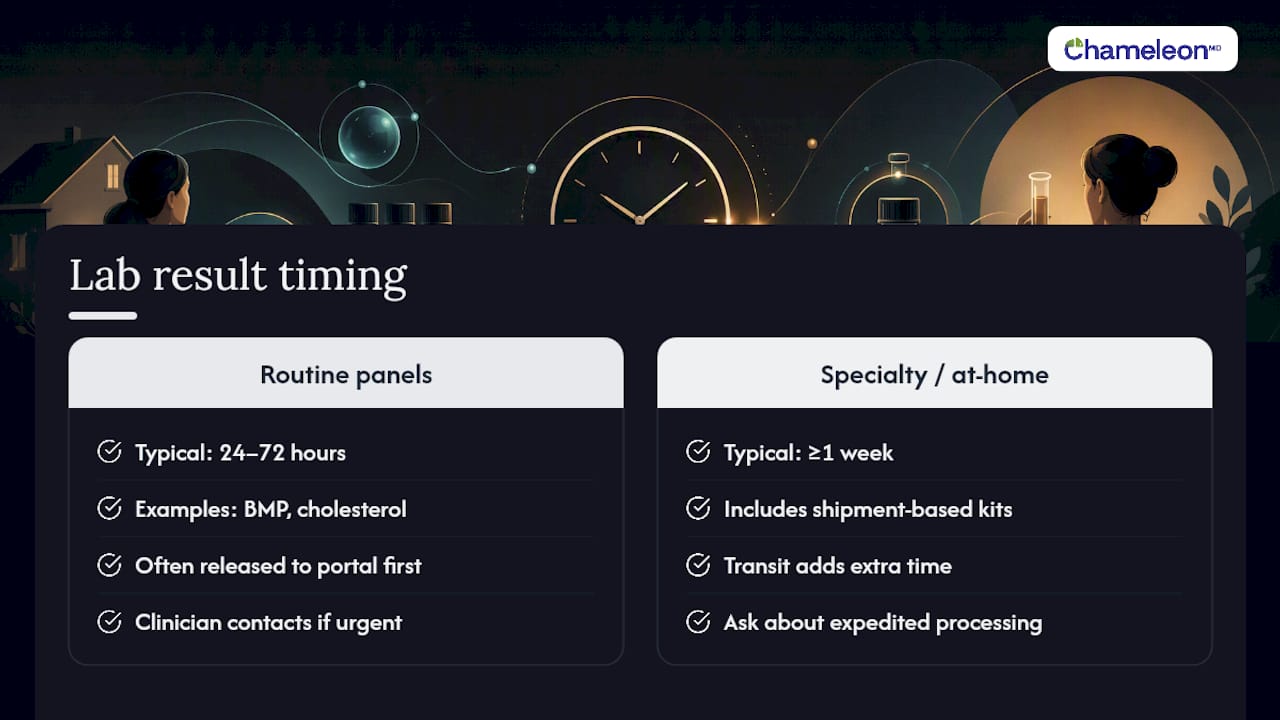
Where you’ll actually see the numbers first might surprise you. Under federal information-blocking rules that took effect in 2021, labs generally have to release results to your patient portal as soon as they’re available, which often means you’ll see them before your clinician has reviewed them. If something looks abnormal or urgent, your clinician will typically reach out promptly to walk through next steps rather than leaving you to interpret a number alone. If your situation is time-sensitive, ask directly whether expedited processing is available.
What to Do Before Your Test to Avoid Delays
A little prep work at home prevents most of the friction patients run into at the draw site.
- Confirm you actually received the requisition, and that your name, date of birth, and insurance details match across your telehealth account and the lab’s system.
- Follow any fasting or medication instructions exactly, and write down your current medications to bring along.
- Pack a photo ID and your insurance card, even if the visit itself was already paid for through the app.
- If you’re using mobile phlebotomy, verify the technician’s credentials and ask about any add-on fees before they show up.
Keeping your telehealth platform account details consistent from booking through billing removes one of the most common, and most avoidable, sources of delay.
How Chameleon Healthcare Handles Lab Orders
The service connects patients with licensed clinicians who evaluate your symptoms first and confirm that testing is medically necessary before anything gets ordered. That’s not a formality. It’s the same clinical judgment you’d expect from an in-person visit, just delivered without a waiting room.
Once a clinician decides a lab test is warranted, the order is routed electronically to a partner lab or delivered as a requisition you can use at a nearby collection site. Results get folded back into your record so your clinician can follow up with clear next steps rather than leaving you to interpret a report alone.
Here’s what patients can expect when working with Chameleonhc:
- Telehealth visits with licensed providers who can evaluate whether lab testing fits your symptoms
- Electronic lab orders routed to partner labs or provided as a requisition for you to use
- Follow-up consultations to review results and adjust care
- A choice between a single visit or a membership, depending on how often you expect to need care
Whether you need a one-time visit or ongoing care, the model is built to remove the guesswork around scheduling and billing that usually accompanies lab work.
What Most Patients Get Wrong About Lab Orders
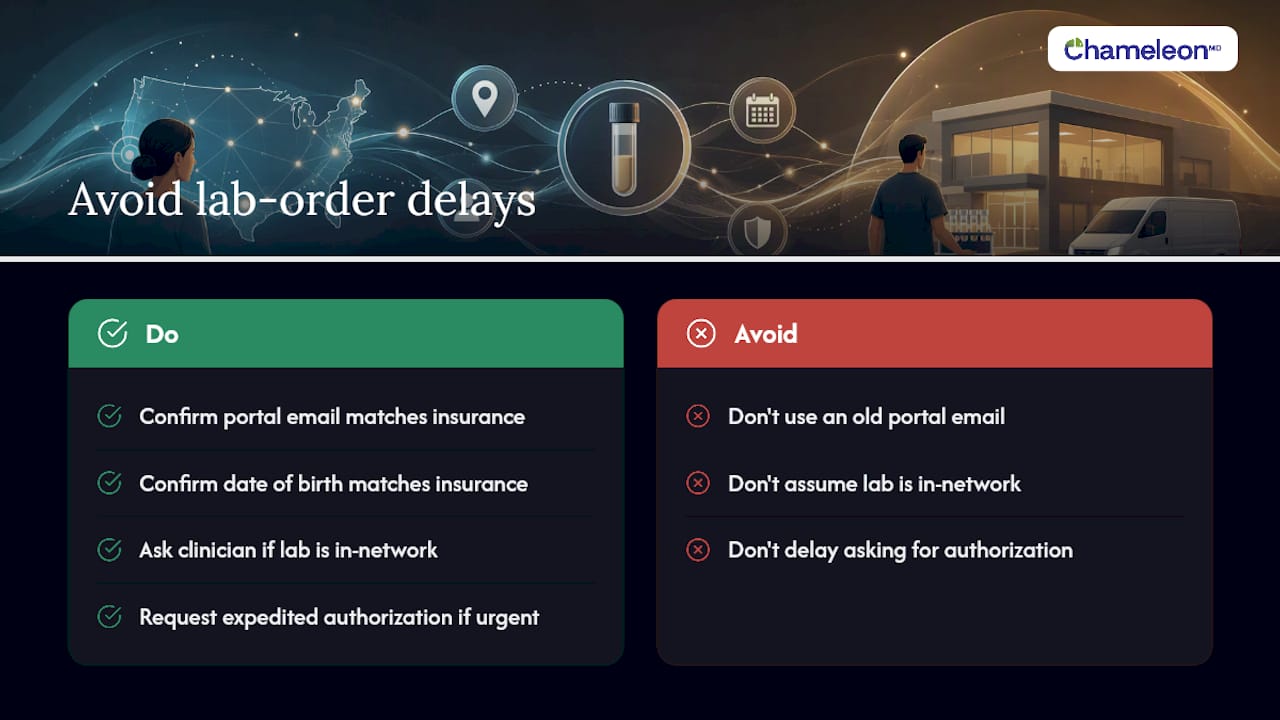
The single biggest source of frustration isn’t the ordering process itself. It’s mismatched details, an old email on file, a maiden name on your insurance card, a typo in your date of birth, that bounce your order back for correction.
Build one habit before every telehealth visit: confirm your portal email and date of birth match your insurance exactly, and ask your clinician outright whether the lab they’re recommending is in-network. If your situation is urgent, ask for expedited authorization on the spot rather than waiting to find out later that it was needed.
— Vector
Ready to Get Your Lab Order Started?
This service gets you in front of a licensed clinician promptly, without the insurance paperwork or waiting room that usually stands between you and a lab order. If a clinician determines testing is appropriate, they’ll issue the order electronically and walk you through collection and follow-up, all as part of one visit.
You can start with a Single Visit for $55 if you just need this one issue evaluated, or join the Single Adult Membership for $25 a month if you expect to need care again down the road. Families can save with the Family Membership at $45 a month, and employers exploring coverage for their teams can check the Employer Plan. Check the plans page to confirm availability in your state, then book your visit when you’re ready.
This article is general information, not a substitute for advice from a qualified doctor. Consult a qualified healthcare professional about your own circumstances before acting on anything here.
Sources
- How To Get A Lab Referral Through A Virtual Doctor
- ASTP / federal review of lab order standards and exchange
- Blood tests (NHLBI patient information)
- CMS proposed rule on interoperability and prior authorization (2026)
FAQ
Can a telehealth provider order labs?
Yes. A licensed telehealth clinician can order lab tests when it’s clinically appropriate, the same way an in-person provider would, and the order is transmitted electronically to a partner lab or home kit provider. State licensure rules determine which clinicians can order for you based on where you’re located during the visit.
What is the biggest telehealth company in the United States?
There isn’t one single dominant telehealth company recognized as the largest across all service types, since the market includes urgent care platforms, mental health services, and chronic care management as separate segments. Chameleonhc focuses specifically on affordable, insurance-free urgent and primary care with same-day access to licensed providers.
Can I get labs done without a doctor’s order?
In most states, standard lab tests require a clinician’s order, though a small number of direct-to-consumer testing services allow patients to order certain panels without one. Telehealth visits solve this by giving you fast, affordable access to a licensed clinician who can evaluate your situation and issue the order the same day.
Can doctors send orders to Labcorp?
Yes, clinicians routinely send electronic lab orders to major national labs, and patients typically schedule their own collection appointment or use an on-demand testing option once the order is placed. Your telehealth clinician’s order should specify the exact panel needed so the lab and your insurer both have clear documentation.