

Telehealth is a solid option for most mild-to-moderate eczema and for ongoing follow-up care, and research backs that up with diagnostic agreement around 84%. The exceptions are cases that look complicated, worsen fast, or involve a lesion that seems out of place for eczema. Those situations still call for an in-person exam, but for everyday flares and check-ins, a virtual visit works.
TL;DR:
- Telehealth diagnosis for eczema has about 84% agreement with in-person exams, with higher accuracy when clinicians consider the full range of eczematous conditions.
- Virtual care significantly reduces wait times from over six months to around six weeks, making early specialist access more feasible.
- Effective teledermatology relies on clear, well-lit photos with multiple angles and proper labeling from patients, as poor images often require in-person follow-up.
- Telehealth is best suited for routine management and follow-up of mild-to-moderate eczema but cannot replace in-person exams for rapidly spreading or complicated cases.
- Evaluation and initiation of biologics like Dupixent are possible virtually, but insurers often require extensive documentation and prior authorization processes before approval.
Table of Contents
- How Does Eczema Telehealth Actually Work?
- Is Teledermatology as Accurate as an In-Person Exam?
- How Do You Prepare for a Telehealth Eczema Visit?
- When Does Telehealth Help, and When Should You See Someone in Person?
- Can You Get Biologics Like Dupixent Through Telehealth?
- How Chameleon Healthcare Approaches Virtual Eczema Care
- The Bottom Line on Eczema Telehealth
- Ready for Your Next Eczema Check-In?
- Sources
- FAQ
How Does Eczema Telehealth Actually Work?
Eczema telehealth generally runs through three models. Synchronous care means a live video or phone call with a provider, similar to an in-person visit but through your screen. Asynchronous care, also called store-and-forward, has you upload photos and a symptom history that a provider reviews later, often within hours. Hybrid models blend both, starting with photo intake and moving to live video if the provider needs more detail.
A typical visit follows this path:
- You submit intake forms, medical history, and photos through a secure patient portal.
- A licensed provider reviews the images and history, sometimes before a live call even starts.
- If needed, you join a video visit so the provider can ask follow-up questions or look more closely at problem areas.
- You leave with a treatment plan, a prescription if appropriate, or a referral to an in-person dermatologist.
Asynchronous review tends to work well for chronic eczema monitoring, where regular photo check-ins replace repeat office visits, according to research on synchronous versus asynchronous teledermatology models. Secure portals encrypt your data, and most platforms give simple photo guidance so the images are actually useful to a clinician.
Is Teledermatology as Accurate as an In-Person Exam?
Diagnostic agreement between telemedicine and in-person dermatology for atopic dermatitis sits at 84.4%, rising above 95% when clinicians group the full range of eczematous conditions. That same research found telemedicine cut the average wait for a specialist visit from 6.7 months to 1.5 months, a reduction of roughly 78%.
By the numbers: Diagnostic agreement for atopic dermatitis reaches 84.4% via telemedicine, and wait times for specialist care can drop from 6.7 months to 1.5 months when teledermatology is part of the care model.
Outcome data tells a similarly reassuring story. Systematic reviews and meta-analyses tracking standard eczema severity tools, including POEM, IGA, and DLQI scores, found comparable results between telemedicine follow-up and face-to-face visits. In plain terms, patients managed virtually reported similar improvement in symptoms and quality of life as those seen in person.
That evidence comes with real caveats:
- Studies vary widely in which telehealth model they tested, making it hard to say one approach beats the others across the board.
- Pediatric cases and complex, treatment-resistant eczema are underrepresented in the research.
- Reviewers consistently call for more randomized controlled trials to pin down which modality performs best for specific situations, a gap noted in research on teledermatology heterogeneity.
The takeaway: telehealth for eczema isn’t experimental. It’s supported by real clinical data, with the strongest evidence backing routine and follow-up care rather than every possible eczema scenario.
How Do You Prepare for a Telehealth Eczema Visit?
A few minutes of prep before your appointment makes a real difference in how quickly your provider can help you.
- Gather your history. Write down when your symptoms started, what seems to trigger flares, and any eczema treatments you’ve already tried.
- List your medications. Include current prescriptions, over-the-counter creams, and doses, even if they seem unrelated to your skin.
- Take clear photos. Use natural daylight, get one close-up and one wider shot of the affected area, and include a coin or ruler for scale.
- Capture multiple angles. Skin can look different depending on the light and position, so two or three photos per affected area help.
- Test your setup. Check your camera and microphone, and find a quiet, private room before your visit starts.
- Confirm coverage. Check your insurance benefits and note your preferred pharmacy so your provider can send prescriptions to the right place.
Pro Tip: Name your photo files by body part and date before uploading. It sounds small, but it helps your provider track changes over time and speeds up the review if you need a follow-up visit.
Good photos genuinely change outcomes here. Clinicians frequently ask for a close-up plus a contextual shot with a simple scale object, and when photos come in blurry or poorly lit, providers often have to redirect patients to an in-person visit instead of resolving things virtually. A little effort on your end avoids that detour. If you want a full walkthrough of booking and tech setup, this guide to scheduling a virtual visit covers the basics.
When Does Telehealth Help, and When Should You See Someone in Person?
Virtual eczema care shines in a few clear ways:
- Faster access. Same-day or next-day appointments are common, compared to weeks or months for an in-person dermatology slot.
- Convenience. You skip the drive, the waiting room, and the time off work or school.
- Reliable follow-up. Photo-based monitoring lets providers track how a treatment plan is working without a repeat office visit.
- Lower cost and less lost time. Fewer missed work hours and no travel expenses add up, especially for chronic conditions that need regular check-ins.
Telehealth has real limits, though. A screen can’t replicate a hands-on skin exam, and texture, warmth, and tactile changes are hard to judge from a photo. Young children and eczema in sensitive areas can also be tricky to assess remotely.
Certain signs mean you should skip the video call and get seen in person: a rash spreading rapidly, fever or other signs of infection spreading through the body, deep or crusting infection, open bleeding or ulceration, or any mole or lesion that looks unusual. Those situations need hands-on evaluation, not a photo review.
Can You Get Biologics Like Dupixent Through Telehealth?
Telehealth providers can evaluate eczema severity, start many standard treatments, and coordinate with a specialist when a case calls for something stronger. Biologics are a good example of where virtual care and specialist referral often work together rather than one replacing the other.
Dupixent (dupilumab) targets the IL-4 and IL-13 pathways and is approved for moderate-to-severe atopic dermatitis that hasn’t responded to topical treatment. Getting there usually means clearing insurance hurdles first:
- Insurers typically require prior authorization and proof that you’ve tried standard topical treatments without success, a process known as step therapy.
- Documented severity scores (POEM or IGA) and a clear treatment history speed up approval.
- Specialty pharmacies handle biologic dispensing, which adds another coordination step beyond a standard prescription.
If a claim gets denied, ask your provider about a peer-to-peer review with the insurer, and make sure your file includes severity scores, photos, and a full record of prior treatments. Administrative delays, not medical uncertainty, are usually what holds up biologic approval, so tight documentation matters more than people expect.
How Chameleon Healthcare Approaches Virtual Eczema Care
The model is built around same-day virtual visits with clear, upfront pricing, which matters for eczema care since flares rarely wait for a convenient appointment slot. Whether you need a single visit or ongoing management, you’re not stuck navigating insurance approvals just to get seen.
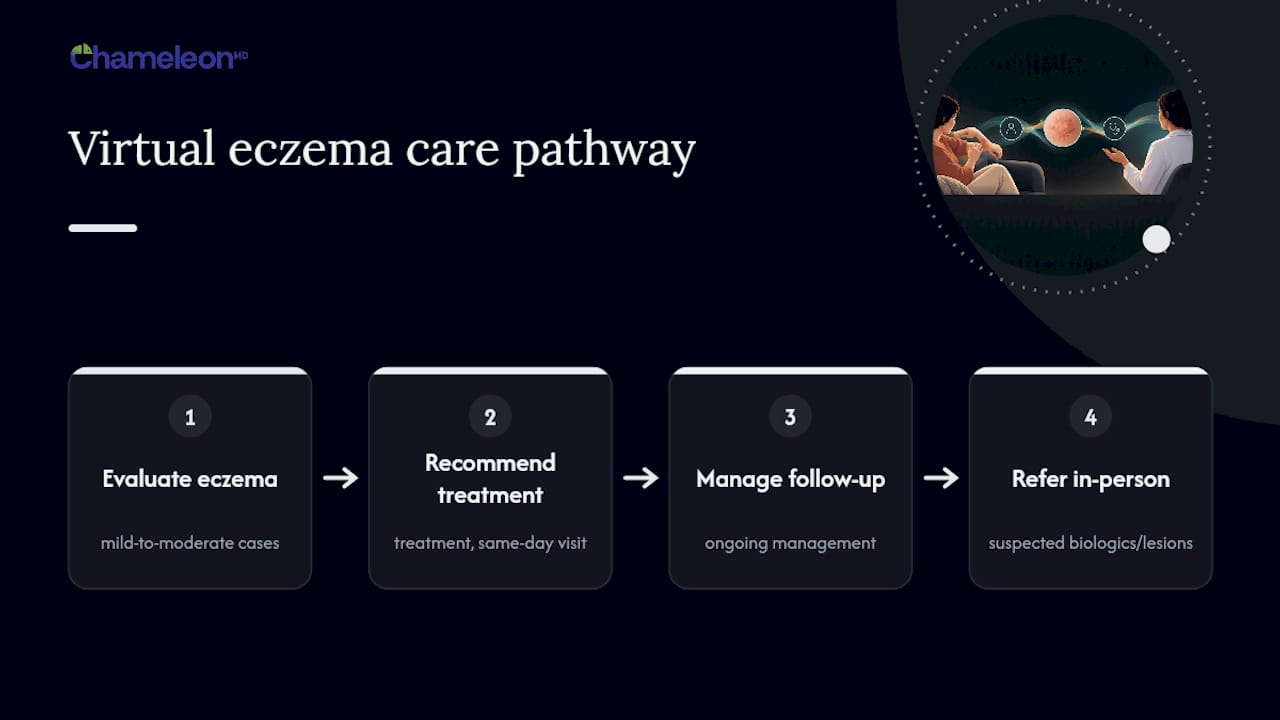
Providers can evaluate mild-to-moderate eczema, recommend treatment, and manage routine follow-up virtually. When a case shows signs of needing a specialist, such as suspected need for biologics or a lesion that warrants closer inspection, referral to in-person dermatology is made rather than trying to manage everything remotely.
The Bottom Line on Eczema Telehealth
For most mild-to-moderate eczema and ongoing follow-up, telehealth is a reasonable, evidence-supported first move. Save in-person care for red-flag symptoms like rapid spread, fever, or suspicious lesions.
Your next steps: take clear photos today, pull together your treatment history, check what your insurance covers, and book a virtual visit. Most providers will want a follow-up check within a few weeks to see how your skin responds.
— Vector
Ready for Your Next Eczema Check-In?
This service offers a way to handle eczema flares and follow-ups without booking weeks out or paying surprise fees, since every visit comes with pricing you see before you commit.
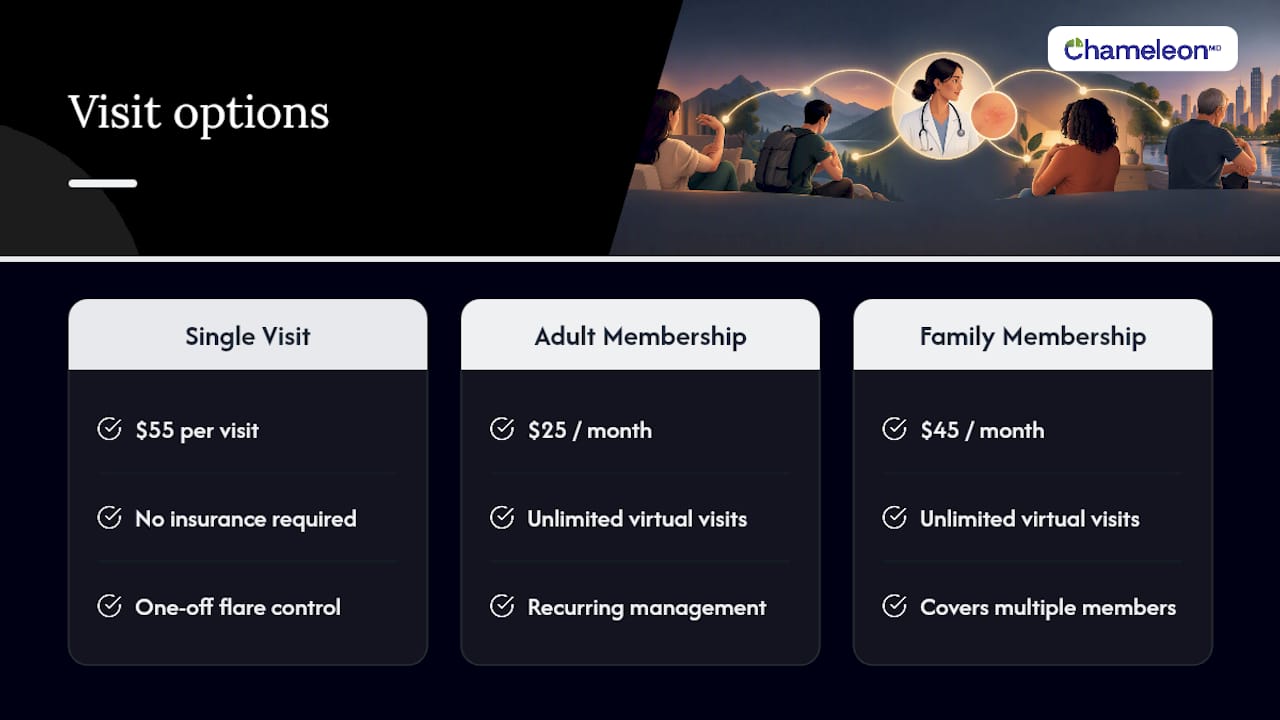
If you just need one visit to get a flare under control, the Single Visit option runs $55 with no insurance required. If eczema is a recurring part of your life, the Single Adult Membership at $25 a month covers unlimited virtual visits, which makes sense if you’re managing flares, medication adjustments, or routine check-ins throughout the year. Families dealing with eczema in more than one household member can look at the Family Membership at $45 a month instead.
If a case needs a dermatologist’s hands-on exam, providers will recommend that next step. Otherwise, most eczema care can start and continue right from your phone. Check plans and book your visit today.
This article is general information, not a substitute for advice from a qualified doctor. Consult a qualified healthcare professional about your own circumstances before acting on anything here.
Sources
- Accuracy and efficiency of telemedicine in atopic dermatitis (JAAD International / related studies)
- Telemedicine in the Care of Patients with Atopic Dermatitis: A Systematic Review and Meta-Analysis
FAQ
Can I get eczema treatment through telehealth?
Yes. Licensed providers can diagnose and treat most mild-to-moderate eczema virtually, and diagnostic agreement with in-person exams reaches 84.4%. Chameleonhc offers same-day visits for eczema evaluation and treatment starting with a $55 single visit.
What is the 3 minute rule for eczema?
The “3 minute rule” refers to applying moisturizer within three minutes of bathing, while skin is still damp, to lock in hydration and reduce flare risk. It’s a skincare habit dermatologists recommend, not a diagnostic or telehealth-specific term.
Why are doctors pushing Dupixent for eczema?
Dupixent (dupilumab) targets the IL-4 and IL-13 pathways involved in eczema inflammation and is approved for moderate-to-severe atopic dermatitis that hasn’t responded to topical treatments. Providers tend to recommend it after standard treatments fail, not as a first-line option.
Who is the top eczema specialist in the USA?
There’s no single ranked “top” eczema specialist in the United States, since expertise varies by case complexity, region, and insurance network. For routine and follow-up eczema care, a telehealth visit with a licensed provider, like those available through Chameleonhc, is often the faster starting point, with referral to a board-certified dermatologist when a case needs deeper specialty care.
Is telehealth as effective as in-person care for eczema follow-up?
Research shows comparable results between telemedicine and in-person follow-up on standard severity measures like POEM, IGA, and DLQI scores, according to a meta-analysis of atopic dermatitis studies. Telehealth works especially well for tracking how an existing treatment plan is performing over time.