

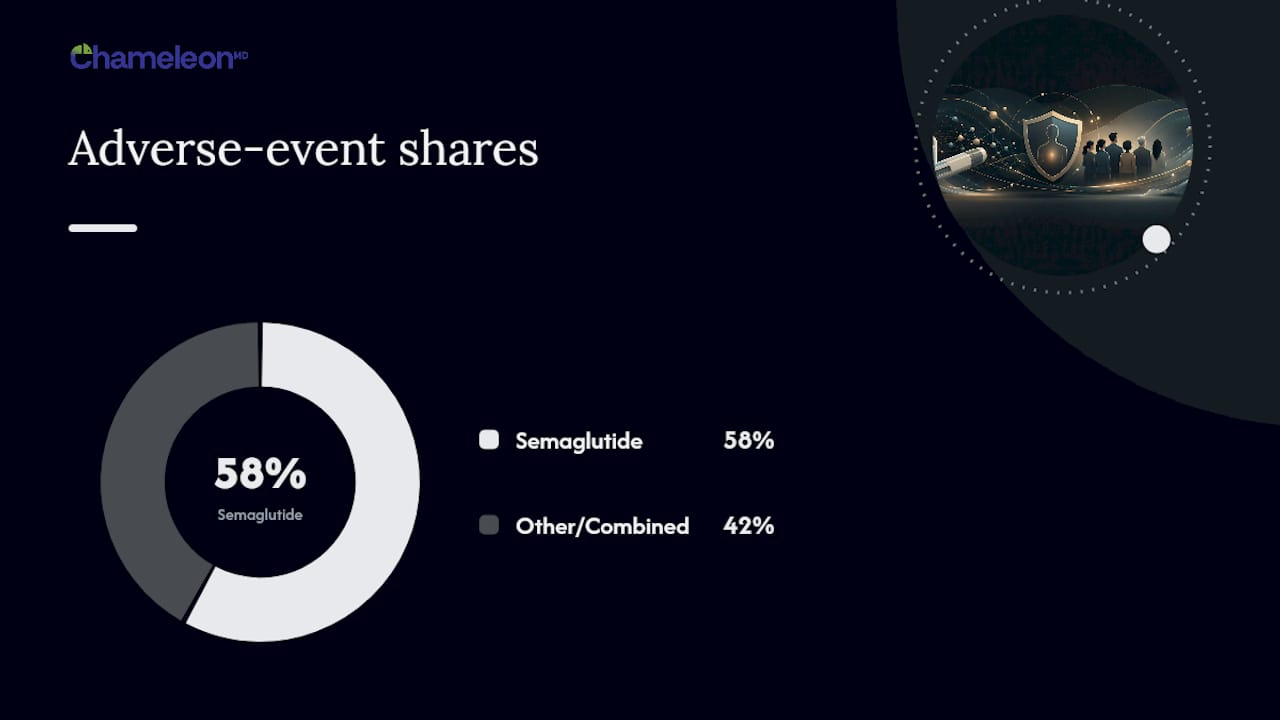
Compounded semaglutide is not FDA-approved, and the safety data backs up the concern: as of May 31, 2026, the FDA had logged more than 1,700 adverse-event reports tied to compounded GLP-1 drugs, with roughly 990 involving semaglutide specifically. If you’re weighing a compounded option, the safest move is choosing an FDA-approved product under a clinician’s care whenever possible. If a compounded version is your only path, verify the pharmacy’s credentials and insist on close medical supervision before you start.
TL;DR:
- Over 1,700 adverse events linked to compounded GLP-1 drugs have been reported to the FDA, with nearly 990 involving semaglutide specifically.
- Compounded semaglutide often leads to dosing errors because it is shipped in multidose vials requiring self-drawing, increasing overdose risks.
- The active ingredients and salt forms in compounded versions can differ from approved products, creating unknown effects and absorption issues.
- Many adverse reactions, including severe nausea, dehydration, and pancreatitis, result from dosing mistakes, with some doses being 10 to 20 times higher than prescribed.
- Regulatory efforts are narrowing access to compounded GLP-1s, emphasizing the importance of choosing FDA-approved products under medical supervision.
Table of Contents
- Compounded Semaglutide Safety: What the FDA’s Numbers Mean
- How Compounded Semaglutide Differs From the Approved Version
- Warning Signs and Dosing Mistakes That Send Patients to the ER
- Where the Regulatory Crackdown Stands Right Now
- Your Safety Checklist Before Starting Compounded Semaglutide
- Switching From a Compounded Product to an Approved One
- The Telehealth Advantage: Why Supervision Changes the Risk Equation
- Get Clinician-Supervised GLP-1 Care Without the Guesswork
- Primary Sources and Recommended Reading
- Sources
- FAQ
Compounded Semaglutide Safety: What the FDA’s Numbers Mean
The FDA’s adverse-event count isn’t a rounding error. Reports span nausea and vomiting severe enough to cause dehydration, gastrointestinal distress requiring emergency care, and in some cases hospitalization for symptoms consistent with overdose. Many of these events trace back to dosing errors, not the drug’s inherent chemistry.
By the numbers: Over 1,700 adverse events tied to compounded semaglutide and tirzepatide combined, with about 990 specifically involving semaglutide, according to FDA safety data.
Here’s why dosing goes wrong so often with compounded versions. FDA-approved semaglutide comes in prefilled pens with fixed, factory-calibrated doses. Compounded semaglutide typically ships in multidose vials, meaning you or a caregiver draw each dose yourself with a syringe. That single difference creates room for error that a prefilled pen simply doesn’t allow.
The FDA has issued repeated alerts about dosing mistakes tied to compounded drugs requiring home administration. Common patterns include:
- Confusing milligrams with milliliters when drawing a dose from a vial
- Using the wrong syringe size, leading to accidental overdose
- Misreading vial concentration labels that vary by compounder (unlike the standardized concentration of an approved pen)
- Drawing partial doses incorrectly when a vial isn’t pre-marked for the prescribed amount
There’s a deeper wrinkle here that most patients never hear about. Compounding pharmacies aren’t required to report adverse events the way drug manufacturers are. That reporting gap means the 1,700-plus figure is likely an undercount of actual harm, not the full picture. If you’ve had a bad reaction to a compounded product and didn’t report it, you’re not alone. That’s part of why regulators are moving cautiously rather than waiting for complete data before acting.
How Compounded Semaglutide Differs From the Approved Version
The active ingredient might share a name, but what’s actually in the vial can differ in ways that matter. FDA-approved semaglutide uses a specific, tested salt form manufactured to exact specifications. Compounded versions sometimes use semaglutide base or alternative salt forms, such as semaglutide sodium or semaglutide acetate, that were never studied in the clinical trials that led to FDA approval.
That distinction sounds technical, but it has real consequences. Different salt forms can absorb differently in your body, meaning the dose your prescription says you’re getting may not translate into the effect you’re expecting. Clinical researchers have flagged this as a genuine unknown, not a hypothetical one, because there’s no published data confirming these alternative forms behave the same way in humans.
Additives compound the uncertainty. Some compounding pharmacies mix in vitamin B12, vitamin B6, or carnitine, marketing these as added benefits for energy or metabolism. A 2026 study covered by Stanford Medicine found that when tirzepatide was compounded with B12, the two substances underwent chemical bonding, a reaction nobody had studied for clinical safety. Nobody knows for certain what that means for how the drug performs in your body, and that is exactly the problem.
Delivery format matters just as much:
- Prefilled pens (FDA-approved): Sealed, pre-measured, and manufactured under strict quality controls with consistent potency from dose to dose.
- Multidose vials (compounded): Require self-drawing with a separate syringe, introduce variability in dose accuracy, and can be more sensitive to temperature swings that degrade potency during shipping or storage.
None of this means every compounded product is dangerous. It means the margin for error is wider, and you’re the one absorbing that risk when something goes off script.
Warning Signs and Dosing Mistakes That Send Patients to the ER
By the numbers: Some FDA-reviewed cases show patients receiving doses 10 to 20 times higher than intended due to vial concentration confusion, according to the agency’s dosing-error alerts.
The most commonly reported harms include severe nausea and vomiting that leads to dehydration, abdominal pain consistent with pancreatitis, and in overdose cases, dangerously low blood sugar or prolonged GI shutdown requiring hospital care. These aren’t rare side effects buried in fine print. They’re the leading reasons compounded semaglutide patients end up in urgent care.
Here’s how the overdose scenario typically unfolds:
- A compounding pharmacy ships a vial at a nonstandard concentration, say 5 milligrams per milliliter instead of the 2 milligrams per milliliter the patient expects.
- The patient, following instructions written for a different concentration, draws what they believe is a normal dose.
- The actual dose delivered ends up several times higher than intended, sometimes 10 to 20 times the prescribed amount.
- Severe GI symptoms, dehydration, or worse follow within hours.
If you experience relentless vomiting, sharp abdominal pain, dizziness, or signs of dehydration after a dose, don’t wait it out. Seek urgent care and bring the product label, the pharmacy’s contact information, and a written record of your recent dosing history. That information helps a provider figure out fast whether you’re dealing with a concentration error, an allergic reaction, or something else entirely. Reviewing common GLP-1 side effects beforehand also helps you recognize what’s normal versus what needs immediate attention.
Where the Regulatory Crackdown Stands Right Now
The FDA declared the national semaglutide injection shortage resolved in February 2025. That single decision changed the legal landscape for compounders overnight, since large-scale compounding under the 503B pathway is generally permitted only when a drug is in shortage. Once supply stabilized, that legal justification for mass compounding started disappearing.
The agency followed up with a bigger move. In April 2026, the FDA proposed permanently excluding semaglutide, tirzepatide, and liraglutide from the 503B bulks list, the roster of substances 503B outsourcing facilities are allowed to compound in bulk. If finalized after the public comment period, this would sharply narrow the main pipeline that’s kept many compounded GLP-1 products on the market.
What this means in practice:
- 503A pharmacies (typically smaller, patient-specific compounders working from an individual prescription) face different rules than 503B outsourcing facilities (larger operations producing in bulk, subject to more FDA oversight).
- A finalized 503B exclusion wouldn’t ban compounding outright, but it would eliminate the bulk-manufacturing route many online sellers currently rely on.
- The FDA has also issued warning letters to companies selling compounded GLP-1s outside appropriate legal channels, a signal that enforcement is intensifying, not easing off.
For telehealth companies and online pharmacies partnering with compounders, this timeline matters. A supply chain built on 503B bulk compounding could look very different by the time the proposal is finalized. You can track how these shifts have unfolded through our GLP-1 shortage updates coverage.
Your Safety Checklist Before Starting Compounded Semaglutide
If you’re evaluating a compounded option, or you’re mid-course and something feels off, work through this list before your next dose.
- Confirm the pharmacy’s registration. Ask whether it’s a 503A or 503B facility, check that it holds a valid U.S. state pharmacy license, and confirm it has a real physical address you can verify independently.
- Require a valid prescription. Any pharmacy willing to ship without one is a red flag, full stop.
- Ask what form of semaglutide you’re getting. Base or salt form? Request a certificate of analysis or potency data if the pharmacy can provide one.
- Inspect the shipment. Confirm the label is intact, legible, and matches what you ordered, and check the expiration date before you draw a single dose.
- Verify the cold chain held. GLP-1 products degrade quickly outside their required temperature range, so ask how the product was shipped and stored in transit.
- Track symptoms daily. Watch for persistent nausea, abdominal pain, dehydration signs like dark urine or dizziness, and anything resembling pancreatitis (severe, radiating abdominal pain).
Pro Tip: Keep a simple notebook or phone note logging every dose, the date, and how you felt afterward. If something goes wrong, that record is often the fastest way for a provider to pinpoint whether it’s a dosing error, a reaction to an additive, or something unrelated.
Before ordering anything, run the pharmacy through the FDA’s BeSafeRx program, which helps you distinguish licensed operations from sites cutting corners. Our guide to GLP-1 online prescriptions walks through what a legitimate telehealth process should look like from the first consultation onward.
Switching From a Compounded Product to an Approved One
Moving from a compounded semaglutide vial to an FDA-approved pen sounds simple. Clinically, it’s rarely that clean, because your provider often has no reliable way to know exactly how much active drug you’ve actually been receiving.
Concentration variability between compounders, plus the dosing errors already discussed, means your true cumulative exposure may not match what your prescription label claims. That’s why clinicians who manage this transition carefully tend to lean conservative:
- Start at a lower equivalent dose than your compounded prescription suggested, rather than assuming a direct one-to-one conversion.
- Titrate more slowly than a standard escalation schedule, watching closely for both under-dosing symptoms and side effects.
- Schedule follow-up check-ins within the first one to two weeks after the switch, then again at each titration step.
- Order lab work if you’ve had unexplained GI symptoms, unexpected weight changes, or signs of pancreatitis while on the compounded product.
Before your appointment, gather your pharmacy label, the stated vial concentration, and a written log of your dosing history. That paperwork turns a guessing game into an informed medical decision.
The Telehealth Advantage: Why Supervision Changes the Risk Equation
Most of the harm described in this article traces back to one root cause: patients managing complex, error-prone dosing decisions without a clinician watching closely. Chameleonhc’s telehealth model puts a licensed provider in the loop from the first visit through ongoing monitoring, which closes the exact gap that leads to overdose and reporting blind spots.
That doesn’t mean every telehealth program offers real oversight. Some operate closer to an automated prescription pipeline than genuine clinical care. When you’re evaluating any program, ask directly whether a licensed provider reviews your history, adjusts your titration schedule, and remains reachable if something feels wrong. If the answer is vague, that’s worth noticing.
— Vector
Get Clinician-Supervised GLP-1 Care Without the Guesswork
The telehealth alternative to ordering semaglutide from an unverified online seller offers licensed provider review, dose adjustments, and ongoing availability, all at a transparent monthly price. The GLP-1 Weight Loss program pricing is detailed on the program page, with no insurance required and no hidden fees.

Every prescription comes with real clinician follow-up rather than a one-time script and silence. If you’re already a member, your dosing history and eligibility get reviewed as part of onboarding to the GLP-1 weight loss program. If you’re new to Chameleonhc, you can start with a membership plan that gives you same-day access to a provider whenever a concern comes up, not just at your next scheduled visit. Before switching from a compounded product, bringing your current medication label and dosing log to your initial evaluation can help a provider develop a safe transition plan. Schedule your evaluation today and get a dosing plan built around your body, not a generic vial label.
Primary Sources and Recommended Reading
- FDA’s Concerns with Unapproved GLP-1 Drugs Used for Weight Loss
- FDA Dosing Errors Alert for Compounded Drugs
- Stanford Medicine: Why Doctors Worry About Compounded GLP-1s
- UIC Drug Information Group: Compounded GLP-1 Safety FAQs
This article is general information, not a substitute for advice from a qualified doctor. Consult a qualified healthcare professional about your own circumstances before acting on anything here.
Sources
- FDA’s Concerns with Unapproved GLP-1 Drugs Used for Weight Loss
- FDA alerts: dosing errors associated with compounded drugs
- Compounded GLP-1s: Why doctors worry and the FDA is cracking down (Stanford Medicine)
FAQ
Is compounded semaglutide safer than Ozempic?
No. FDA-approved products like Ozempic go through standardized manufacturing and testing that compounded versions skip, and the FDA’s adverse-event data shows compounded versions carry higher documented risk, particularly around dosing errors.
Is compounded semaglutide going to be banned?
Not outright, but the FDA’s April 2026 proposal to exclude semaglutide from the 503B bulks list would eliminate the main bulk-compounding pathway if finalized, significantly shrinking legal availability.
What damage can semaglutide cause, whether compounded or approved?
Both forms can cause nausea, vomiting, and in rare cases pancreatitis, but compounded versions carry added risk from dosing errors, untested salt forms, and unverified additives that approved pens don’t.
Is semaglutide a high-risk drug?
FDA-approved semaglutide has a well-documented safety profile when properly dosed and monitored, but compounded semaglutide raises that risk substantially due to inconsistent concentrations and self-administered dosing from multidose vials.
How much does clinician-supervised GLP-1 care cost through Chameleonhc?
Chameleonhc’s GLP-1 Weight Loss program costs $55 per month per adult for new members and $30 per month per adult for existing ChameleonMD members, with pricing and enrollment details on the weight-loss program page.