
Yes, rapid at-home strep test kits exist and can detect Group A strep antigen in minutes, but their accuracy depends heavily on the test type and your swab technique. A positive result usually calls for a clinician’s follow-up to confirm treatment, and a negative result may still need a throat culture if your symptoms strongly suggest strep.
TL;DR:
- Some FDA cleared home kits report sensitivity above 95% under controlled conditions, but real world accuracy can fall with poor swabbing or mistimed readings.
- Swab both tonsils and the back of your throat, avoid your tongue and cheeks, and follow the kit’s result window, typically 5 to 10 minutes.
- A negative result does not rule out strep; with strong or worsening symptoms, especially in a child, ask a clinician whether to get a throat culture.
- A positive result warrants clinician follow up to confirm the diagnosis and decide whether antibiotics fit your symptoms and medical history.
- Seek immediate in person care for trouble breathing or swallowing, uncontrolled drooling, dehydration, severe throat pain, or a high fever that resists basic care.
Table of Contents
- What’s inside an at-home strep test kit
- How a rapid strep test actually works
- How accurate are home strep tests compared to lab culture?
- Using your kit correctly and avoiding common mistakes
- Where to buy a kit and what to check on the label
- When you should see a clinician regardless of your home result
- Where telehealth fits between a home test and the clinic
- Get a same-day strep evaluation without the waiting room
- FAQ
- Sources
What’s inside an at-home strep test kit
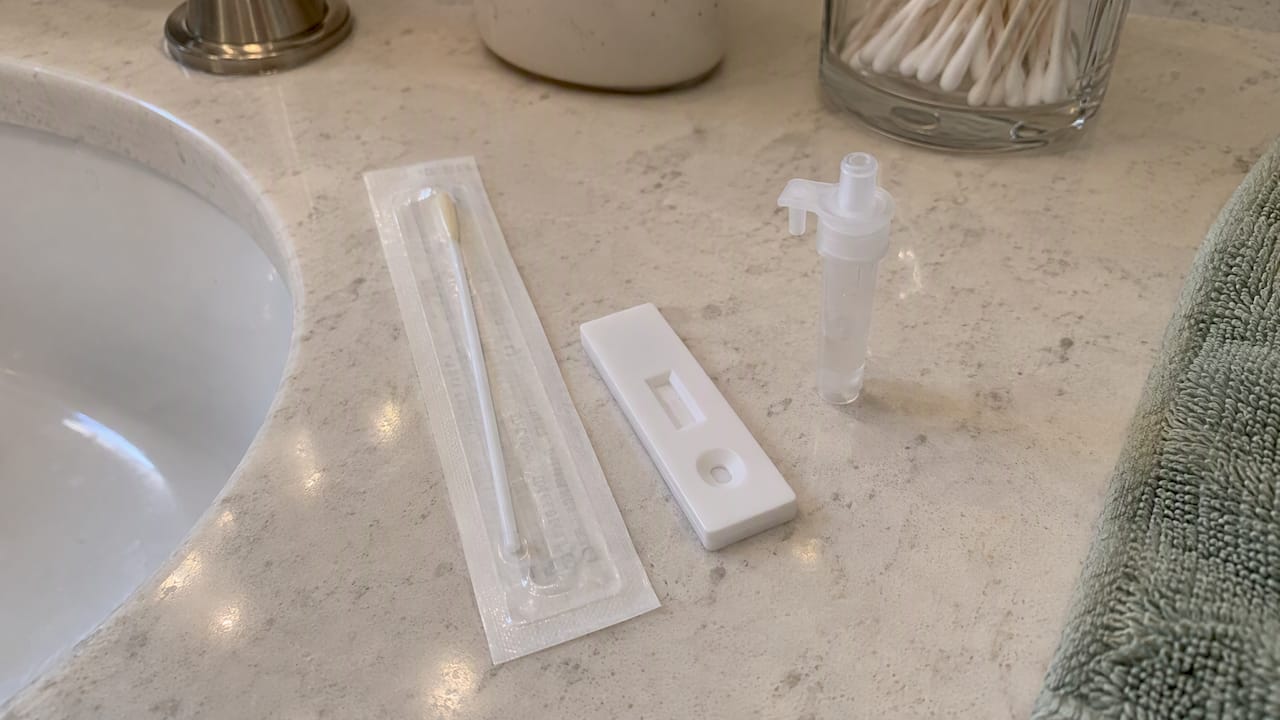
Most over-the-counter strep kits follow a similar format, and knowing what’s in the box helps you use it with confidence. A typical kit includes:
- A sterile throat swab for collecting a sample from your tonsils and the back of your throat.
- An extraction tube or reagent solution that releases the antigen from the swab.
- A test strip or cassette that displays your result as one or two lines.
- Printed instructions with timing and interpretation guidance.
These kits are rapid antigen detection tests (RADTs) that screen specifically for Group A Streptococcus antigen. They’re built for people who already have sore throat symptoms, not as a general screening tool, and they won’t tell you whether your sore throat has a different cause, like a virus or another bacterial infection.
How a rapid strep test actually works
The test strip inside your kit is coated with antibodies designed to bind to Group A strep antigen. When you add your swab sample to the extraction solution and apply it to the strip, any antigen present binds to those antibodies and triggers a visible colored line. A separate control line confirms the test ran correctly, so a result without a control line isn’t valid no matter what the test line shows.

Most kits ask you to read results within a set window, typically around 5 to 10 minutes. This is fundamentally different from a lab culture, which grows live bacteria over a day or two. An antigen test detects a protein marker left behind by the bacteria, while a culture confirms the bacteria are actually alive and present, which is part of why culture remains the more definitive method.
How accurate are home strep tests compared to lab culture?
Some FDA-cleared rapid antigen tests report clinical sensitivity above 95% when evaluated under controlled conditions, but real-world performance at home often runs lower. The Healgen Strep A Rapid Test reported clinical sensitivity of 97.1% and specificity of 99.4% in its FDA submission, and the Flowflex Plus Strep A test reported sensitivity around 97 to 98% and specificity around 95 to 96% in clinical site evaluations. Both submissions note that negative results should still be confirmed by culture when clinical suspicion remains.
Throat culture stays the diagnostic gold standard because it allows bacteria to grow in a lab setting, making it more sensitive than rapid antigen tests. That’s why clinicians often follow up a negative RADT with a culture, especially when symptoms point strongly toward strep.
Several factors can swing a home test’s real-world accuracy away from its lab numbers:
- How many bacteria is on your swab: lighter bacterial loads are harder for antigen tests to detect.
- How well you swabbed your tonsils and the back of your throat rather than your cheeks or tongue.
- Whether you read the result within the manufacturer’s specified time window.
- How symptomatic you are at the time of testing, since testing too early or too late in an infection can affect antigen levels.
Pediatricians and other clinicians have cautioned that home strep tests can give false negatives that create a false sense of reassurance, which is exactly why a negative result paired with strong symptoms deserves a second look.
Using your kit correctly and avoiding common mistakes
A clean, careful swab makes the biggest difference in whether your result reflects what’s actually happening in your throat. Follow these steps:
- Wash your hands before opening the kit to avoid contaminating the swab.
- Open your mouth wide and use a light source if needed to see your tonsils and the back of your throat clearly.
- Rub the swab firmly against both tonsils and the posterior pharynx, avoiding your tongue and cheeks.
- Insert the swab into the extraction tube exactly as described in your instructions, usually with a set number of rotations.
- Apply the solution to the test strip or cassette and start your timer.
Pro Tip: Set a timer the moment you start reading, since checking too early can miss a faint positive and checking too late can create a false positive line.
Reading outside the manufacturer’s window is one of the most common sources of inaccurate results, along with gentle or incomplete swabbing.
Where to buy a kit and what to check on the label
You’ll find strep test kits in pharmacy aisles, at major retailers, and through online marketplaces, but not every product on the shelf is meant for home use. Before you buy or rely on a kit, check a few things:
- Confirm the label says it’s intended for home or over-the-counter use, since some antigen tests are labeled for professional use only.
- Look for an expiration date and lot number, and avoid kits that are expired or close to it.
- Make sure instructions are clear and complete, with a specific read-time window listed.
- Check that the packaging identifies the test as an FDA-cleared product for detecting Group A strep antigen specifically.
Matching the kit’s intended use to your situation helps you avoid relying on a result the test was never designed to give you.
When you should see a clinician regardless of your home result
A positive home test result is a good reason to contact a clinician for a treatment decision, since many will confirm the result and prescribe antibiotics when it fits the clinical picture. A negative result deserves more caution if your symptoms strongly suggest strep, particularly for children, people with a history of complications, or anyone whose symptoms are getting worse rather than better. In those cases, in-clinic testing and culture give a more complete picture than a home antigen test alone.
Some symptoms call for immediate in-person care no matter what your home test shows: difficulty breathing or swallowing, drooling you can’t control, severe throat pain, signs of dehydration, or a high fever that isn’t responding to basic care. These point toward complications that a home kit was never designed to catch.
Where telehealth fits between a home test and the clinic
A home test can tell you something, but it can’t weigh your symptoms, your history, or your risk factors the way a clinician can. Virtual visits let a licensed provider evaluate your symptoms directly, interpret a home test result in that broader context, and decide whether antibiotics are appropriate or whether an in-person culture makes more sense. That combination often shortens the gap between “I think I might have strep” and actually starting treatment.
Telehealth isn’t the right fit for every situation. Severe symptoms like difficulty breathing, significant swelling, or signs of dehydration still need in-person evaluation, since those require a physical exam and sometimes immediate intervention that a screen can’t provide.
— Vector
Get a same-day strep evaluation without the waiting room
When a home test leaves you with more questions than answers, a quick virtual visit can clear things up without a trip to urgent care. We connect you with a licensed provider the same day, at a clear price with no insurance required, so you’re not stuck wondering whether that faint line on your test strip means anything.
Before your visit, it helps to have a few details ready:
- A timeline of your symptoms, including when your sore throat started and how it’s changed.
- A photo of your home test result if you have one, along with the kit’s name.
- Any fever readings or other symptoms like swollen glands or white spots on your tonsils.
A Single Visit costs $55 with no membership required, or you can choose the Single Adult Membership at $25 per month or the Family Membership at $45 per month for unlimited virtual visits across common conditions, including sore throat and strep throat evaluation and treatment. If your provider determines an in-person culture is the better next step, they’ll tell you plainly so you can get that scheduled without delay.
This article is general information, not a substitute for advice from a qualified doctor. Consult a qualified healthcare professional about your own circumstances before acting on anything here.
FAQ
Can I take a strep test at a pharmacy like CVS?
Many pharmacies carry over-the-counter rapid strep antigen kits you can take home and use yourself, though availability varies by location and some pharmacies also offer in-store testing services. Check your specific pharmacy’s offerings, and confirm the kit is labeled for home use before you buy it.
Can you buy a strep test to use at home?
Yes, over-the-counter rapid antigen strep tests are widely available at pharmacies, major retailers, and online marketplaces. These kits use a throat swab and test strip to detect Group A strep antigen, typically giving a result within 5 to 10 minutes.
Can I get a strep test at a retailer like Walgreens?
Many retail pharmacies stock at-home rapid strep test kits in their health aisles, and some also offer clinical testing services on-site. Call ahead or check the retailer’s website to confirm what’s available near you.
Is there a reliable way to tell if you have strep at home?
A rapid antigen home test can give you a quick read, with some FDA-cleared kits reporting sensitivity above 95% and specificity above 99% under controlled conditions. Real-world accuracy depends on your swab technique and timing, and a throat culture remains the more definitive confirmation when results are uncertain or symptoms are severe.
Should I still see a doctor if my home strep test is negative?
Yes, especially if your symptoms are severe, getting worse, or strongly suggest strep despite the negative result. CDC guidance supports selective testing based on clinical features, and a clinician can determine whether a follow-up culture is warranted.
Sources
- Why Home Strep Tests Aren’t Reliable
- CDC: Clinical guidance for strep throat
- Streptococcal screen: MedlinePlus Medical Encyclopedia
- 510(k) Substantial Equivalence Determination Decision Summary — Healgen Strep A Rapid Test (K212623)