

Yes, telehealth can diagnose and treat most suspected flu cases and speed up access to antivirals when your symptoms call for them. Timing matters most: antivirals work best when started early, and the CDC notes that lab confirmation isn’t required before a clinician prescribes. That combination, quick access plus no testing bottleneck, is exactly what makes a virtual visit worth trying first.
TL;DR:
- Most uncomplicated flu cases can be diagnosed and treated effectively through telehealth, with antivirals most beneficial when started within 48 hours of symptoms.
- Prescriptions for antivirals are often issued based on symptoms and local flu activity, without requiring lab confirmation or testing, streamlining urgent treatment.
- State-specific rules and platform policies may affect e-prescribing, so users should verify pharmacy compatibility and platform restrictions before booking.
- High-risk patients, including pregnant women and immunocompromised individuals, may need to seek in-person care sooner, especially if symptoms worsen.
- Preparing symptom history, vaccination info, medication lists, and home test results prior to the appointment can help ensure a faster, more accurate diagnosis.
Table of Contents
- How a Flu Telehealth Visit Actually Works
- What to Expect: Testing, Antivirals, and Prescriptions
- Federal Rules, State Variation, and What Providers Actually Allow
- Telehealth or In-Person Care: How to Decide
- Getting Ready for Your Telehealth Flu Appointment
- After Your Visit: Monitoring, Side Effects, and the Flu Shot
- Chameleon Healthcare: Same-Day Flu Care When You Need It
- Why Speed Matters More Than People Realize
- Get Same-Day Flu Care Without the Wait
- Sources
How a Flu Telehealth Visit Actually Works
You’re not just describing symptoms into a void. A flu telehealth visit follows a structured process, even though it happens over video or phone instead of in an exam room.
Your provider starts by gathering the details that shape every decision that follows: when your symptoms started, whether you’ve been around anyone sick, your vaccination status this season, and any conditions that put you at higher risk, like asthma or diabetes. This intake matters more in virtual flu care than it does for something like a rash, because your provider can’t listen to your lungs or press on your stomach. They’re relying on your words and their questions to fill in that gap.
From there, clinicians lean on symptom patterns and what’s circulating locally to reach a clinical diagnosis, without waiting on a lab result. Flu tends to move fast and hit hard: sudden fever, aching muscles, that flattened-out fatigue that’s different from a regular cold. When your symptoms line up with what’s already spreading in your area, that’s often enough for a confident call.
A telehealth flu visit for suspected flu typically ends in one of three ways:
- Home care guidance, if your case looks mild and low risk
- An antiviral prescription sent electronically to your pharmacy, if treatment is indicated
- A referral to in-person testing or urgent care, if something about your presentation needs closer evaluation
Most people fall into the first two categories, which is part of why virtual flu care has become such a practical first move.
What to Expect: Testing, Antivirals, and Prescriptions
Here’s something that surprises a lot of people: your provider likely won’t require a flu test before prescribing treatment. CDC guidance is explicit that antiviral treatment can be empiric, meaning it’s based on your symptoms and what’s going around, not a confirmed lab result.
Pro Tip: If you already took an over-the-counter home flu test, don’t throw it away. A dated photo showing your name and the result gives your provider useful information, even though it’s not required for prescribing.
That said, testing still has a place, and it’s worth knowing your options:
- Home antigen tests: fast and convenient, but with moderate sensitivity, meaning a negative result doesn’t fully rule out flu
- Rapid molecular tests: quicker turnaround than PCR, often available at urgent care or pharmacy clinics
- PCR testing: the most sensitive option, generally reserved for cases where results will change treatment or infection control decisions
For most uncomplicated cases, your provider skips testing altogether and moves straight to a treatment decision. If antivirals like oseltamivir are appropriate, the workflow is simple: your provider documents your history, weighs your risk factors, and sends an e-prescription directly to your pharmacy. No paper script, no separate errand.
Timing drives the whole equation. Antivirals deliver the greatest benefit when started within about 48 hours of symptom onset, though clinicians still treat high-risk patients or worsening cases beyond that window. That two-day mark is the reason same-day access matters so much with flu. Waiting three days for an in-person opening can mean missing the window where treatment does the most good.
Federal Rules, State Variation, and What Providers Actually Allow
The regulatory picture here is more favorable than most people assume, but it has layers worth understanding before your visit.
At the federal level, the DEA has extended its telemedicine flexibilities through December 31, 2026. Those flexibilities mostly concern controlled substances. Standard flu antivirals, including oseltamivir, aren’t controlled medications, so they were never subject to the stricter federal in-person exam rule in the first place.
Where things get more complicated is at the state level:
- State medical boards set their own telehealth prescribing rules, and they vary by state
- When state rules are stricter than federal allowances, clinicians must follow the state rule
- Individual telehealth platforms sometimes add their own internal restrictions, even when law would permit prescribing
That third point trips people up. A platform can legally be allowed to prescribe something and still choose not to, simply to limit its own regulatory exposure, according to Telehealth.
Pro Tip: Before you book a visit, check whether the platform confirms e-prescribing for antivirals and ask which pharmacies they can send to. A five-minute check now saves you a frustrating call later.
Telehealth or In-Person Care: How to Decide
Most flu cases are the kind telehealth was built for: uncomfortable, disruptive, but not dangerous. Knowing where the line sits gives you one less thing to worry about while you’re already feeling awful.
- Choose telehealth first if you have typical flu symptoms, mild-to-moderate severity, and you’re within that early window where antivirals do the most good.
- Seek in-person or emergency care if you notice shortness of breath, chest pain, severe dehydration, confusion, or a rapid decline instead of gradual improvement.
- Ask about faster in-person evaluation if you’re pregnant, caring for an infant, over 65, or immunocompromised. Your telehealth provider may still see you first, but they might recommend moving to in-person care sooner given the higher risk.
If you’re a parent trying to sort out whether your child’s symptoms warrant a virtual visit or something more urgent, this guide on virtual care for sick kids walks through the specific red flags to watch for. And if there’s a newborn in the house, pediatric guidance on flu and RSV season is worth a read, since infants can decline faster than older kids or adults.
Getting Ready for Your Telehealth Flu Appointment
A little prep goes a long way toward a faster, more accurate visit. Your provider is working with less information than they’d have in person, so the details you bring fill in real gaps.
Before you log on, have these ready:
- The date your symptoms started
- Your flu vaccination status this season
- A current list of medications and allergies
- Any chronic conditions (asthma, diabetes, heart disease, pregnancy)
- A photo of any home flu test result, dated and labeled with your name
- Thermometer readings, and pulse oximeter readings if you have one
Pro Tip: Track your temperature every few hours before your visit if you can. A simple pattern, like fever climbing instead of settling, tells your provider a lot more than a single number.
On the technical side, find a quiet, well-lit spot, make sure your device is charged, and know which pharmacy you’d like a prescription sent to. Have your insurance or payment information on hand too, since that determines what you’ll owe for the visit itself.
After Your Visit: Monitoring, Side Effects, and the Flu Shot
Getting a prescription doesn’t mean you’re done paying attention. Watch for symptoms that plateau instead of improve, or that shift into something new, like trouble breathing or persistent chest tightness. Either of those is a reason to reach back out or escalate to in-person care.
If you’re prescribed an antiviral, expect mild side effects for some people, most commonly nausea or an upset stomach with oseltamivir. Taking it with food usually helps. Contact your provider if side effects feel severe or if you’re not improving within a few days of starting treatment.
Once you’re feeling better, it’s worth talking about prevention for next time:
- Annual flu vaccination is recommended for most people six months and older
- Your provider may bring up vaccination at a follow-up visit, especially if you weren’t vaccinated this season
- If you’re caring for someone high-risk at home, ask about vaccination timing for the whole household
For a broader look at flu symptoms, risk factors, and treatment approaches, Chameleonhc’s influenza overview covers the full picture in more depth.
Chameleon Healthcare: Same-Day Flu Care When You Need It
This telehealth model is built for situations where you feel terrible, have little time, and need a real answer without hassle. It offers same-day access to licensed providers, clear pricing upfront, and no insurance requirement.
A typical flu visit follows the same intake-evaluation-prescription path outlined above. You describe your symptoms and history, your provider evaluates severity and risk, and if an antiviral is appropriate, it gets e-prescribed straight to your pharmacy. No waiting room, no guessing what the visit will cost.
- Access to licensed providers with same-day visits
- Transparent, upfront pricing without insurance dependency
- E-prescribing for noncontrolled medications, including standard flu antivirals, when clinically appropriate
If flu symptoms hit and you want same-day access without the runaround, same-day telehealth visits explain how quickly you can typically get seen.
Why Speed Matters More Than People Realize
The conventional wisdom around flu care tends to focus on symptom relief: rest, fluids, ride it out. That advice isn’t wrong, but it undersells the one factor that actually changes outcomes for a lot of patients, which is how fast you get in front of a clinician.
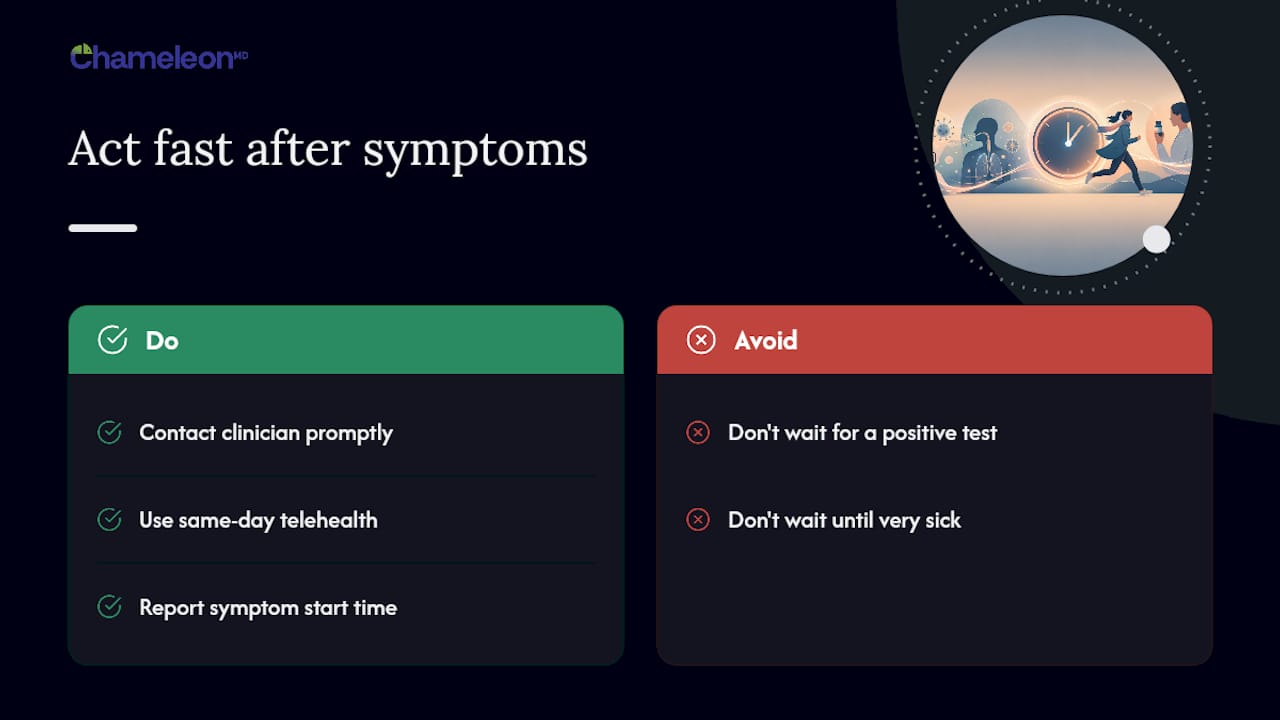
The research here is consistent. Antivirals work best in that early window, and the biggest obstacle to hitting it usually isn’t the medicine itself. It’s access. A same-day telehealth visit removes the two- or three-day wait that so often pushes people past the point where treatment does the most good.
What gets overlooked is that testing anxiety keeps people from seeking care at all. Patients wait, assuming they need a positive test before a doctor will take them seriously. CDC guidance says otherwise: clinical judgment, not lab confirmation, drives the treatment decision in most cases. If there’s one thing worth prioritizing here, it’s this: don’t wait to feel “sick enough” or to get a positive test result before reaching out. The clock that matters most started when your symptoms did.
— Vector
Get Same-Day Flu Care Without the Wait
This telehealth service offers an alternative to waiting for same-day appointments or urgent care visits. Patients can access licensed providers with transparent pricing set before the visit and possibly receive an e-prescribed antiviral when clinically appropriate, without needing insurance.

This model fits flu care especially well, since the whole point is speed: the sooner you’re seen, the sooner treatment can help. It also works for the other things that show up alongside flu season or afterward, from reflux to vomiting that lingers longer than expected. If flu symptoms are hitting you now, take a look at Chameleonhc’s plans and book a same-day visit before the window for antiviral treatment starts to close.
This article is general information, not a substitute for advice from a qualified doctor. Consult a qualified healthcare professional about your own circumstances before acting on anything here.
Sources
- Federal Register — Extension of telemedicine flexibilities (2025-12-31)
- CDC — Guide for considering influenza testing when influenza viruses are circulating in the community
- Telehealth