

Yes, telehealth can often get you a prescription antiviral for a cold sore, sometimes the same day, when a licensed clinician determines it’s safe and appropriate. Oral antivirals like valacyclovir work best when started at the very first tingle, so a quick virtual visit can beat waiting for an urgent care slot. If your symptoms are unusual, severe, or affect your eye, telehealth will typically direct you to in-person care instead.
TL;DR:
- Telehealth prescriptions for cold sore antivirals are typically approved only if the clinician confirms the symptoms are uncomplicated and the patient is not experiencing eye involvement or severe illness.
- The most effective antiviral treatment, valacyclovir, should be started at the first sign of a tingle or itch for optimal results, with some availability for same-day electronic prescribing.
- State licensure restrictions may prevent online prescriptions if the clinician is not licensed in the patient’s location, making prior verification essential.
- Patients should prepare a clear photo of the sore, record symptom onset dates, and list current medications to expedite the telehealth visit.
- Antivirals are safe for most, but high-risk groups such as pregnant women, those with kidney issues, or immunocompromised individuals should seek in-person care for thorough evaluation.
Table of Contents
- How Does Cold Sore Telehealth Work, Step by Step?
- Which Medications Treat Cold Sores, and Why Does Timing Matter?
- When Should You Skip Telehealth and See Someone in Person?
- What Do Clinicians Check Before Prescribing Online?
- Does State Licensure Affect Your Online Prescription?
- Are Cold Sore Antivirals Safe? Side Effects to Watch For
- Our Take: Speed Matters, But Not More Than Safety
- Get Treatment Fast with Chameleon Healthcare
- Sources
- FAQ
How Does Cold Sore Telehealth Work, Step by Step?
Most cold sore telehealth visits fall into three formats, and they don’t all move at the same speed.
- Asynchronous intake — you fill out a questionnaire and upload a photo; a clinician reviews it later, often within a few hours.
- Message-based visits — you exchange messages with a provider who may ask follow-up questions before deciding on treatment.
- Live video visits — required in some states or for complicated cases, and generally the fastest route to a firm decision.
Once a clinician approves treatment, the prescription usually gets sent electronically to your pharmacy the same day. From there:
- Pickup at a local pharmacy is often possible within hours.
- Mail-order delivery adds a day or two, so factor that in if you’re already symptomatic.
- Some services bill per single visit, while others operate on membership plans with unlimited visits, and either model may have age restrictions, typically requiring patients to be 18 or older, or to have a guardian involved for minors.
Which Medications Treat Cold Sores, and Why Does Timing Matter?
Telehealth clinicians commonly prescribe one of three oral antivirals for cold sores:
- Valacyclovir — often dosed at a high-dose twice daily for one day in adults, according to Mayo Clinic and FDA prescribing information, though your exact dose depends on kidney function and other health factors.
- Acyclovir — an older option, usually taken more frequently over several days.
- Famciclovir — another short-course alternative with similar effectiveness.
Timing is everything with these drugs. Antivirals work by slowing viral replication, and they do that best in the first day or so after you notice the telltale tingle or itch, before blisters fully form. Start late, and you’ll still get some benefit, but less of one.
If your outbreak is very mild, over-the-counter docosanol (sold as Abreva) can help as a topical add-on, though it’s generally less effective than oral antivirals for shortening an outbreak. None of these medicines cure the herpes simplex virus. They shorten the outbreak and ease discomfort, and that’s a meaningful difference even though the virus stays with you.
When Should You Skip Telehealth and See Someone in Person?
Telehealth is built for straightforward, uncomplicated cold sores around the lips and mouth. It is not the right tool for every outbreak, and knowing the difference protects your health.
Seek in-person or urgent care right away if you notice:
- Pain, redness, or a gritty feeling in or near your eye, which can signal ocular herpes and needs same-day ophthalmic evaluation.
- Widespread or unusually severe sores, or a first-time outbreak that looks atypical.
- Lesions that haven’t started healing after two weeks.
- Trouble drinking fluids, significant pain, or fever that won’t quit.
- A weakened immune system, a history of organ transplant, or frequent recurring outbreaks that suggest something beyond routine management.
Pregnant patients with an outbreak that looks different from past episodes should also get evaluated in person rather than relying on a photo review, since dermatology guidance flags atypical presentations as a reason for closer evaluation.
What Do Clinicians Check Before Prescribing Online?
A telehealth clinician isn’t just glancing at a photo and typing a prescription. Safe prescribing depends on a short but important list of screening questions.
Expect to be asked about:
- Kidney or liver disease, since dosing changes based on how well your body clears the medication.
- Immune status, including any history of transplant or immunosuppressive treatment.
- Pregnancy or breastfeeding.
- Every medication and supplement you currently take, to check for interactions.
- Any known drug allergies.
These answers can change more than paperwork. A patient with reduced kidney function may need a lower dose or a different antiviral entirely, and MedlinePlus notes that certain safety flags can prompt a clinician to request lab work or an in-person referral before writing anything.
Pro Tip: Before your visit, snap a clear, well-lit close-up photo of the sore, jot down when symptoms started, and have your medication list and preferred pharmacy ready. Those four things alone can shave real time off your visit.
Does State Licensure Affect Your Online Prescription?
Where you’re physically located when you log on matters more than most patients expect. Federal guidance is clear that telehealth providers generally must be licensed in the state where the patient is located, not just where the clinician lives or the company is based.
That single rule explains a lot of telehealth friction. A platform might have great reviews and fast turnaround, but if it lacks licensed clinicians in your state, it legally cannot prescribe to you there. Some states also require a live video visit rather than a questionnaire-only review before any prescription goes out.
Before you pay for a visit, run through this quick check:
- Confirm the telehealth service explicitly treats patients in your state.
- Verify the assigned clinician holds active prescribing authority there.
- Check whether your local pharmacy can fill the prescription same day or whether you’ll need mail delivery.
Skipping this step is the single most common reason a telehealth visit ends in disappointment instead of a same-day prescription. For more on how this plays out across different states, see how telehealth works across state lines.
Are Cold Sore Antivirals Safe? Side Effects to Watch For
Antivirals for cold sores have a solid safety record, but “safe” doesn’t mean “risk-free for everyone.”
Mild, common side effects include headache and nausea, and most people tolerate a short course without any issue. Warning signs that need urgent attention are different and shouldn’t wait for a follow-up message:
- Decreased urination or swelling, which can point to kidney strain.
- Confusion, unusual drowsiness, or seizures.
- A severe or spreading rash.
MedlinePlus specifically flags these reactions as reasons to seek urgent care rather than wait it out. Older adults, people with existing kidney impairment, and anyone taking other medications that stress the kidneys face higher risk and may need lab monitoring before or during treatment. This is exactly why intake screening exists. It’s not paperwork for paperwork’s sake.
Our Take: Speed Matters, But Not More Than Safety
The conventional cold sore advice treats telehealth like a vending machine: type your symptoms, get your pills, done. That framing undersells what’s actually happening. A good telehealth visit is fast because it’s careful, not despite it. The clinicians asking about your kidneys and your medication list aren’t slowing you down for no reason. They’re the reason a same-day prescription is safe to write in the first place.
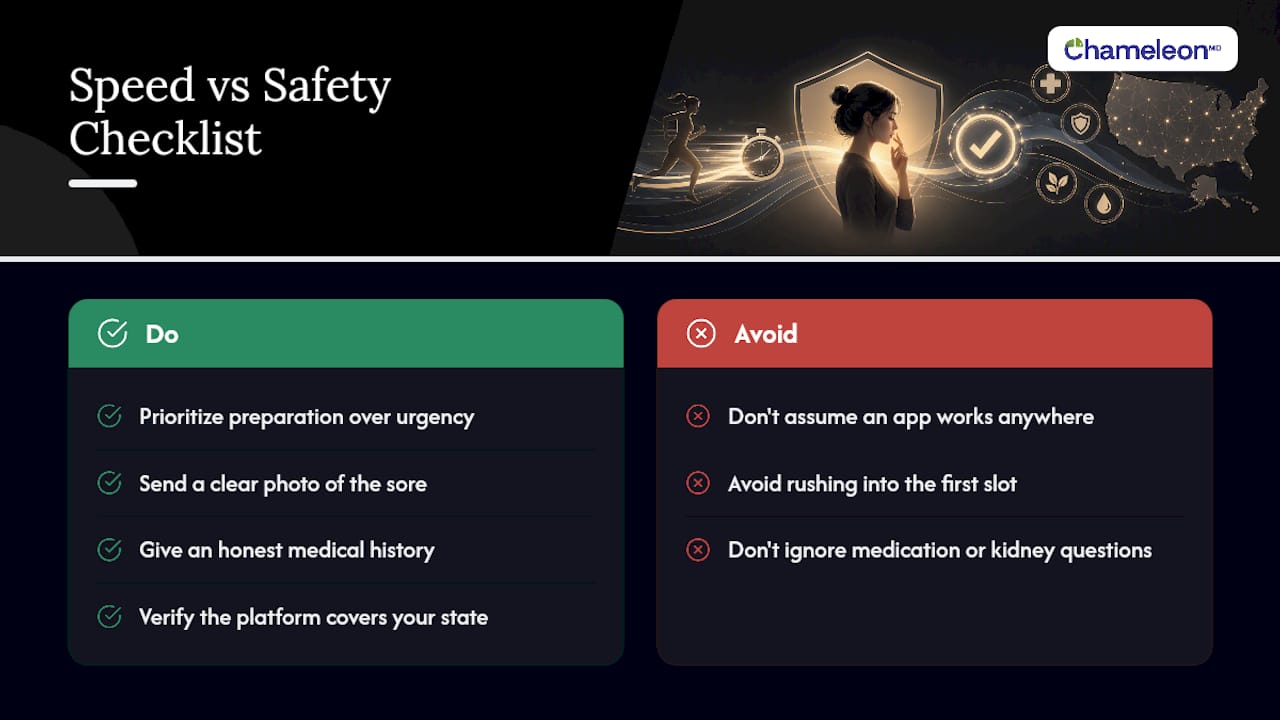
Where conventional wisdom really falls short is on licensure. Patients assume any telehealth app will work anywhere, then get stuck when a state rule blocks the visit entirely. That’s not a flaw in telehealth. It’s a feature of how U.S. medical licensing works, and it rewards patients who check coverage before they book, not after.
If you take one thing from this, prioritize preparation over urgency. A clear photo, an honest medical history, and the right platform for your state will get you treated faster than rushing into the first available slot.
— Vector
Get Treatment Fast with Chameleon Healthcare
If you’ve read this far, you already know the fastest path to relief: catch it early, prepare your information, and choose a telehealth option built for same-day answers. There are telehealth services designed around exactly that, offering online urgent care visits with licensed providers and transparent pricing, no insurance required and no waiting room in sight.

Here’s how to move quickly. First, notice the earliest signs, the tingle or itch, and don’t wait for a full blister to form. Second, take a clear photo, note when symptoms started, and list your current medications along with your preferred pharmacy. Third, pick the option that fits you: a single visit for $55 if you just need this one issue handled, or a membership starting at $25 a month if you expect to need care again down the road. Book your visit, and if a video call is requested, expect one, since it can be the deciding factor in getting an e-prescription instead of a referral. Head to the Chameleon Healthcare plans page to book and get started today.
Sources
Claims in this article draw on the following authoritative sources:
- Valacyclovir (oral route) - DailyMed / FDA label
- Telehealth
- American Academy of Dermatology: Cold sores treatment
- Valacyclovir: MedlinePlus Drug Information
This article is general information, not a substitute for advice from a qualified doctor. Consult a qualified healthcare professional about your own circumstances before acting on anything here.
FAQ
How Do the Amish Treat Cold Sores?
There’s no single documented “Amish method” for treating cold sores backed by clinical research. Many Amish communities do rely on home remedies and topical folk treatments, but the medically supported approach, regardless of community, remains early antiviral treatment and OTC options like docosanol for mild cases.
Is There a Cure for Cold Sores Expected in 2026?
No approved cure exists for cold sores as of 2026. Gene-editing and vaccine research targeting the herpes simplex virus is ongoing and shows promise in preclinical studies, but nothing has reached routine clinical use yet.
Can I Get Valacyclovir Prescribed Online Through Telehealth?
Yes, many telehealth services can prescribe valacyclovir for cold sores when a clinician licensed in your state reviews your symptoms and confirms it’s safe based on your health history. Dosing must be individualized, particularly for people with kidney issues, so screening always comes before the prescription.
Can Teladoc Prescribe Valtrex?
Prescribing decisions depend on the individual telehealth platform, the clinician’s state licensure, and your specific health screening, not the brand name of the service. Chameleon Healthcare offers same-day online visits where a licensed provider can evaluate your cold sore and prescribe an appropriate antiviral like Valtrex when it’s clinically appropriate for your state and health profile.
What Does a Cold Sore Telehealth Visit Cost?
A single telehealth visit through Chameleon Healthcare costs $55 with no insurance required. If you expect to need ongoing virtual care, a membership starting at $25 a month for individuals or $45 a month for families may cost less over time.