
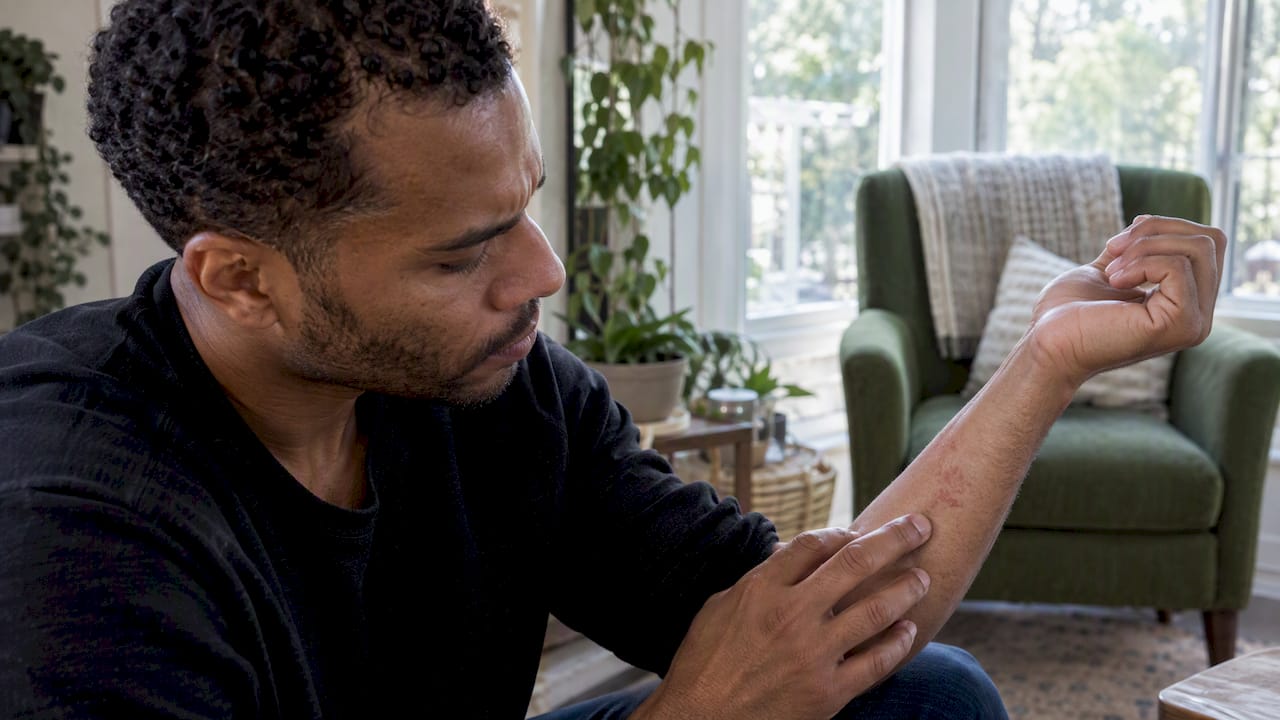
Most rashes are not dangerous, but a few are, and the difference usually comes down to what else is going on in your body. A rash that comes with trouble breathing, swelling of the lips or eyes, or sudden purple spots needs emergency care now. A rash that blisters, spreads fast, hurts, or comes with a fever should be looked at by a provider soon. A mild, itchy patch that is slowly improving can often be watched at home for a couple of days.
Below, we walk through each level of concern in plain language, so you can decide what to do without guessing.
TL;DR
- Call 911 or go to the ER for a rash with trouble breathing or swallowing, swelling of the eyes or lips, or sudden purple, bruise-like spots.
- Get care within a day for a rash that spreads quickly, blisters, hurts, shows signs of infection, or comes with a fever.
- Mild rashes that itch but are not spreading can be soothed at home, but a new rash that is not improving after a few days deserves a professional look.
- A video visit can sort out many everyday rashes quickly, and it can also tell you when you need to be seen in person.
- Trust your gut: a rash that worries you is reason enough to ask.
Table of Contents
- Why a rash can be hard to judge
- Emergency signs: go to the ER or call 911
- Urgent signs: get seen within a day
- Lower-concern rashes you can usually watch at home
- How long should you wait before getting a rash checked?
- What about rashes in children?
- Do you need a doctor, urgent care, or a video visit?
- Getting your rash looked at without the waiting room
- Our perspective
- What to prepare before you see a provider
- Frequently asked questions
- Sources
Why a rash can be hard to judge
A rash is simply a change in how your skin looks or feels. It can be red, bumpy, scaly, blistered, itchy, or sore. Dozens of different conditions cause them, from a new laundry detergent to a viral infection to a medication reaction.
That is why the picture alone rarely tells the story. Dermatologists at the American Academy of Dermatology Association note that most rashes are not life-threatening, but some can signal a serious condition. So the useful question is less “what does it look like?” and more “what is happening along with it?”
Ask yourself:
- Do I feel sick, or do I feel fine apart from the skin?
- Is it changing quickly, or has it stayed about the same?
- Does it hurt, burn, or blister, or does it mostly itch?
- Where is it? Face, eyes, mouth, and genital skin matter more than a patch on your forearm.
The University of Pennsylvania’s Perelman School of Medicine teaches clinicians a similar first step: decide whether the patient seems “sick” or “not sick”, because that sets how urgent care needs to be. You can use the same idea at home.
Emergency signs: go to the ER or call 911
Some combinations are never worth waiting on. The American Academy of Dermatology Association says emergency care may be necessary right away for a rash with trouble breathing or swallowing, or swelling of the eyes or lips. These can be signs of a severe allergic reaction.
Go to the nearest emergency department or call 911 if a rash comes with:
- Trouble breathing, wheezing, or a tight throat
- Trouble swallowing
- Swelling of your lips, tongue, face, or around the eyes
- Sudden purple or dark red spots that look like bruises but did not come from an injury (HealthyChildren.org lists sudden bruise-like spots as a reason for emergency care)
- Confusion, extreme drowsiness, a stiff neck, or a severe headache along with the rash
- Widespread blistering or painful peeling skin, especially after starting a new medication
A quick home check some people use: press a clear glass firmly against the spots. If they stay dark and do not fade under the pressure, treat that as an emergency, especially with a fever.
If you are worried about cost, know that emergency departments are required by federal law to treat and stabilize anyone who arrives, as the American College of Emergency Physicians explains. When the signs above are present, do not let a bill keep you home.
Urgent signs: get seen within a day
This middle group is where most worry lives. These rashes are not usually 911 situations, but they should not sit for a week either. The American Academy of Dermatology Association lists several warning signs: a rash that blisters or turns into open sores, spreads rapidly, is painful, involves the eyes, lips, mouth, or genital skin, or comes with fever.
Contact a provider the same day or the next day if you notice:
- Rapid spread. The rash is clearly bigger than it was this morning.
- Fever. A rash plus a fever can mean an infection. The American College of Emergency Physicians notes that rashes with a moderate fever (below 102°F) are often caused by common viral infections like roseola, but a provider should still confirm that, particularly in a child or if you feel very unwell.
- Blisters or open, raw skin. Broken skin is an easy way in for bacteria.
- Pain. An itchy rash is common. A rash that hurts, burns, or is very tender is a different signal.
- Mouth, eye, or genital involvement. These areas are delicate and can worsen quickly.
- Feeling generally ill. The Irish Health Service Executive points out that a rash that appears quickly while you feel unwell may indicate an infection.
Signs the skin may be infected
Skin infections can start small. The American Academy of Dermatology Association says pus, yellow or golden crusts, warmth, swelling, pain, or an unpleasant smell may point to infection. MedlinePlus adds that red streaks, swelling, or very tender areas are reasons to contact a provider.

Red streaks spreading away from a sore or rash are worth acting on the same day. Infections that are treated early are usually simpler to clear.
A rash after a bite, hike, or new medicine
Providers often ask about your recent history, not just your skin. MedlinePlus notes they may ask about recent travel, medication changes, and time spent in wooded areas. If your rash showed up after starting a new prescription, after a tick bite, or after a trip, say so. A rash shaped like a growing circle or bullseye after time outdoors is worth having checked promptly.
Lower-concern rashes you can usually watch at home
The University of Rochester Medical Center reminds patients that not every rash needs medical attention, and some symptoms can be soothed at home. A rash is more likely to be in this group if all of these are true:
- You feel well otherwise, with no fever.
- It itches or looks irritated but does not hurt.
- It is limited to one area and not spreading fast.
- You can link it to something likely, such as a new soap, plant, bug bite, or sweaty workout gear.
- The skin is intact, with no oozing, crusting, or open sores.
Common examples include mild contact irritation, a few bug bites, and a mild eczema flare. HealthyChildren.org says mild eczema and bug bites can be monitored at home, and that moisturizing and avoiding irritants usually help mild eczema.
Simple ways to calm it
- Cool the area with an ice pack wrapped in a cloth, or take an oatmeal bath. The University of Rochester Medical Center relays the dermatologists’ advice that ice packs and oatmeal baths are safe ways to cool an itchy rash.
- Moisturize with a plain, fragrance-free product.
- Skip the thing you suspect: the new detergent, lotion, or plant.
- Try not to scratch. Broken skin raises the chance of infection.
- Take a photo today so you can tell tomorrow whether it is spreading.
If you take medications or are pregnant, or if the rash is on a baby, ask a provider before using any cream or pill.
How long should you wait before getting a rash checked?
There is no single rule that fits every rash, which is why the signs above matter more than the calendar. Still, many people want a number. One widely read consumer guide suggests speaking with a healthcare professional if a new rash does not improve after about two days, and that a rash lasting more than a week should be looked at.
Here is a practical way to apply that:
| Situation | What to do |
|---|---|
| Trouble breathing, swelling of face or lips, sudden purple spots | Call 911 or go to the ER now |
| Fever, blisters, fast spread, pain, signs of infection | Get seen the same day or next day |
| Mild, itchy, no fever, but not improving after a couple of days | Book a visit |
| Still there after a week, or keeps coming back | Get it evaluated, even if it is mild |
| Mild, improving, clearly tied to a known trigger | Keep soothing it and watch |
If the rash gets worse at any point, move up a row. Do not wait for the full two days when something changes for the worse.
What about rashes in children?
Children get many rashes, and most come with common viral illnesses. Still, kids can change quickly, and they cannot always tell you what hurts. Call your pediatrician promptly if your child has a rash with a fever, seems unusually sleepy or fussy, is not drinking, or has blisters or open sores. Sudden bruise-like spots call for emergency care, as noted above.
Recurring skin problems matter too. HealthyChildren.org advises that eczema that does not improve with regular moisturizing and over-the-counter creams should be discussed with your pediatrician.
Do you need a doctor, urgent care, or a video visit?
Choosing where to go is half the stress. A simple way to think about it:
- Emergency room: breathing trouble, facial swelling, bruise-like spots, confusion, widespread peeling or blistering.
- In-person care: a rash you cannot assess by looking, a very painful or rapidly worsening rash, or when a provider needs to touch, test, or sample the skin.
- Video visit: a stable rash without emergency signs, where a provider can see it, ask about your history, and recommend treatment or tell you to be seen in person.
A video visit works well for rashes because so much of the evaluation is visual and based on your story. Good lighting and a few clear photos help. If you would like to know what a visit covers, our page on rash and skin conditions explains it, and our guide to what winter rashes mean and when to get help covers the seasonal ones. If your rash may be allergy-related, see our overview of allergies. Not sure which symptoms suit an online visit? Our guide to symptoms to consult online can help you decide.
Getting your rash looked at without the waiting room
If your rash is in the “see someone soon” group and you do not have insurance, or do not want to sit in a waiting room for hours, a telehealth visit is a straightforward option.
With Chameleon Healthcare, a single visit is $55, with no insurance needed. If you expect to use care more than once, a Single Adult Membership is $25 per month and a Family Membership is $45 per month, both with unlimited virtual visits. You can see the details and choose what fits on our plans page.
If the provider sees signs that need hands-on or emergency care, they will tell you so, and that is part of the value: a clear answer about what to do next.
Our perspective
We talk with people every day who have waited too long with a rash because they were unsure it was “bad enough” to bother anyone, or worried about what a visit would cost. We also hear from people who rushed to an emergency room for a mild irritation because they had no way to ask a quick question.
We think both situations come from the same gap: it is hard to get a fast, affordable, honest opinion. Our view is that you should not need to decide between ignoring a worrying rash and paying for a high-cost visit. A short video check-in can help you sort out the middle ground, and clear pricing means you know the cost before you start.
We also believe in being straightforward about limits. A screen cannot replace the emergency room when you have trouble breathing or sudden bruise-like spots. In those moments, skip us and call 911.
— Vector
What to prepare before you see a provider
A little preparation makes any visit more useful, whether in person or online.
- Take clear photos. Use natural light, include a close-up and a wider shot, and take a new one each day so changes are obvious.
- Write down the timeline. When did you first notice it? Has it spread, changed color, or started to hurt?
- List recent changes. New medications, supplements, soaps, detergents, foods, plants, travel, or tick and bug exposure.
- Note other symptoms. Fever, sore throat, fatigue, joint pain, or itching that disturbs sleep.
- Know your health background. Allergies, chronic skin conditions, and current medicines.
- Skip heavy creams before a visit if you can. Thick products can hide how the skin actually looks. Do not stop a prescribed medicine on your own, though.
Frequently asked questions
How can I tell if a rash is serious?
Look at the whole picture, not just the skin. A rash is more concerning if it blisters, opens into raw skin, spreads quickly, hurts, involves your eyes, lips, mouth, or genital area, or comes with fever or feeling ill. Trouble breathing or swallowing, or swelling of the face or lips, makes it an emergency.
What does a concerning rash look like?
Warning looks include blisters, open sores, yellow or golden crusts, pus, and areas that are red, warm, swollen, or tender. Dark purple spots that look like bruises and do not fade when pressed are also a red flag. Color alone does not tell you much, so pay attention to how fast it changes and how you feel.
Can a rash be a sign of something like cancer or an autoimmune disease?
Sometimes, though this is far less common than irritation, allergies, or infection. A rash that lasts for weeks, keeps returning, does not respond to basic care, or appears alongside symptoms such as joint pain, unexplained fatigue, or a sore that will not heal should be evaluated by a provider. Diagnosing these conditions often takes an exam, and sometimes testing, which is why a persistent rash deserves a professional look.
How long should I wait before getting a rash checked?
If you have emergency signs, do not wait at all. For a mild new rash that is not getting worse, many guides suggest seeking advice if there is no improvement after about two days, and certainly if it lasts over a week. If it spreads, hurts, or comes with a fever, get seen sooner.
Can I get a rash diagnosed online?
Often, yes. Many rashes can be evaluated through a video visit with photos and a good history, and a provider can recommend treatment or direct you to in-person care. Emergency symptoms are the exception and should always go to the ER.
Sources
- Rash 101 in adults: When to seek medical treatment, American Academy of Dermatology Association
- Rashes: Know When to Go to the ER, American College of Emergency Physicians
- Rashes, MedlinePlus Medical Encyclopedia
- Urgent Care, ER or Pediatrician? A Parent Guide, HealthyChildren.org
- Itching to Know: When to Seek Medical Attention for a Rash, University of Rochester Medical Center
- Rash: types, causes, diagnosis and treatments, HSE
- Rashes, Peds in Practice, Perelman School of Medicine
- When to Worry About a Rash in Adults, Healthline